Swiss Hound
A medium Swiss scenthound with four coat varieties, a carrying hunting voice, and a nose-led pace that needs secure everyday management.
How these guides are researched and reviewed
- Origin
- Switzerland
- Adult standard size
- Males 49–59 cm; females 47–57 cm
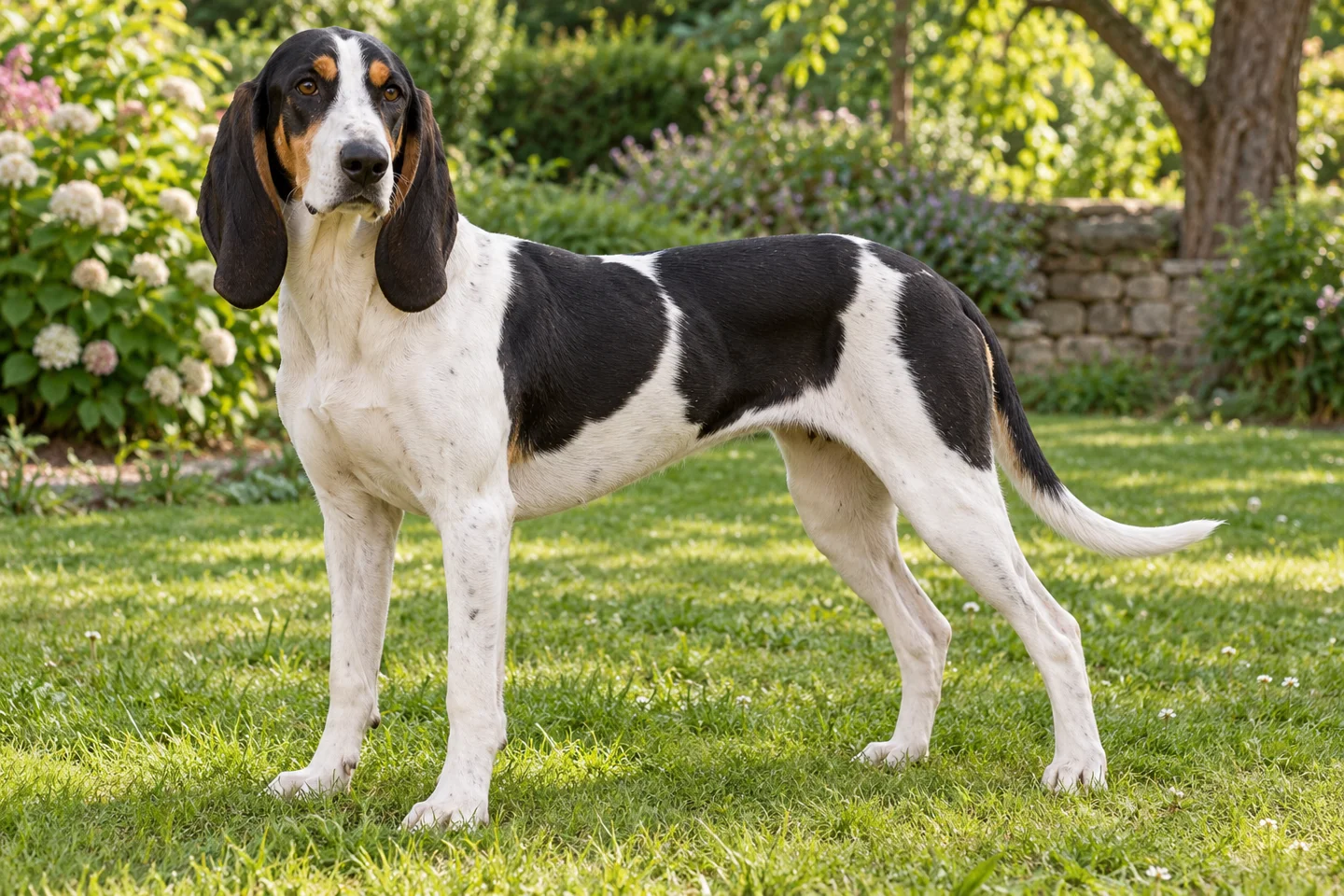
- Illustrated coat
- Bernese variety: white, black, and tan
General information for owners. These articles have not been reviewed by a veterinarian. Medical decisions need your dog's history and an examination.
Four varieties under one Swiss Hound standard
The Swiss Hound is a medium-sized scenthound from Switzerland. The FCI standard covers four varieties: Bernese, Jura, Lucerne, and Schwyz. Their color patterns help distinguish them, while the shared standard describes the general build and work. The Bernese Hound is the variety illustrated here. It should not be confused with the much heavier, long-coated Bernese Mountain Dog simply because the English names share a place reference.
The Bernese variety has a white background with black patches or a saddle and tan markings in specified areas of the face and body. Jura coloring is largely black and tan, Lucerne includes a blue-looking mixture produced by black and white hair, and Schwyz is white with orange. These descriptions explain varieties within this standard. They should not become an excuse to assign any similarly colored rescue hound a documented pedigree from appearance alone.
The FCI describes independent hunting accompanied by voice. A modern pet household should take both parts seriously. A dog can become absorbed by a trail while its bay carries well beyond the garden. Before choosing one, consider whether the people involved enjoy a walk shaped partly by sniffing and can manage noise, boundaries, and recall expectations. Enthusiasm for the elegant ears is not enough to answer those questions.
Appearance and adult measurements
Adult males measure 49 to 59 centimeters at the withers under the FCI standard; females measure 47 to 57 centimeters. The body is moderately longer than tall, with a deep chest, lean head, and long muzzle. It should suggest endurance rather than excessive mass. The standard's height ranges do not create a fixed compulsory body weight. Ask the veterinarian to assess the individual frame and condition rather than trying to fill out a puppy to match a large adult photograph.
The coat is short, smooth, and dense, with finer hair on the head and ears. The long, low-set ears fold and hang beside the face. Eyes are brown and the nose is black in the illustrated Bernese variety. The complete tail tapers and is carried according to activity, without a tight curl over the back. These features create a lean scenthound outline, not a heavy mastiff or a short-legged basset silhouette.
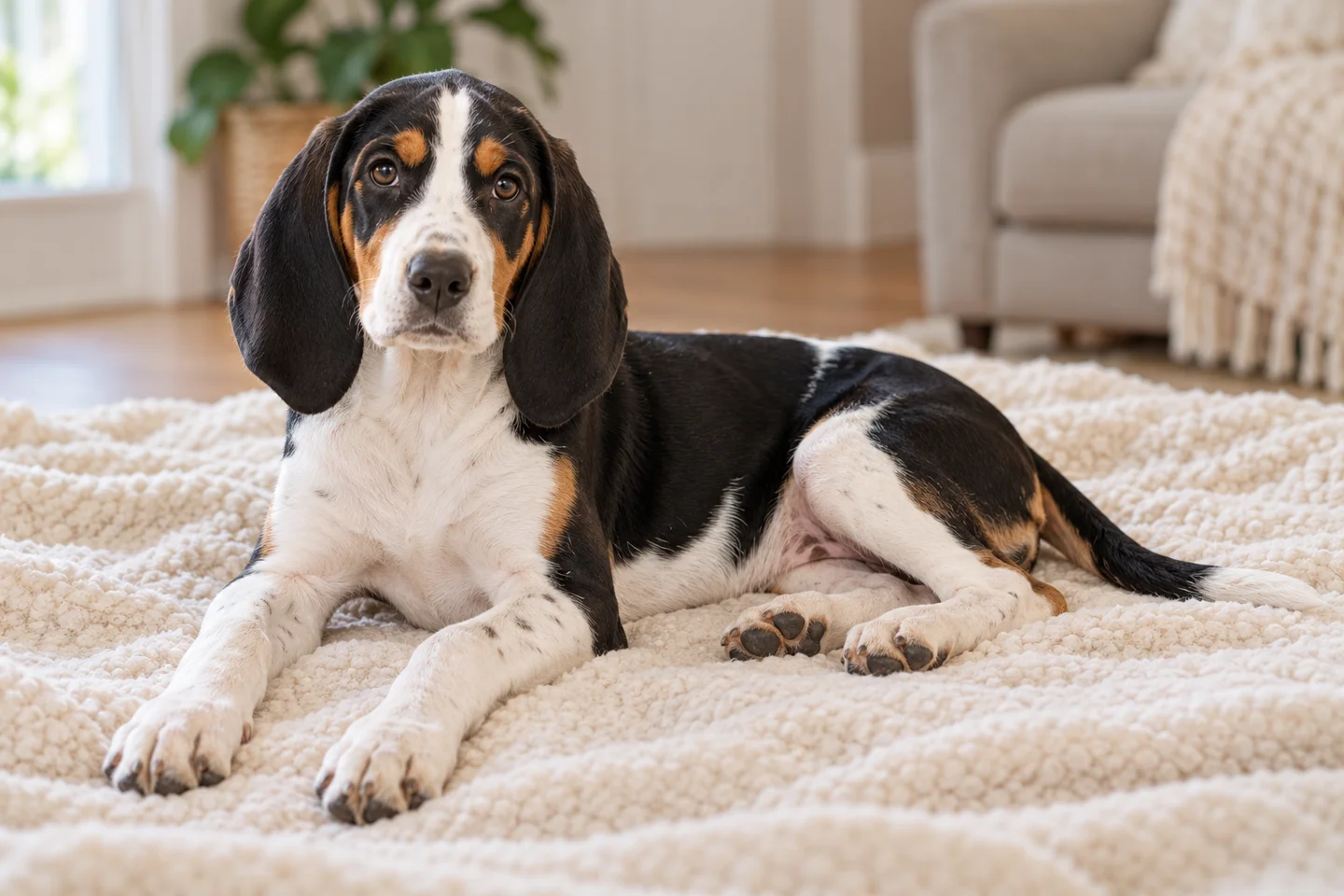
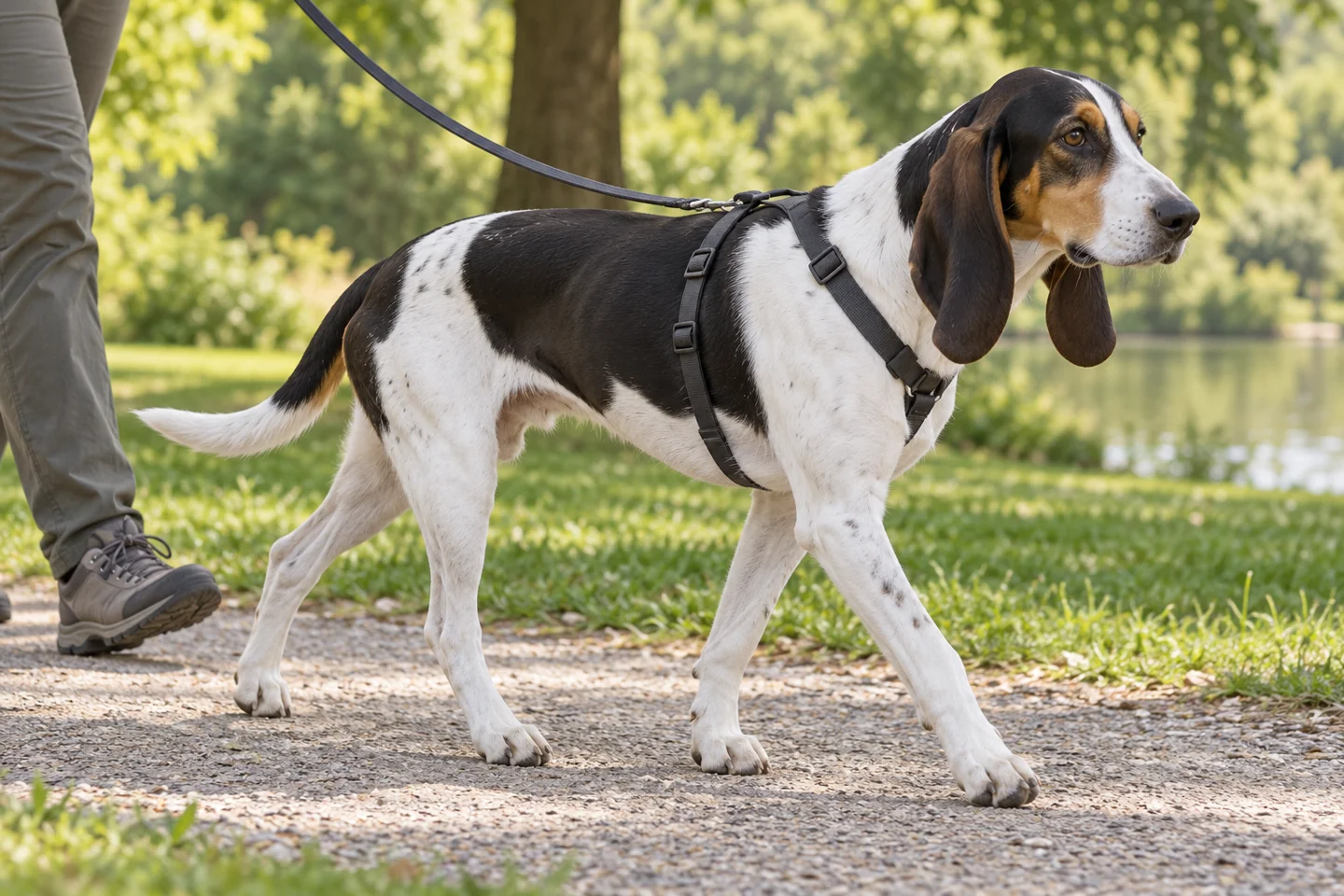
Our three images use consistent Bernese-variety coloring across adult, puppy, and walking scenes. They are labeled AI-generated illustrations. A young dog naturally has developing proportions and should not be made to carry an adult's muscle or head. Artwork cannot show veterinary findings or prove that a real dog's ears, joints, or eyes are healthy. Those decisions require the actual animal and the relevant records.
Voice, rest, and the home schedule
Find out when the individual dog vocalizes. A bay while tracking, an alert at the boundary, and distress during an absence require different investigation. Ask a breeder or foster carer for examples from ordinary life, including how long the sound continues and what helps it stop. Housing rules and neighbors' tolerance matter. A rural address does not automatically make every level of noise acceptable or prevent repeated rehearsals at a fence.
Provide a resting place where the dog can sleep without constant disturbance. After a walk, water and a quiet transition can help establish that activity has ended. Avoid restarting play every time the dog stands up. A new adult may need time to reveal its usual pattern, so gather observations across several situations rather than defining its temperament from one tired evening after travel.
Introduce absences in manageable steps and observe the dog directly or through a suitable recording. Repeated pacing, escape attempts, and persistent distress vocalization should prompt changed arrangements and professional advice. The explanation should fit the pattern rather than the assumption that all hounds simply like making noise. A companion dog is not a guaranteed remedy, and the household still needs reliable care when its usual people are away.
Training beyond the recall question
Useful lessons include a mat, a comfortable stand, following a hand target, and releasing safe objects. Teach each with clear rewards and an easy starting point. These skills reduce reliance on physical intervention when the dog is excited. A hound that can move voluntarily onto a mat is easier to manage at dinner than one that must be repeatedly pushed away from the table.
Practice recall in secure settings before adding distraction. Reward arrival and sometimes allow exploration to continue so returning has value beyond losing access to the outdoors. Use a suitable long line when safe, accounting for entanglement and other users. An off-lead test beside wildlife or a road places too much at stake. Success under ordinary conditions cannot establish reliability in every situation the dog has yet to encounter.
Teach handling for the long ears, feet, and mouth in brief rewarded stages. A veterinary team or groomer should know about discomfort before the appointment starts. Ask a reward-based trainer how the setup changes when the dog is worried, and how progress will be measured. A plan that merely restrains harder may overlook pain or make a necessary procedure increasingly difficult to approach.
Exercise and a body prepared for the terrain
Offer regular movement and varied exploration while building fitness gradually. The right plan depends on development, health, conditioning, and conditions. A puppy following a new scent, an adult on a familiar route, and an older dog recovering from illness have different demands. Avoid selecting a universal daily distance and treating every individual as if it must complete it regardless of response.
Simple searches can engage the nose without uncontrolled pursuit. Hide an easy object or part of the measured food ration where the dog can understand the task. Inspect the area first for litter, chemicals, and animal hazards. Organized scent activities may be useful with suitable instruction. Mental engagement supplements physical care rather than replacing toileting, movement, comfortable rest, or contact with the household.
Check recovery after difficult ground. Inspect pads, nails, and the spaces between toes, and watch whether the dog moves differently after rest. A keen hound may continue investigating despite discomfort. In hot conditions, choose cooler hours and carry water. If breathing, gait, or alertness changes concerningly, seek advice rather than urging completion. A smooth coat cannot prevent every heat-related problem.
Aggression and the household's responsibility
A breed description of friendliness cannot establish the safety of an individual Swiss Hound. Fear, pain, and conflict over resources can affect dogs of any ancestry. Take stiffening, freezing, growling, and snapping as reasons to examine the situation and protect people from another close encounter. Sudden difficulty during handling should also lead to veterinary assessment, particularly if the dog previously tolerated the same task.
Give meals and chews where no child or pet must pass close by. Prevent access to rubbish and tempting unsafe objects, and teach exchanges during calm practice. If guarding is already present, obtain qualified help rather than repeatedly taking items to demonstrate control. The owner needs an arrangement that can be followed consistently by the whole household, including anyone who takes over care temporarily.
Disclose bite incidents accurately to professionals and carers. Include the surrounding events, contact, and injury rather than a vague label such as grumpy. A carefully introduced basket muzzle can support some individual plans, but it cannot make forced interaction comfortable or replace reliable separation. A good plan explains how to avoid the problem situation while the relevant veterinary and behavioral work proceeds.
Children, long ears, and other household animals
Long ears may invite a child's hand, so explain that pulling or holding them hurts and can frighten the dog. Arrange contact while an adult watches and stop when the dog withdraws. Children should not hug the head, disturb sleep, or retrieve objects from the mouth. The dog needs a resting area that remains private even when friends visit and the household becomes noisy.
A medium hound can still knock over a small child during an excited turn. Choose activities with a clear adult-controlled structure, such as a simple search or familiar cue. Avoid games in which the child runs away with food while the dog follows. When adults cannot supervise closely, use physical separation. Being nearby while occupied with another task does not guarantee that the interaction is being watched.
Assess other dogs through repeated calm experiences and separate resources at home. Hunting background cannot certify universal compatibility. Cats need individual evaluation and escape routes, while rabbits, rodents, and poultry require secure protection from a hunting dog. Calm behavior toward a familiar animal should be described narrowly. It does not establish what happens when an unfamiliar animal runs across the path outdoors.
Grooming and the ear inspection routine
The short coat benefits from gentle brushing to remove loose hair and inspect skin. Pay attention to areas under equipment and along the underside after rough-ground walks. Persistent itching, odor, or inflamed skin needs assessment rather than a succession of stronger shampoos. Keep a note of when the change began and any products used; those details can help the clinician choose useful next steps.
Lift the ear flap gently and look without pushing anything into the canal. Repeated head shaking, pain, discharge, or redness should be brought to the veterinary team. Ask whether this individual needs routine cleaning and have the technique demonstrated. The length of the ears makes inspection a practical habit, but it cannot diagnose an infection or establish its cause. Leftover medication from another episode may be unsuitable.
Introduce nail care and toothbrushing separately from brushing the coat. Short, rewarded attempts can build tolerance before a longer task is needed. A hound that suddenly resists one foot being touched may have an injury. Do not assume that firmer restraint will solve it. Keep bedding dry, check equipment fit, and make the routine simple enough that a temporary carer can continue it accurately.
Health evidence and Swiss breeding approval
The Swiss Hound Club's published breeding regulations require its breeding candidates to pass an approval process and describe identity, health, conformation, and behavior conditions. That process should be explained by the source for a proposed litter. It must not be presented as a universal international DNA panel, or confused with a promise that a dog can never become ill. Ask which documents apply to the parents and read the actual outcome.
The Swiss Cynological Society provides information about recognized preventive examinations, including official assessment of joint radiographs and specialist eye work. Those general resources help owners distinguish a scored assessment from a casual impression. They do not by themselves mean that every listed examination is compulsory for every Swiss Hound. Confirm the current breed and country requirements rather than borrowing a complete list from an unrelated breed.
For the family history, ask about confirmed diagnoses, repeated lameness, persistent skin or ear trouble, and long-term treatment in close relatives. Separate a diagnosis from a story that a dog slowed down. For an adopted adult, the available clinical notes may reveal unresolved follow-up or previous medication even if no pedigree is known. Bring that history to the first consultation instead of allowing the transfer to erase useful information.
Everyday performance needs observation as well. A dog that still wants to follow a trail may have discomfort, reduced stamina, or a change in hearing that deserves assessment. Record what changed and when. A DNA result addresses its named variants, while the examination of the current patient answers another question. Neither a hunting title nor an attractive short coat replaces that individual care.
Feeding, mixes, and the practical budget
Feed a complete diet appropriate to life stage and measure portions. Include training rewards and food provided by other people. Activity may change with season or injury, so review intake instead of retaining the same ration automatically. Ask the clinic to demonstrate condition assessment. Appetite or weight changes should be investigated when persistent, rather than explained solely by the idea that a hound is either greedy or naturally lean.
A Swiss Hound cross may show a different coat pattern, ear length, size, or hunting interest. Ask which parentage is documented. A tricolor dog is not automatically a Bernese-variety cross, and a crossbreed name cannot guarantee improved health. For an adult, observed behavior around animals and handling may be more useful to placement than a guessed family tree. For a puppy, acknowledge the remaining uncertainty as it develops.
Obtain local prices for veterinary care, dental work, secure transport, training, boarding, and unexpected treatment. Ask a boarding provider about fencing and noisy-hound routines. A backup walker should understand gate handovers and wildlife precautions. Read insurance conditions before relying on a policy, and discuss continuing support with the source. The acquisition fee is only one part of an arrangement that must remain practical over many changing circumstances.
A dogsDating meeting with time to sniff
On dogsDating, describe the Swiss Hound's preferred pace, response to other dogs' vocalization, and interest in scent. Ask whether the proposed partner is comfortable with a dog that may pause often. Two active dogs can still want different walks. Agree that shared movement is a valid goal without adding wrestling, toys, or free running to the first encounter.
Choose a public route wide enough for each handler to turn away and avoid an opening greeting at a narrow gate. Begin with independent exploration and sufficient separation to assess recovery after the dogs notice one another. If one repeatedly pursues, stiffens, or tries to leave, make the situation easier or end calmly. Continuing until the dogs are exhausted provides less useful information than stopping while both remain manageable.
Keep exact user coordinates private. Use approximate discovery to identify a convenient area and then agree on a public landmark. A home address or private hunting location is unnecessary. Afterward, note which pace and distance worked, and whether both dogs could disengage. That record supports a sensible next meeting while allowing either owner to decide that another companion would be more comfortable.
Sources and editorial notes
Sources checked October 22, 2026. Breed measurements describe reference ranges, not a diagnosis or an individual dog's ideal weight. Images are AI-generated breed illustrations and do not document a particular dog or health condition.
- AVSAB: Humane Dog Training Position Statement
- VCA Animal Hospitals: Food aggression in puppies
- Orthopedic Foundation for Animals: CHIC health screening programs
- VCA Animal Hospitals: Aggression toward unfamiliar dogs, diagnosis
- VCA Animal Hospitals: Grooming and coat care for your dog
- VCA Animal Hospitals: Ear infections in dogs (otitis externa)
- AAHA: Feeding plans for healthy, appropriate weight cats and dogs
- VCA Animal Hospitals: Heat stroke in dogs
- AVSAB: Puppy Socialization Position Statement
- VCA Animal Hospitals: Dog behavior problems, aggression toward children
- Swiss Hound Club: Breeding regulations ZR-SLC-2021
- Swiss Cynological Society: Preventive examinations
- Swiss Hound: official breed standard
Keep getting to know dogs.
Read another guide or return to your dogsDating community.
Explore breed guidesBack to dogsDating