Rhodesian Ridgeback
A large Southern African hound with a distinctive back ridge, athletic strength, and a need for thoughtful socialization and health checks.
How these guides are researched and reviewed
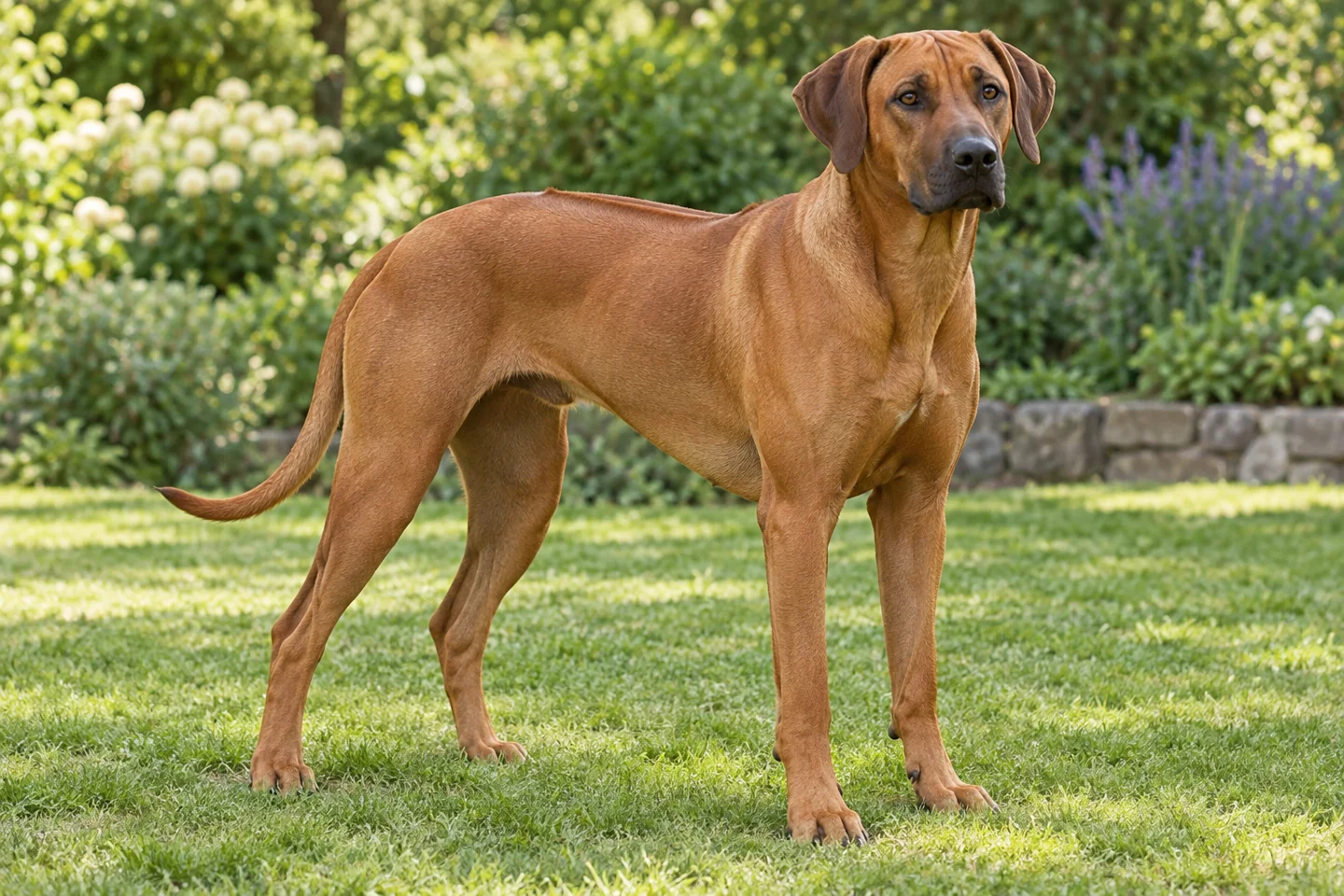
- Origin
- Southern Africa
- Adult standard size
- Males 63–69 cm/36.5 kg; females 61–66 cm/32 kg
- Illustrated coat
- Wheaten short coat with dorsal ridge
General information for owners. These articles have not been reviewed by a veterinarian. Medical decisions need your dog's history and an examination.
The Ridgeback behind the familiar ridge
The Rhodesian Ridgeback is a large hound developed in Southern Africa. Its most recognizable feature is a narrow strip of hair growing in the opposite direction along the back. That feature is useful for identifying the breed's intended appearance, but an owner lives with the whole dog: its strength, alertness, appetite, hunting interest, and response to unfamiliar situations. A handsome outline does not reduce the work involved in teaching a large adolescent how to move through a crowded world.
The FCI standard describes historical hunting work that included keeping a lion at bay until the hunter arrived. That account is frequently exaggerated into claims that individual Ridgebacks killed lions. It should not become a reason to encourage confrontation with wildlife or people. Modern ownership requires preventing pursuits and teaching safe cooperation. A family dog needs no opportunity to demonstrate a historical working task that would place it, other animals, and the handler at risk.
The breed's origins also explain why a dog may investigate movement at a distance while remaining relatively quiet indoors. Individuals vary, and ancestry cannot predict the exact household routine. Meet adults where possible, ask about everyday life beyond a show or a litter visit, and discuss the activities you expect to share. A source who can explain difficult moments as well as pleasant ones gives you more useful information than an advertisement built around courage or loyalty.
Adult size and physical details
The current FCI standard gives males a height of 63 to 69 centimeters at the withers and females 61 to 66 centimeters. Its desirable weights are 36.5 kilograms for males and 32 kilograms for females. These describe the standard's adult target, not an obligation to feed every dog to the same weight. Frame, muscle, age, and body condition still matter. A puppy's progress should be assessed over time with veterinary guidance rather than compared with the largest puppy in a photograph.
The coat is short, dense, and sleek, in light wheaten through red wheaten shades. A black or brown nose is allowed under the standard, with appropriate eye color. The ears hang naturally beside the head and the full tail tapers toward its end. The ridge should be clearly defined and symmetrical, with two matching crowns. A missing or imperfect ridge affects conformation classification; it does not by itself describe a dog's ability to enjoy family life.
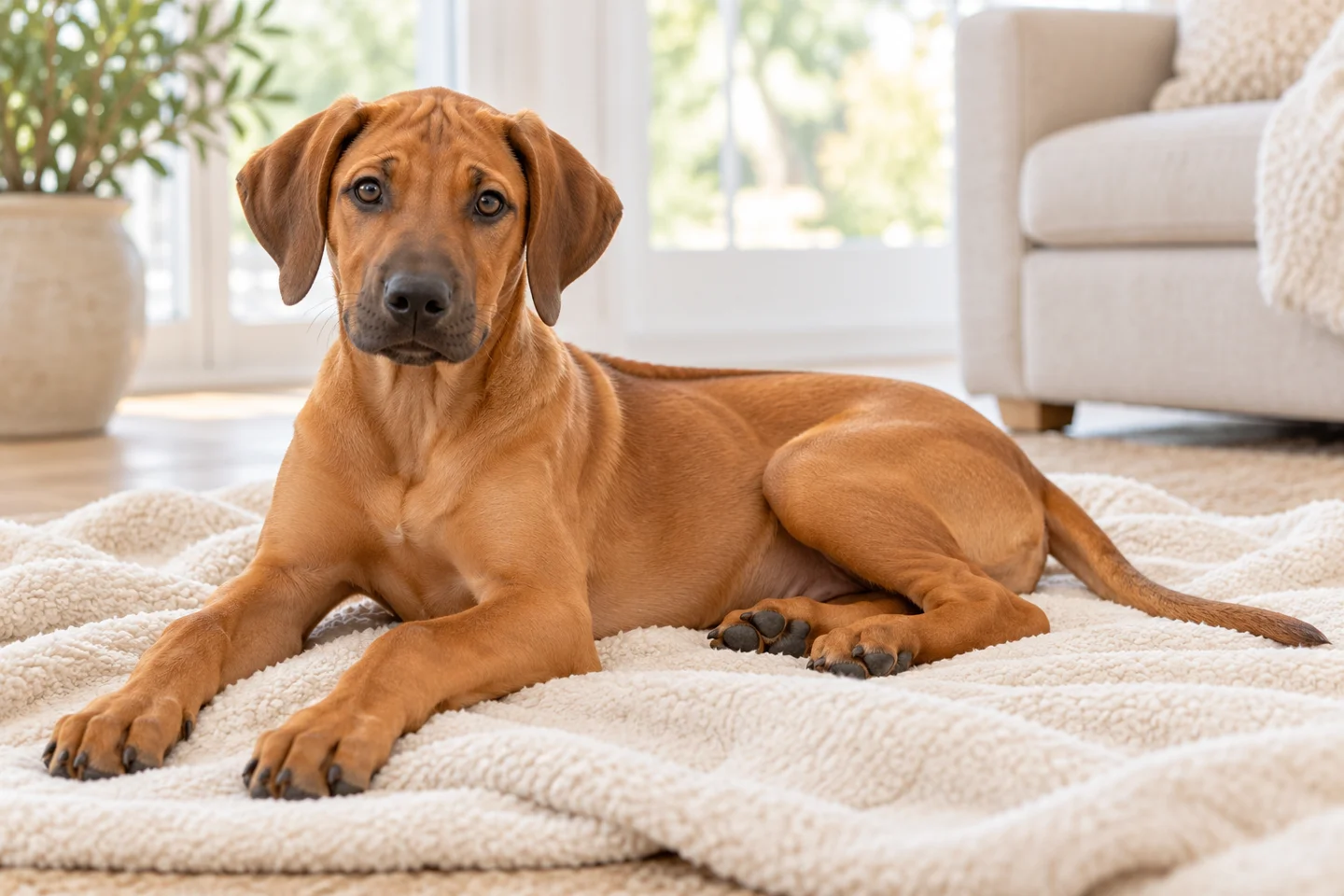
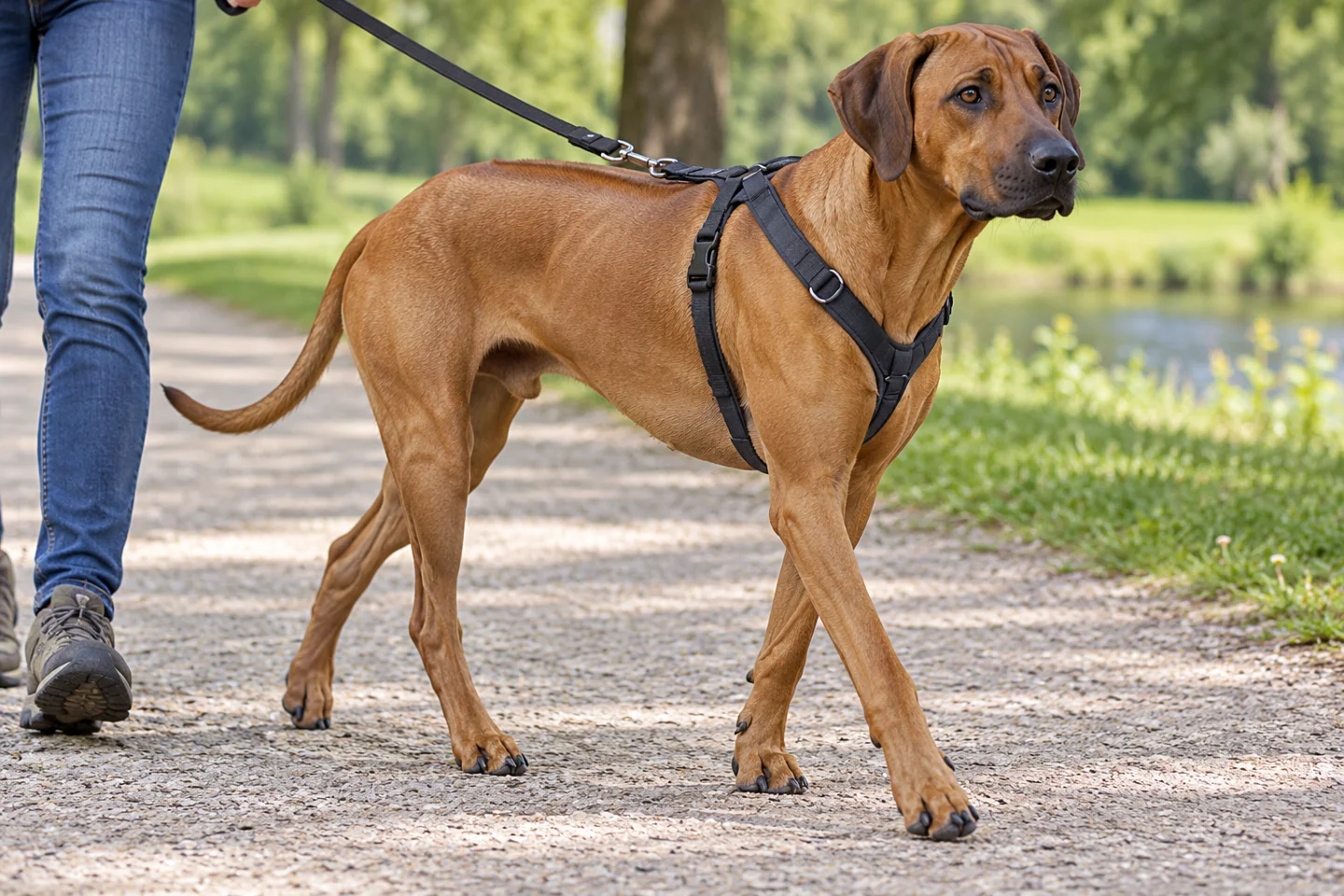
The illustrations here show a wheaten dog with a black nose, natural hanging ears, and a complete tail. They cannot document a health examination, prove a pedigree, or show every acceptable shade. When choosing equipment, check the dog's chest and neck measurements directly. A broad, athletic torso can require a different harness adjustment from another dog of the same weight. Reassess during growth and after changes in body condition.
Choosing a household for an observant hound
The standard describes a dignified, intelligent dog that can be reserved with strangers. Reserved should mean that people allow time and choice, rather than insisting on immediate handling. A visitor can enter calmly, avoid leaning over the dog, and let the owner manage the space. A Ridgeback that prefers to watch from a mat does not need to be repeatedly called into a circle of unfamiliar hands to prove sociability.
At home, decide what access makes sense before the dog reaches adult size. If the sofa is available, teach an easy way to leave it in exchange for a reward. If a particular room must remain private, use a dependable barrier instead of repeated arguments at the doorway. Predictable arrangements reduce uncertainty for people and dog. They are especially useful when visitors, cleaners, or delivery workers arrive at times the owner cannot supervise closely.
Plan alone time as a skill with individual limits. Observe whether the dog can settle during a brief departure and increase difficulty only when that is comfortable. Damage near an exit or persistent distress needs investigation. It cannot be dismissed as the price of owning a loyal breed. A household with long unavoidable absences should arrange appropriate help before bringing the dog home, including a realistic plan for the first weeks of adjustment.
Training before strength becomes a problem
A young Ridgeback can learn where to stand while a door opens, how to follow a handler's turn, and how to rest on a mat while people eat. These small tasks matter because adult strength makes improvised restraint unreliable. Practice each behavior where success is easy, reward it, and then change one part of the situation. A quiet doorway and a doorway containing an excited visitor are different lessons.
Reward-based methods make the desired response clear without creating a contest over physical control. If a dog jumps to reach food, change how the food is stored and reinforce keeping feet on the floor. Do not rely on pushing the dog away every time it approaches. A trainer should help identify what the dog gains from the current behavior and how to make a safer response worthwhile. Ask how the plan will change when the dog is worried or distracted.
Teach recall in fenced areas and use managed equipment outside them. A hound that returns from ordinary sniffing may still pursue a suddenly running animal. Avoid testing this beside roads or livestock. Also practice accepting examination of the back, feet, ears, and mouth. Veterinary care becomes easier when touching predicts manageable steps and rewards. If handling suddenly becomes difficult, check for pain before deciding that more determined restraint is the answer.
Exercise, secure running, and recovery
An adult Ridgeback may enjoy long walks, scent activities, or appropriate sports, but fitness must be built. A weekend of strenuous running cannot safely replace a regular routine. Increase workload with attention to the dog's age, health, surface, and response afterward. Growing dogs need particular care with repetitive impact. Ask the veterinarian about the proposed activity rather than applying a fixed age or distance rule to every puppy.
Secure exercise means inspecting the enclosure and the approach to it. Check gates, other users, and whether livestock or wildlife are immediately beyond the boundary. A strong dog can reach a surprising speed before a person reacts. Practice entering and leaving with the lead attached and reward waiting while the gate moves. Release only when the surroundings and the individual dog's behavior make that reasonable.
Allow rest as part of the schedule. A dog that has difficulty settling after a busy outing may need a quieter transition and a less demanding next session. In warm conditions, choose cooler hours and avoid exposed hard surfaces. Provide water and watch the individual dog's response rather than trusting its willingness to continue. A short coat does not prevent overheating, and enthusiasm cannot measure internal temperature or recovery.
Aggression and the cost of inaccurate assumptions
Breed history cannot certify a Ridgeback as safe with unfamiliar people. A large dog's threatening behavior deserves prompt, careful management even if no bite has occurred. Prevent access to the trigger while veterinary and behavioral advice is arranged. If the dog reacts at the gate, provide a separate secure area before admitting visitors. Asking a visitor to demonstrate confidence while the dog advances creates avoidable risk.
Food, chews, beds, and stolen objects need sensible routines. Give high-value items where nobody must pass closely and teach exchanges during calm practice. Do not punish a warning growl and then assume the underlying concern has disappeared. A professional can help distinguish guarding from pain, fear, or another problem and design gradual teaching. The owner should be able to explain where barriers are placed and who is responsible for using them.
Share a bite history with anyone responsible for the dog. Describe the event and injury accurately, including the circumstances and changes made afterward. People need that information to decide whether they can provide care. If a muzzle forms part of an individual plan, introduce it gradually with rewards and use a suitable basket design. It does not make forced contact safe or replace the distance and management the dog needs.
Children, cats, and dogs in the same home
A Ridgeback can be affectionate with familiar family members while still needing clear boundaries around children. Adults should supervise actively and separate when attention moves elsewhere. Children should not lie across the dog, hold its face, or follow it into a resting place. A dog moving away has already provided useful information. Give it a route that does not lead to being cornered behind furniture.
Consider the practical effect of size during play. An excited turn or jump can injure a small child without a deliberate bite. Choose activities with a predictable role for each participant, such as an adult-led search or a brief mat exercise. Running games involving children and a young hound need particular caution. Stop before arousal rises beyond the dog's ability to respond, rather than waiting for someone to fall.
Compatibility with cats and small animals must be assessed individually. A history of calm indoor coexistence is useful, but it may not predict the response to an animal running outdoors. Provide separate spaces and do not stage chase tests. With another dog, inspect the ordinary pressure points: narrow hallways, access to people, food preparation, and sleeping areas. Separate resources initially and judge progress over repeated relaxed experiences rather than one exuberant greeting.
Grooming and checking the whole back
The short coat needs regular gentle brushing and inspection rather than elaborate styling. Use the opportunity to check under the collar, along the belly, and between the toes. A ridge is a normal hair-growth feature. A swelling, draining opening, tender spot, or unusual attachment beneath the skin is a different matter and should be assessed by a veterinarian. Do not squeeze or probe a suspicious area because it lies close to the ridge.
Maintain nails and teeth through short, rewarded sessions. A dog that can place a foot on a towel and remain comfortable during a brief nail check is easier to care for than one that must be wrestled into position. Build duration slowly. Check ears for discomfort or discharge, and ask the clinic about cleaning when needed. Routine care should help you notice a change early, not become a repeated struggle the dog learns to avoid.
Skin irritation under equipment may need a fit adjustment, but persistent itching deserves clinical assessment. Photograph a changing area for the veterinarian and record when it appeared, any products used, and whether activity changed. Avoid treating every skin problem as an allergy or every raised patch as a dermoid sinus. A photograph can support a consultation; it cannot replace examination and the diagnostic steps the clinician recommends.
Health records: joints, dermoid sinus, and JME
The AKC hound testing summary lists hip and elbow evaluations for the Rhodesian Ridgeback. Ask for identifiable reports for both parents, including the actual result and age at assessment. A report is more informative than a claim that the parents run freely or have never appeared lame. It also answers a narrower question than a complete lifetime health guarantee. Discuss the current breed-club recommendations with the breeder because summaries and protocols can change.
Dermoid sinus is a congenital abnormal tract associated with this breed. The Rhodesian Ridgeback Club of the United States explains that it can occur along the midline and can also affect ridgeless puppies. Ask how puppies are checked and whether an experienced veterinarian has examined any questionable area. A normal-looking ridge cannot establish that the condition is absent. If surgery has occurred, request the operative record and the ongoing care plan. Treatment decisions belong with the veterinary team; older breed literature contains recommendations that should not substitute for a current individual assessment.
Juvenile myoclonic epilepsy is another specific discussion to have with a breeder. The Midland and Northern club describes a recessively inherited form with a DNA test and symptoms that can include repeated muscle jerks in young dogs. Obtain the actual test identity and results when JME status is advertised. A clear result for the known variant does not rule out every cause of seizures. Record unusual episodes for a veterinarian when safe, noting timing and awareness rather than diagnosing from a resemblance to an online clip.
Food, mixes, and the long-term commitment
Measure a complete life-stage diet and assess body condition regularly. A large athletic dog can gain excess weight when exercise decreases, especially if training food and table scraps are ignored. Discuss growth diets with the veterinarian rather than adding calcium or other supplements to make a puppy bigger. Changes in appetite, persistent gastrointestinal signs, or weight loss require investigation. Adjustments should follow the individual dog's needs, not a universal breed ration.
A Ridgeback mix can vary widely in size and behavior. A ridge does not identify the other parent, establish health status, or guarantee the temperament claimed in a listing. Ask for evidence of known ancestry and concentrate on the dog's observed needs. If both parents are known, their relevant medical and behavioral histories matter. An appealing crossbreed name provides no substitute for those details.
Budget for large-dog transport, secure accommodation, training help, routine care, and unexpected treatment. Check local quotes and insurance exclusions before taking responsibility. Plan who can safely walk the dog when the usual handler is unavailable. A family that enjoys thoughtful training and can offer secure exercise may find the work manageable. If everyone expects a puppy to teach itself calm manners because the breed looks composed, revise that expectation before choosing a litter.
Planning a dogsDating introduction
Use the dogsDating profile to describe this Ridgeback's current comfort with dogs, preferred pace, and any restrictions. Mention whether it enjoys chase games, needs a gradual start, or has difficulty when another dog rushes its face. Ask the prospective walking partner for the same detail. Photographs and breed labels cannot answer those questions. The purpose of a first outing is to collect useful information while keeping both dogs comfortable.
Meet at a public place with a wide exit route and enough room to walk separately. Begin with movement in the same general direction, leaving space for each handler to turn away. Avoid an enclosed gate greeting where leads cross and neither dog can retreat. End if repeated staring, stiffness, or attempts to escape continue despite more distance. A digital match does not create an obligation to make the dogs play.
Keep exact user coordinates private in profiles and messages. Approximate discovery can identify a suitable area, and an agreed public landmark can establish the meeting point. Afterward, record whether the dogs could disengage, rest briefly, and leave calmly. Those observations support the next decision far better than assuming that two large hounds automatically share the same social preferences.
Sources and editorial notes
Sources checked October 22, 2026. Breed measurements describe reference ranges, not a diagnosis or an individual dog's ideal weight. Images are AI-generated breed illustrations and do not document a particular dog or health condition.
- AVSAB: Humane Dog Training Position Statement
- VCA Animal Hospitals: Food aggression in puppies
- Orthopedic Foundation for Animals: CHIC health screening programs
- VCA Animal Hospitals: Aggression toward unfamiliar dogs, diagnosis
- VCA Animal Hospitals: Grooming and coat care for your dog
- VCA Animal Hospitals: Ear infections in dogs (otitis externa)
- AAHA: Feeding plans for healthy, appropriate weight cats and dogs
- VCA Animal Hospitals: Heat stroke in dogs
- AVSAB: Puppy Socialization Position Statement
- VCA Animal Hospitals: Dog behavior problems, aggression toward children
- American Kennel Club: Hound group health testing requirements
- Rhodesian Ridgeback Club of the United States: Dermoid sinus
- Midland and Northern Rhodesian Ridgeback Club: Juvenile myoclonic epilepsy
- Fédération Cynologique Internationale: Rhodesian Ridgeback official breed standard
Keep getting to know dogs.
Read another guide or return to your dogsDating community.
Explore breed guidesBack to dogsDating