Russell Terrier
The AKC Russell Terrier is a low, rectangular working terrier, with registry naming that overlaps internationally with Jack Russell Terrier.
How these guides are researched and reviewed

- Origin
- England; development in Australia
- Adult standard size
- AKC both sexes 10–12 inches; weight proportional
- Illustrated coat
- White and tan broken coat
General information for owners. These articles have not been reviewed by a veterinarian. Medical decisions need your dog's history and an examination.
Russell, Jack Russell, and Parson: read the registry
Russell Terrier is the American Kennel Club's name for a small, rectangular terrier whose internationally familiar name often includes Jack Russell. The catalog has separate naming entries, but those entries should not imply that the FCI recognizes a universally independent Russell Terrier breed alongside its Jack Russell Terrier. The FCI lists Jack Russell Terrier as breed number 345, with Great Britain as origin and Australia as the country of development.
The United Kennel Club provides a useful example of the naming history. It recognized the shorter-legged dogs as Russell Terriers in 2001 and changed that name to Jack Russell Terrier in 2009. The taller, more square Parson Russell Terrier is treated separately in those registry descriptions. Working organizations may also use their own registration criteria. Ask which standard and organization a breeder means instead of assuming the name alone settles height, proportions, or eligibility.
For an owner, this is a document-checking issue as well as a vocabulary issue. Read the actual registration and the parents' information. When a rescue's ancestry is uncertain, describe the dog as a terrier or possible cross with appropriate caution. A low white-and-tan body can guide equipment and care choices without proving membership in a registry. The individual's behavior, clinical history, and requirements still matter regardless of the label.
A small working body, not a scaled ornament
The AKC Russell Terrier standard gives a height of 10 to 12 inches for both sexes. Weight should remain proportional to size and structure. The outline is longer than tall, with enough flexibility and practical build for working-terrier functions. A heavy, overfed dog and an unusually fragile dog do not represent opposite equally desirable versions of the same goal. Ask the veterinarian to assess condition rather than choosing a target from an unverified weight chart.
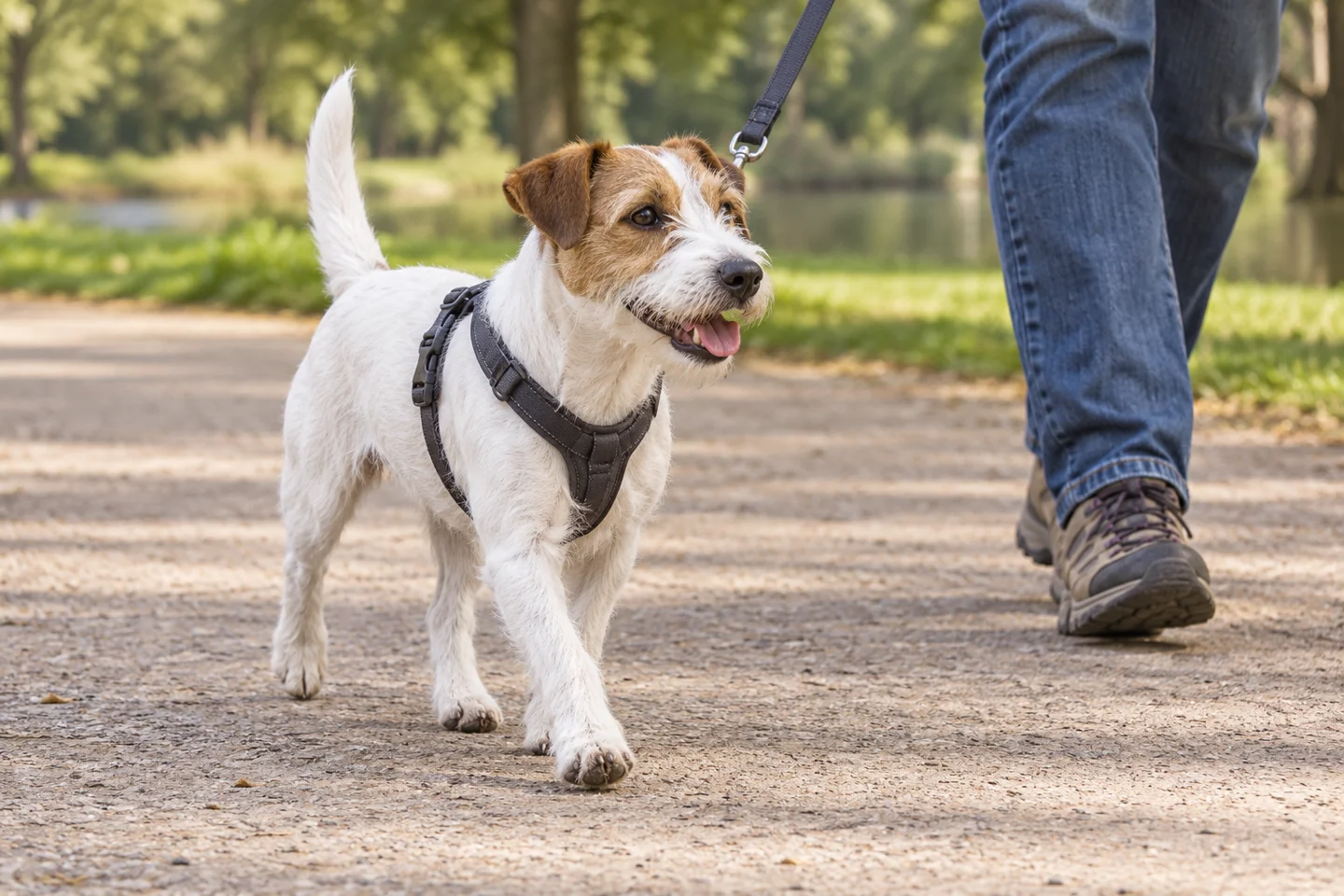
The coat may be smooth, broken, or rough, with white predominating and permitted darker markings. Our illustrations use a broken coat with tan markings, natural folded ears, and a complete tail. Broken does not mean damaged. It describes an intermediate coat appearance that can include some facial furnishings while remaining shorter and less uniformly rough than a fully rough coat. A puppy's eventual adult texture may still be developing.
Check the actual dog when selecting a harness. The chest and shoulders need room to move, while straps must not slide far enough to permit escape. A small terrier can reverse out of poorly fitted equipment quickly when focused on a hole or frightened by an approaching dog. Recheck fit during growth and after grooming. Attach identification and maintain the dog's microchip details as part of the ordinary escape-prevention plan.
What a working-terrier background asks of a home
A Russell may investigate holes, moving objects, and small animals with determination. That is relevant to fencing, toys, and walking routes. It does not mean every individual will behave identically, but it makes a promise of effortless off-lead reliability unwise. A household needs opportunities for exploration and teaching alongside practical containment. A low fence or a narrow gap that contains a heavier dog may offer a terrier an attractive problem to solve.
Look under sheds, beside gates, and around the bottom of the boundary before arrival. Prevent access to dangerous burrows, chemicals, and stored equipment. An owner may choose to provide an appropriate digging area, introducing it through rewards and supervision. That does not establish permission to dig everywhere. Management keeps the dog from repeatedly discovering that an unsafe area is the most rewarding place in the garden.
Inside, teach a resting routine as deliberately as a game. A terrier that has learned to keep presenting a toy may continue long after a person intended to stop. Put toys away calmly, offer a comfortable bed, and reward settling. If the dog struggles with absences, observe what happens and arrange support. More frantic exercise is not a complete treatment for distress, and acquiring another dog adds responsibilities without guaranteeing a solution.
Training that gives persistence a useful task
Begin with clear, achievable lessons. Reward turning toward the owner, following a few steps, and waiting briefly while a door opens. A quick dog can repeat an unwanted action many times while a person tries to interrupt, so change the setup early. Store food securely, prevent access to tempting laundry, and give the terrier tasks where success produces a reward. Good management protects teaching time from repeated emergencies.
Practice exchanges with safe, low-value objects. Offer a worthwhile reward, mark release, and sometimes return the object when appropriate. Do not begin by confronting the dog over the most valuable chew it has ever found. A qualified reward-based trainer can help when guarding or conflict is already present. Ask the trainer what behavior is being reinforced and how they will adjust the exercise if the dog becomes worried.
Recall practice belongs in secure places before greater distraction is added. Reward coming back and sometimes allow further exploration, so returning does not always end the walk. A long line can support managed practice when used safely, with attention to entanglement and other people. An owner should not use a roadside rabbit as an exam. The cost of a failed test is too high, and the experience may strengthen pursuit.
Exercise, search work, and a useful off switch
Offer physical activity and tasks that require investigation, while adjusting demands to age and health. A growing puppy should not be pushed through repetitive jumping or long forced running to match an adult's enthusiasm. For a healthy adult, build conditioning gradually and watch recovery. New stiffness, intermittent skipping, or reluctance to continue warrants advice even if the dog still becomes excited at the sight of a lead.
Simple searches can give persistence a constructive outlet. Hide a familiar toy at an easy level or use part of the measured food ration in a safe search area. Make the task understandable before increasing complexity. Check locations for rubbish, chemicals, and gaps the dog could enter. Some owners enjoy organized dog sports, but an appropriate instructor should assess the individual and explain how the activity is introduced safely.
End vigorous play while the dog can still respond and recover. Repeated ball chasing can become a narrow routine that increases arousal without teaching calm behavior. Mix activities and include ordinary sniffing walks and rest. In heat, choose cooler conditions and carry water. A short or broken coat cannot prevent overheating, and a willing terrier may continue playing beyond the point at which a sensible owner should stop.

Aggression and handling real risk
A small working terrier can cause a significant bite. Do not laugh at growling over a sofa or provoke a reaction for a video. Notice where the concern occurs and prevent another encounter while advice is arranged. Sudden changes in tolerance deserve veterinary assessment because pain can alter behavior. Breed descriptions of confidence cannot tell an owner why a particular dog snapped during a nail check.
Resource guarding needs a controlled plan. Give meals and chews where children and other animals cannot interfere. Stop removing objects simply to demonstrate authority. If the dog has already bitten or threatens contact, use dependable separation and obtain qualified behavioral support. A basket muzzle may be appropriate within an individual plan after gradual positive introduction. It should not be used to make forced contact possible.
Share incidents factually with carers and trainers. Describe contact, injury, circumstances, and present precautions rather than using a vague label such as feisty. An owner who knows that the dog reacts at a narrow gate can arrange a different handover. A person who receives only reassurance may unknowingly recreate the dangerous situation. Accurate information and practical routines reduce that avoidable uncertainty.
Children and animals smaller than the terrier
Children can share suitable activities with a Russell when an adult controls the setup. They should not tease with food, pull facial hair, or take objects from the mouth. Protect the dog's sleeping and eating places and use separation whenever supervision cannot remain active. A small dog that can fit on a child's lap still needs room to move away. Being held in place does not make contact affectionate from the dog's perspective.
Running games require caution when a young terrier starts chasing clothing or heels. Stop the game through adult management and choose a calmer task before arousal escalates. Older children may help prepare searches or practice familiar cues, but lead handling near traffic needs a realistic assessment. The adult remains responsible for the situation and should not ask a child to correct threatening behavior.
Rabbits, rodents, and poultry need secure separation from a working terrier. A quiet moment through cage bars does not establish safety if the animal escapes. Cats require individual assessment and escape routes. With another dog, observe access to food, beds, and people as well as play. A dog that repeatedly blocks or follows its companion needs a changed arrangement before the pressure becomes a fight.
Grooming smooth, broken, and rough coats
Ask what coat the individual dog has and how it is maintained. A smooth coat needs gentle removal of loose hair and skin checks. Broken and rough coats may require different professional techniques depending on the owner's goals and the dog's condition. A groomer familiar with terrier coats can explain what stripping, trimming, or clipping would involve. The decision should account for skin health and tolerance rather than a promise that one method suits every dog.
Inspect between the toes and under equipment after activity. Short stature can place the belly close to vegetation and debris. Check ears for discomfort, discharge, or repeated shaking without inserting tools into the canal. A folded ear is normal anatomy, not a diagnosis. Persistent symptoms need the clinic rather than repeated use of an old bottle of drops or a product chosen from a grooming discussion.
Keep nails and teeth on the routine. Introduce tiny portions of each task and reward participation. If a dog suddenly resists one foot being touched, inspect for injury and ask for help rather than assuming it has forgotten its training. Cooperative care can make future work easier, but it cannot remove an embedded object or treat painful disease. Clear records of what changed help the relevant professional decide the next step.
Health screening: hearing, eyes, knees, and PLL
The AKC's terrier health-testing list identifies patella evaluation, an ophthalmologist evaluation, BAER hearing testing, and a primary lens luxation DNA test for the Russell Terrier. Obtain the actual parental results and confirm the current protocol. The hearing test and eye examination answer questions that cannot be settled by a photograph or a puppy responding to a sound in the room. Ask which dog was tested and how its identity was recorded.
Primary lens luxation can displace the eye's lens and become painful. The UC Davis Veterinary Genetics Laboratory explains the relevant inherited variant and the interpretation of results. A DNA result should be read for the specific variant tested, not translated into freedom from every eye disorder. A clinical eye examination remains a different assessment. Ask the veterinarian or a genetic counseling service about breeding implications rather than interpreting carrier status from an advertisement.
Keep screening separate from diagnosis in the pet you own. Squinting, a painful-looking eye, or sudden visual difficulty requires prompt veterinary advice even if the parents had satisfactory results. A hearing concern may also need investigation beyond ordinary observation at home. Record what the dog does and in which circumstances. Useful observations can support professional assessment without requiring the owner to choose a diagnosis first.
A complete clinical history includes previous lameness, surgery, medication, and the age and health of close relatives where known. A routine check of a puppy does not replace the adult screening program. Conversely, a completed program does not predict every future condition. Ask what follow-up support the source provides and how new information about the litter will be shared. That continuing communication can matter when a concern emerges later.
Food, mixes, costs, and choosing realistically
Measure a complete life-stage food and include training rewards in the daily total. A small active dog can still become overweight, especially when activity drops after injury or during a change in routine. Ask the clinic to demonstrate a body-condition check and repeat it regularly. Avoid feeding a growing puppy to an arbitrary adult weight or adding supplements to make it stronger without veterinary guidance.
Russell crosses can vary considerably in coat, proportions, and behavior. The shared use of Jack Russell naming makes careful questions especially useful: is the ancestry documented, and which registry or working background is meant? A familiar crossbreed name cannot guarantee a quiet temperament, reduced prey interest, or freedom from inherited disease. Ask about both known parents and evaluate the actual animal rather than relying on an appealing label.
Budget for secure boundaries, safe transport, preventive care, training support, and unexpected treatment. Obtain local prices for boarding that can manage an active terrier securely. Arrange a backup carer who understands gate routines and the dog's animal precautions. A small food bill does not make the whole responsibility inexpensive. The household needs to enjoy an engaged, persistent dog while providing the management that keeps its investigations safe.
Using dogsDating for a compatible walk
On dogsDating, explain what this Russell currently enjoys and what it finds difficult. Mention whether it prefers sniffing walks, becomes excited around running dogs, or needs extra room during the opening minutes. Ask the other owner how their dog responds when play stops. A good match can involve shared walking without physical play, particularly when size, speed, or arousal differs.
Choose a public place with enough width to avoid a tight face-to-face greeting. Walk separately at first and let both handlers observe whether their dogs can investigate the ground and disengage. Avoid starting beside rabbit burrows or an excited group of loose dogs. If either animal repeatedly stiffens, pursues, or tries to leave, change direction and finish calmly rather than demanding a successful-looking photograph.
Keep exact user coordinates private. Approximate discovery and an agreed public landmark are enough to arrange the outing without sharing a residence. Afterward, note what distance worked and whether both dogs could settle. Those details help plan the next experience. A registry name can clarify identity, but the individual dogs' responses determine whether another meeting is a sensible choice.
Sources and editorial notes
Sources checked October 22, 2026. Breed measurements describe reference ranges, not a diagnosis or an individual dog's ideal weight. Images are AI-generated breed illustrations and do not document a particular dog or health condition.
- AVSAB: Humane Dog Training Position Statement
- VCA Animal Hospitals: Food aggression in puppies
- Orthopedic Foundation for Animals: CHIC health screening programs
- VCA Animal Hospitals: Aggression toward unfamiliar dogs, diagnosis
- VCA Animal Hospitals: Grooming and coat care for your dog
- VCA Animal Hospitals: Ear infections in dogs (otitis externa)
- AAHA: Feeding plans for healthy, appropriate weight cats and dogs
- VCA Animal Hospitals: Heat stroke in dogs
- AVSAB: Puppy Socialization Position Statement
- VCA Animal Hospitals: Dog behavior problems, aggression toward children
- American Kennel Club: Terrier group health testing requirements
- United Kennel Club: Jack Russell Terrier standard and registry naming history
- Fédération Cynologique Internationale: Jack Russell Terrier, breed 345
- UC Davis Veterinary Genetics Laboratory: Primary lens luxation
- American Kennel Club: Russell Terrier official breed standard
Keep getting to know dogs.
Read another guide or return to your dogsDating community.
Explore breed guidesBack to dogsDating