Schiller Hound
A Swedish tan-and-black scenthound, with guidance on single-hound working context, safe scent outlets, Swedish health records and family seizure history.
How these guides are researched and reviewed
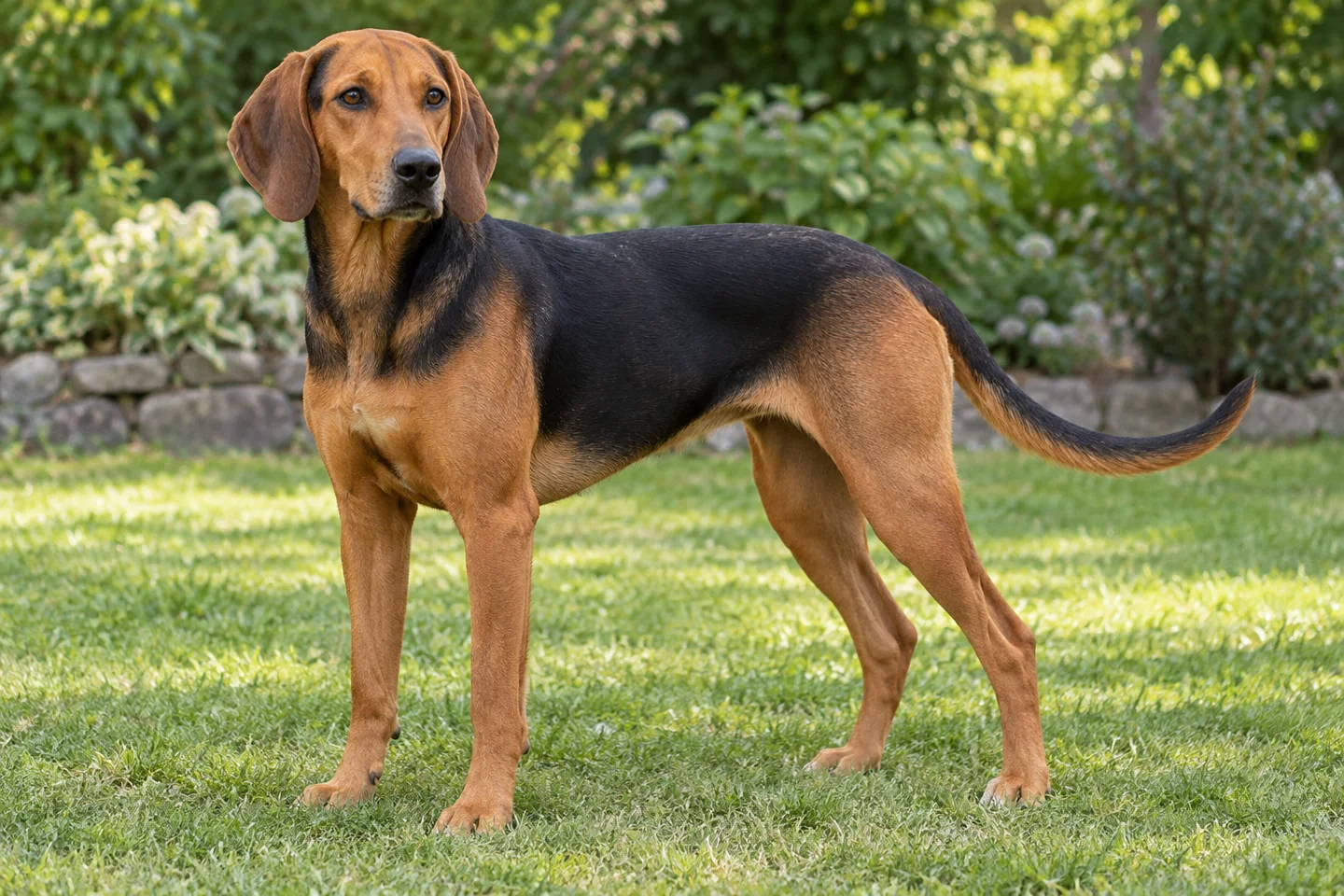
- Origin
- Sweden
- Adult male height
- 53–61 cm; ideal 57 cm
- Adult female height
- 49–57 cm; ideal 53 cm
- Coat
- Short tan with clearly defined black mantle
General information for owners. These articles have not been reviewed by a veterinarian. Medical decisions need your dog's history and an examination.
A Swedish hound whose name describes a separate breed
The Schiller Hound, usually called Schillerstövare in Sweden, is a medium-sized scenthound with a tan coat and clearly defined black mantle. It is distinct from the tricolor Hamiltonstövare and other Swedish hounds. Similar working backgrounds do not make their standards or health information interchangeable. Check the complete identity on documents when choosing a puppy and use observed behavior and clinical findings when a rescue's ancestry is uncertain.
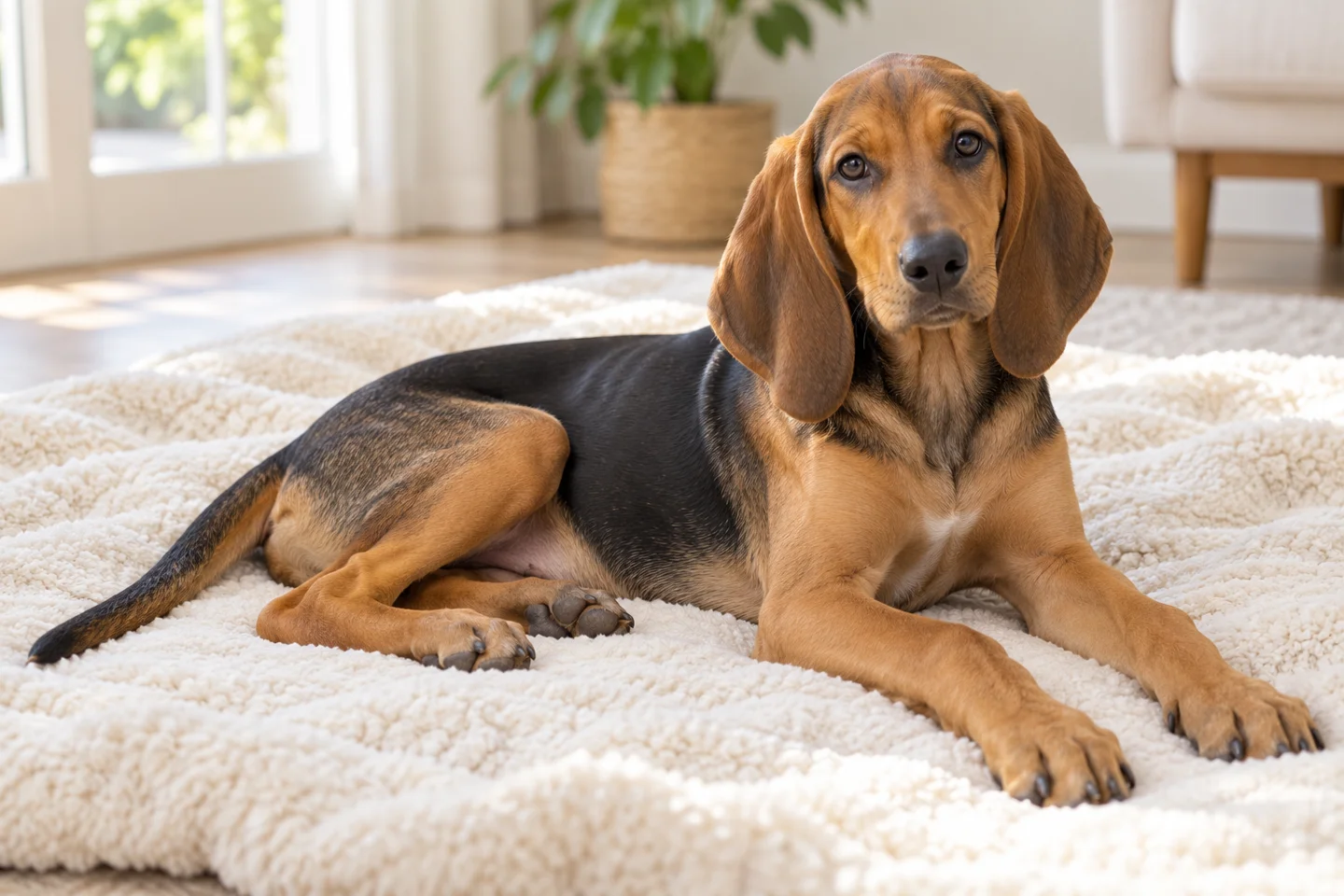
The illustrations show natural hanging ears, a full tail, and an athletic hound body. They cannot demonstrate pedigree, sound movement, or safe behavior. Ownership needs a plan for scent-led exploration, secure entrances, and recovery after activity. Meet adults outside a posed setting when possible and ask what the day looks like when no hunting or sport is available. A dog that follows a task enthusiastically still needs teaching about travel, quiet rest, and the ordinary interruptions of a home.
Single-hound work and why pack assumptions mislead
The FCI describes the Schiller as a hound used for hare and fox, giving voice on the trail. It specifically distinguishes its use from pack hunting or hunting in couples. That matters when someone assumes all scenthounds are automatically comfortable sharing every resource with a group. Working descriptions explain selection and use; they cannot establish compatibility with a particular unfamiliar dog in a domestic setting.
The standard records Swedish development around early exhibitions and dogs associated with Per Schiller. Treat that account as breed history rather than proof of an individual puppy's future performance. Ask the breeder about current adults: how they respond to dogs passing close, how they rest, and how necessary handling is taught. Companion owners can provide safer scent searches and managed trails without allowing access to quarry. The practical aim is suitable investigation within a routine the household can maintain, not recreating every historical task or letting a hound choose where the walk ends.
Adult heights and a body built for comfortable travel
The FCI gives males a height at the withers of 53–61 cm, with an ideal of 57 cm. Females measure 49–57 cm, with an ideal of 53 cm. It does not prescribe an adult weight range in this standard. Use veterinary body-condition assessment and the individual's frame rather than inventing a kilogram target or borrowing one from a similar-looking hound.
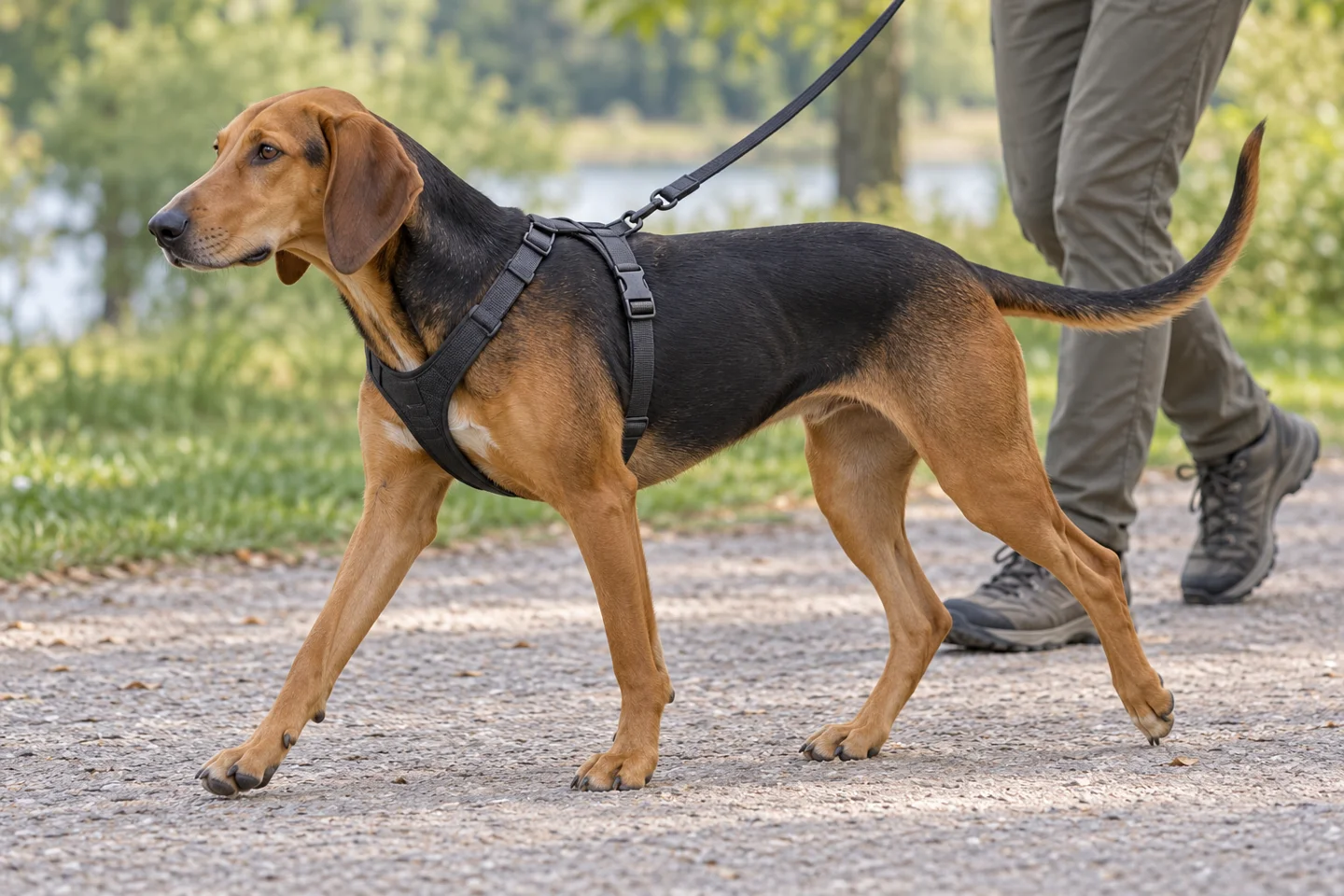
The athletic outline should retain suitable muscle and condition. A dog that remains keen outdoors can still gain weight or develop discomfort that becomes clearer after the outing. Record changes and ask the veterinary team to demonstrate checking ribs and waist. Check that the walking harness allows an unrestricted stride and cannot slip over the head if the hound reverses away from something. Measure the adult's vehicle space and teach calm loading while it is well. A stable ramp or entry routine is easier to learn before an injury makes an awkward jump painful or a heavy lift necessary. Practice with rewards on a stable surface and keep the first attempts brief. Confirm that every carer can follow the same loading arrangement, attach the lead safely before doors open, and secure the dog before turning attention to bags or another passenger. Small procedural details matter during an unfamiliar arrival.
The black mantle and what a puppy image cannot prove
The tan-and-black pattern is a defined part of the Schiller's identity. A clear mantle differs from the extensive white markings of a tricolor hound. Puppy pattern and proportions develop with maturity, so ask a breeder to explain the particular dog's development rather than treating one early photograph as an exact adult forecast. Unusual markings should not be the main evidence used to choose a litter.
Look at the whole animal, including natural ears, moderate head, movement, and ordinary handling. A picture cannot show the contents of a health report or how a dog recovers after excitement. Ask for documents tied to the correct parents and inspect the actual dog gently. Avoid a seller who uses a rare-color claim to deflect questions about identity, temperament, or medical history. For an adopted dog, resemblance to the pattern can suggest a background, but care should be based on what is known and observed rather than a label made certain by a black saddle alone.
Training that makes the handler relevant to scent
Reward turning toward a name and moving with the handler in quiet conditions before practicing beside a very interesting verge. Permission to inspect a safe smell can reinforce comfortable walking. This gives cooperation a practical purpose for the hound rather than making the lead a repeated argument about leaving the environment. Add distractions gradually and make the next exercise easier if the dog cannot respond.
Practice recall with appropriate physical safety, keeping a line clear of people, other animals, and obstacles. Let coming back lead to more safe investigation sometimes, so the cue does not always end the enjoyable part. Teach an exchange for found objects and a pause at doors. Avoid jerking the collar, shouting repeated cues, or opening the mouth by force. A qualified reward-based instructor can help with pulling or intense fixation before a growing dog becomes difficult to handle. The question is what response has been taught in that setting, not whether a hound ought to obey from a breed reputation.
Exercise that includes terrain and recovery
Offer regular walks, scent searches, and appropriate controlled activity, adjusting the plan to age, health, and fitness. Introduce longer routes and difficult terrain gradually. Puppies need manageable movement and rest rather than an adult endurance schedule. An older dog may still enjoy solving a short trail even when previous distance is no longer comfortable. Observe recovery after an outing as carefully as enthusiasm during it.
Carry water, choose cooler periods in warmth, and avoid assuming Swedish working ancestry protects against heat illness. In cold or wet weather, assess the actual conditions and provide shelter and suitable recovery. Check feet after rough ground and notice stiffness, limping, or reluctance the following morning. If those changes persist, arrange assessment rather than forcing more exercise to build toughness. Inspect enclosed areas for gaps and weak gates before free movement. A scent beyond the boundary may become important quickly, so safe exercise requires physical preparation as well as training.
Voice, rest, and a plan for absences
The Schiller's working voice does not mean the household should accept every prolonged episode of barking without investigating its cause. Notice whether the dog is responding to movement outside, anticipating activity, or struggling with separation. Change a repeatedly triggering window or boundary and reward coming away before excitement becomes sustained. Teach an alternative resting location rather than shouting over the response after it has already escalated.
Introduce time apart in small comfortable stages and observe what happens. Record pacing, vocalizing, eating, and sleep instead of deciding from damage alone that the dog is spiteful or merely bored. Persistent distress deserves veterinary and qualified behavior advice. Another dog is not an automatic solution and brings its own compatibility questions. Give the hound a predictable pattern of activity and rest, and introduce a trusted carer before an urgent absence requires a sudden handover. A workable routine should continue when the usual person is briefly unavailable.
Socialization through manageable experiences
A puppy needs exposure to ordinary people, dogs, equipment, sounds, and surfaces without being overwhelmed. Let it watch from a comfortable distance and pair novelty with rewards. Visitors can wait without leaning over the head or lifting ears. Contact is optional, and a short observation followed by comfortable recovery can be useful learning even when nobody strokes the dog.
Practice passing dogs without greeting as well as meeting suitable partners. If the puppy stiffens, repeatedly retreats, or cannot respond to an easy familiar cue, lower the difficulty. Continue learning through adolescence and after major changes in the home. For an adult rescue, use its present comfort rather than assuming maturity supplies experience with lifts, grooming, or city traffic. A working description cannot identify every situation the animal understands. Review the evening afterward too: disrupted sleep or prolonged vigilance can show that the next outing needs fewer demands.
Children and a hound that needs protected quiet
A family walk creates several jobs at once: an adult controls the Schiller's lead, another person watches young children, and everyone needs room near road crossings. Do not hand the lead to a small child because the dog happens to be walking quietly at the start. A fresh scent can change the physical demands abruptly. Children can choose the next safe search location while an adult retains control of the hound and checks the ground first.
Inside, arrange a bed beyond the route children use between rooms. A dog should be able to sleep without someone stepping over its legs or touching its hanging ears. During birthday visits, put the hound in a comfortable separate area before the first arrivals rather than waiting for excitement to become difficult. Explain that its food, stolen objects, and chews are adult responsibilities. If a child approaches and the dog freezes or turns its head away, interrupt the approach promptly. The family's familiarity cannot establish that a visiting child understands these boundaries.
Aggression and the practical facts around a response
Consider a Schiller that growls when someone reaches under its belly after a long outing. The immediate task is to stop the reach and arrange safe examination, including possible discomfort. Calling this stubbornness misses information about the actual trigger. Another incident at the gate may involve anticipation or frustration around an arriving dog. Write down what happened before the warning, how close everyone stood, and whether the hound had a clear route away.
Until the situation is understood, change the arrangement that allowed it. Secure the dog before admitting visitors, give chews in a protected place, and avoid hands near a contested item. Teach exchanges in easy situations with suitable professional guidance. Punishing a growl can leave the underlying concern unresolved while removing a useful warning. A veterinarian should investigate new touch sensitivity or other abrupt changes. After a bite, the injured person needs appropriate medical care, and future access requires a specific prevention plan. Muzzle conditioning may form part of that plan; wearing equipment does not make an uncomfortable encounter acceptable.
Dogs, cats, and the limits of a hunting label
The Schiller standard's single-hound working description is a useful reason to question an invitation to a crowded hound gathering. Ask what this particular dog has enjoyed before. An initial walk with one compatible dog allows the handlers to observe pace, interest, and recovery without several animals competing for space. If one repeatedly cuts off the other's path, increase separation and reconsider the arrangement rather than waiting for a confrontation.
For a home with cats, inspect the layout before bringing the dog inside. The cat needs access to food, litter, and rest without crossing the hound's immediate space. Secure doors and barriers must work during ordinary chores as well as a carefully supervised first meeting. Stop pursuit immediately through safe management; repeated rehearsals can make the household harder to manage. A history of living with one cat cannot answer what will happen around an unfamiliar running animal outside. Rabbits and other small pets require protected accommodation, with a dependable plan for cleaning enclosures and moving animals between rooms.
Grooming a short coat and examining outdoor contact points
Brush gently and inspect skin, feet, nails, and areas beneath equipment after exploring. Short hair makes some findings visible but does not rule out parasites, small wounds, or rubbing. Check between toes without digging into tissue. Persistent licking, swelling, or a limp needs advice even if the dog remains motivated to follow scent.
The natural hanging ears should be inspected for odor, discharge, soreness, and repeated head shaking. Ask the veterinary team how to clean the individual ears when cleaning is appropriate, rather than using leftover drops or deep tools. Maintain nails and introduce tooth brushing through brief rewarded handling. A stable nonslip surface can make necessary care easier. If resistance repeatedly concerns one area, investigate pain before increasing restraint. A routine that the dog can cooperate with allows the owner to notice a change earlier, without waiting until a problem becomes severe enough that ordinary touch is difficult.
Health: Swedish information and questions about hips
The Swedish Kennel Club's breed page notes that hip dysplasia occurs in Schillerstövare and links the breed-specific breeding strategy. Ask the source to show actual parental results and explain which current recommendations apply to the proposed litter. A statement that the parents work well cannot replace an identifiable assessment. Do not convert a registry note into an invented worldwide frequency or copy the entire panel used for another Swedish hound.
For an individual dog, record changes in rising, turning, loading into the vehicle, and recovery after activity. A favorable parental assessment cannot exclude every cause of lameness. If movement changes, seek clinical advice rather than assigning hip disease from a video. Maintain suitable body condition and safe footing while investigation proceeds. Keep the dog's own examination and treatment records alongside family information so a new practice can distinguish screening background from a current problem that needs its own explanation.
Seizure history and what to record safely
The Swedish breed strategy discusses epilepsy, making a direct family-history question appropriate. Ask whether relatives have had seizures, what investigation was performed, and how information was shared with owners. Avoid treating an absence of reported cases as a genetic guarantee or assigning a present-day frequency from a limited historical account. A seizure can have several causes and does not establish inherited epilepsy solely because the dog belongs to this breed.
If an episode occurs, keep people and other animals away, remove nearby hazards where safe, and avoid putting hands in the mouth. Time the event and contact the veterinary team for instructions; record video only when doing so does not delay care or create danger. Tell the clinic about recovery, medicines, possible toxins, and whether another episode followed. Ask for an individualized emergency plan after assessment. Do not start another dog's medication or alter a prescribed schedule through advice from a breed group. Accurate observations and clinical investigation guide the next step.
Food, mixes, and an ownership budget that includes cover
A hound doing a quiet household routine may need a different ration from the same animal during a period of sustained field activity. Ask the veterinary team to help assess condition, then review measured meals against actual work and weight change. Include training food in the calculation. Constantly adding extras because the dog looks eager can obscure how much it receives. Persistent changes in thirst, appetite, stool, or weight need investigation rather than an automatic increase in food.
A Schiller mix needs its own assessment. Ask which ancestry is documented and which is an estimate, then discuss adult size, vocal behavior, and pursuit using available family information. Crossing with another breed does not promise reliable recall. For either a mix or a pedigree dog, price the practical arrangements near home: secure transport, boundary repairs, preventive veterinary appointments, training help, and cover when the usual walker is ill. A replacement carer must be able to manage the dog at doors and around scent distractions. Demonstrate the routine together before leaving the person responsible for an unfamiliar hound.
dogsDating introductions on a route with room to leave
A useful Schiller dogsDating profile explains the proposed outing: perhaps a steady woodland-edge walk with one dog, rather than wrestling or a busy group. Mention whether wildlife scent makes the dog difficult to redirect. Share an approximate locality while keeping exact home coordinates and the household address private. Agree on a recognizable public starting point where each handler can park or arrive without forcing the dogs through a narrow entrance together.
Begin with enough space that each hound can notice the other and continue walking. Choose a route with turning options, and agree beforehand how either person will request a pause or end the outing. Food rewards can be delivered separately when appropriate; avoid a shared scattering that draws both noses into one small patch. Watch whether scent exploration remains relaxed or whether either dog repeatedly blocks, stares at, or pursues the other. Walking at a greater distance may be the best result of the first meeting. Afterwards, exchange specific observations about the route and handling before deciding whether the same arrangement is worth repeating.
Sources and editorial notes
Sources checked October 22, 2026. Breed measurements describe reference ranges, not a diagnosis or an individual dog's ideal weight. Images are AI-generated breed illustrations and do not document a particular dog or health condition.
- AVSAB: Humane Dog Training Position Statement
- VCA Animal Hospitals: Food aggression in puppies
- VCA Animal Hospitals: Common emergencies in dogs
- Orthopedic Foundation for Animals: CHIC health screening programs
- VCA Animal Hospitals: Aggression toward unfamiliar dogs, diagnosis
- VCA Animal Hospitals: Grooming and coat care for your dog
- VCA Animal Hospitals: Ear infections in dogs (otitis externa)
- AAHA: Feeding plans for healthy, appropriate weight cats and dogs
- VCA Animal Hospitals: Heat stroke in dogs
- AVSAB: Puppy Socialization Position Statement
- VCA Animal Hospitals: Dog behavior problems, aggression toward children
- FCI Schillerstovare standard 131: Swedish identity, single-hound work, coat and adult heights
- Swedish Kennel Club: Schillerstovare breed information and hip-health note
- Swedish Kennel Club-hosted Schillerstovare breed-specific breeding strategy, including epilepsy discussion
- VCA Animal Hospitals: seizures in dogs, clinical investigation and safe response
Keep getting to know dogs.
Read another guide or return to your dogsDating community.
Explore breed guidesBack to dogsDating