Sealyham Terrier
A substantial small Welsh terrier, with guidance on coat care, practical training and the distinction between lens-luxation DNA results and clinical eye health.
How these guides are researched and reviewed
- Origin
- Great Britain, Wales
- Adult standard height
- Not exceeding 31 cm
- Ideal adult weight reference
- Males approximately 9 kg; females approximately 8.2 kg
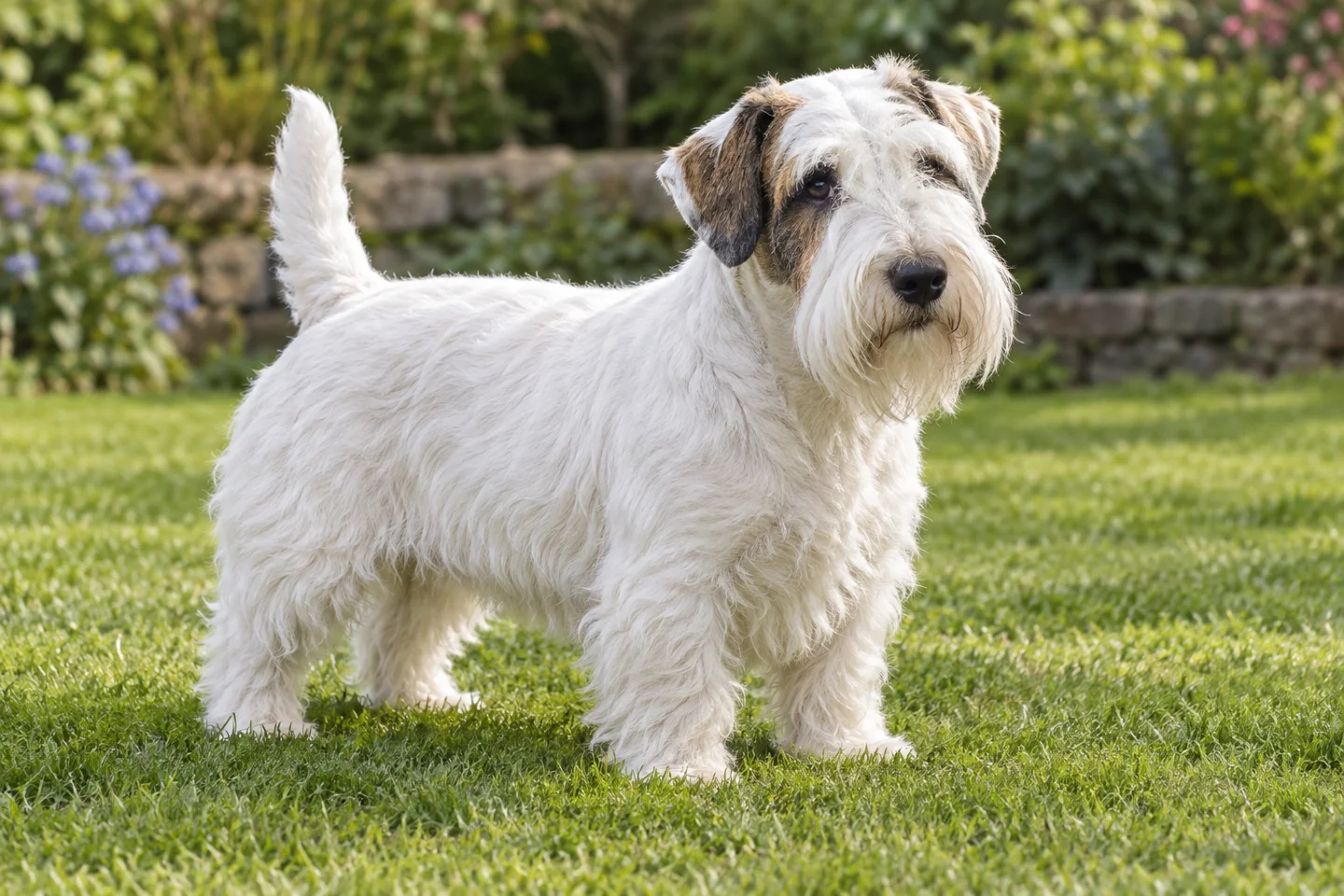
- Illustrated coat
- White with limited badger markings on head and ears
General information for owners. These articles have not been reviewed by a veterinarian. Medical decisions need your dog's history and an examination.
A substantial small Welsh terrier
The Sealyham Terrier is a low-set, strong terrier with an oblong outline, a long powerful head, naturally folded ears, and a harsh white coat. The beard and brows give the face a familiar furnished appearance, but the eyes should remain visible and comfortable. It is a distinct breed from the West Highland White Terrier, whose ear carriage and proportions differ. Ask for the complete identity on records rather than assuming every small white rough-coated dog has the same needs.
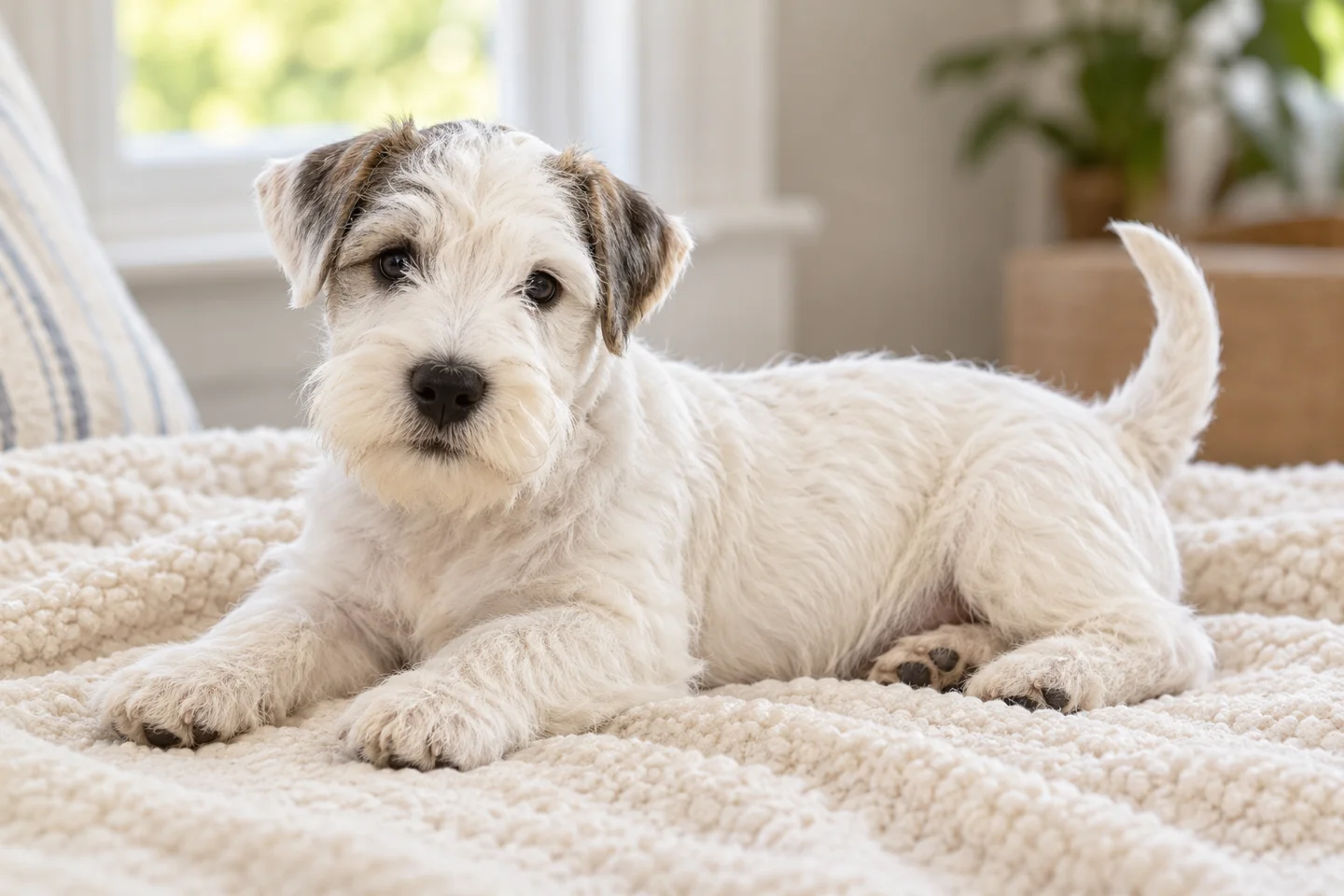
The illustrations select white with limited badger-colored markings around the ears and head, natural ears, and a full tail. They show a chosen example rather than a documentary pedigree. Prospective owners should think about coat maintenance, patient teaching, safe investigation, and a household routine that permits rest. Meet adults in ordinary conditions and ask about handling and recovery after activity. A sturdy little body is not evidence that the dog will tolerate every child, visitor, or grooming task without preparation.
An independent companion still learns from consequences
The FCI describes an active, workmanlike terrier, while its origin belongs to Great Britain and the Welsh terrier tradition. Working identity helps explain interest in investigating close to the ground. It does not require owners to provide access to wildlife or dangerous burrows. A companion can use scent, explore suitable routes, and solve managed searches without confronting another animal.
When someone calls a Sealyham stubborn, ask what happened before the refusal. The dog may be absorbed in a smell, confused by a cue, tired of a long session, or avoiding pain. Those possibilities call for different changes. Teach useful responses with outcomes the animal values and make the setting manageable. Ask breeders how adults cope with interruption, grooming, and ordinary domestic life instead of relying on an affectionate breed description. For a rescue, previous experience with handling and separation may be more immediately useful than a general account of historical work.
Adult height and sex-specific weight references
The October 2026 FCI standard says height should not exceed 31 cm at the shoulder. Its ideal weight references are approximately 9 kg for males and 8.2 kg for females, with overall balance and substance important. These are adult conformation figures, not feeding targets for a growing puppy or a reason to make a dog heavier when its condition is already appropriate.
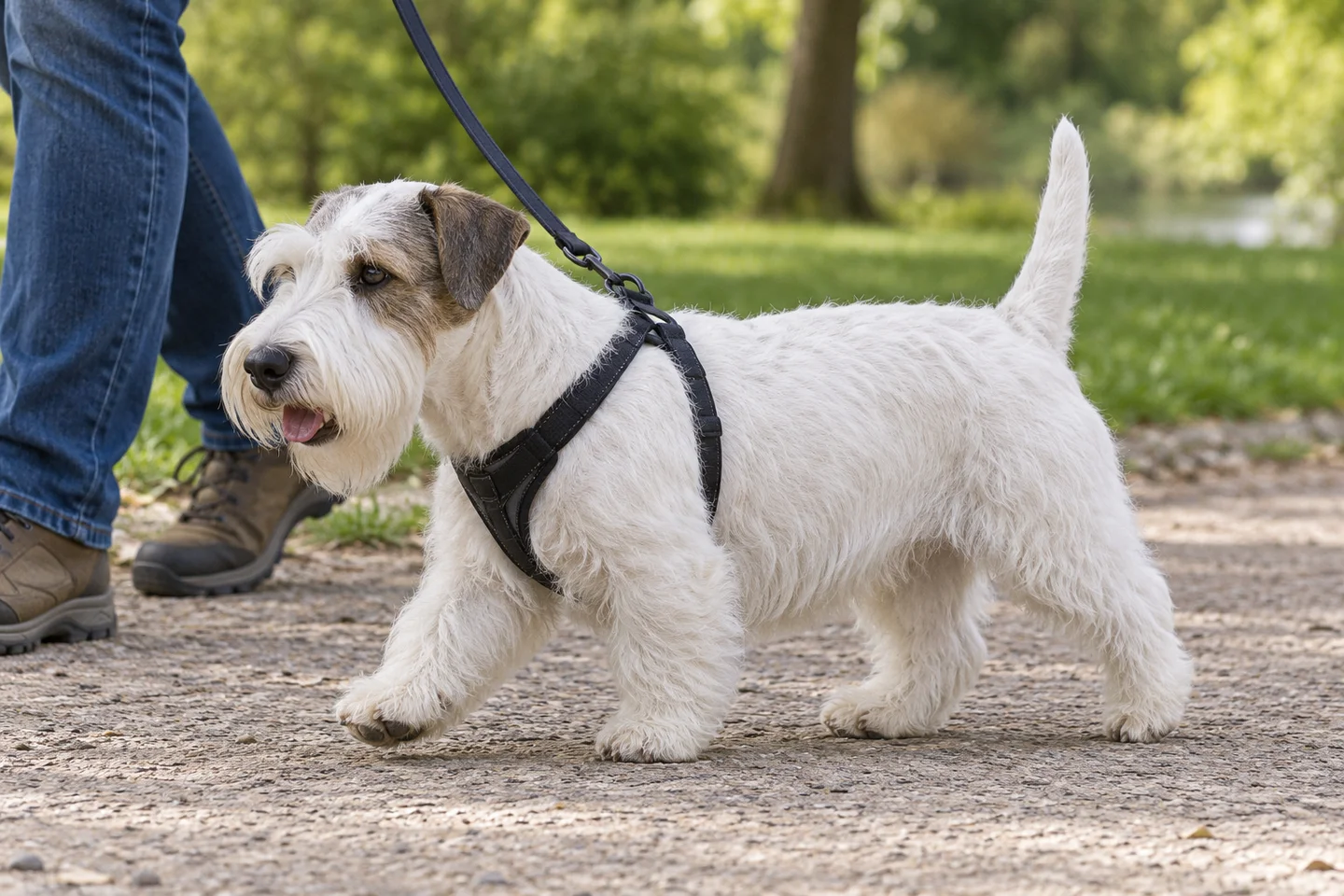
Have the veterinary team assess ribs, waist, and muscle beneath the coat. A broad chest and furnishings can obscure gradual weight gain, so use hands and records rather than photographs alone. Watch comfortable walking and turning on a normal surface. Choose a harness that fits without rubbing behind the elbows and check it during growth. Provide a stable way into a vehicle where repeated awkward jumping is avoidable. Teach a ramp or step while the dog is well, with a nonslip surface and rewards, instead of introducing unfamiliar equipment for the first time during a painful episode.
White coat, natural ears, and an undocked tail
The standard allows an all-white coat or white with specified markings on the head and ears, including lemon, brown, blue, or badger pied. Heavy ticking or black body patches are not the illustrated choice. Markings should not become a substitute for assessing health and behavior. Ask how an advertisement relates to the registry used if a seller emphasizes unusual coloring as the main reason to choose a puppy.
The natural ears fold beside the cheeks. The full tail is a normal option described by the current standard and should not be altered to match an older docked picture. Puppy furnishings take time to develop, and a young animal should not be expected to reproduce a mature groomed beard immediately. An AI image can explain selected morphology but cannot show clinical skin, sound movement, or a test result. Examine the actual dog gently and ask for records rather than interpreting every difference from an illustration as a medical finding.
Training a terrier that needs a useful reason to respond
Teach attention, coming at short range, waiting at openings, and moving onto a mat during household activity. Begin where the dog can succeed and reward promptly. Food, a suitable toy, or access to a safe smell may be useful depending on the individual. Let recall lead back to exploration sometimes, so returning does not always predict that the enjoyable part has ended.
Practice exchanges with ordinary objects before a dangerous find appears. Offer a reward, let the dog move away, and recover the object calmly. Do not open the mouth by force or take possessions repeatedly to prove authority. Avoid scruffing, pinning, and lead jerks; these can create conflict while leaving the requested behavior unclear. A qualified reward-based professional can help when guarding, pulling, or handling resistance already interferes with care. If an exercise fails repeatedly, review difficulty, reward, fatigue, and discomfort instead of assuming a terrier needs stronger punishment to understand.
Exercise without overlooking recovery on short legs
Provide regular walks with sniffing, suitable searches, and controlled play. Adjust distance and terrain to age, health, and fitness. A puppy needs manageable movement and rest, while an older animal may enjoy a shorter search rather than its former route. The goal is comfortable engagement, not proving that a small working terrier can keep up with any schedule.
Inspect enclosed areas for gaps, weak panels, and digging opportunities. Use suitable equipment while recall develops near wildlife or traffic. Carry water in warmth, choose cooler periods, and stop if recovery becomes difficult. A white coat does not eliminate heat risk. Notice gait and willingness to rise after the outing, not only enthusiasm during it. If the dog becomes stiff, limps, or consistently avoids an ordinary movement, revise the plan and arrange assessment when needed. Avoid repeated high-impact games as the sole outlet; investigation and learning can provide useful activity without keeping excitement elevated throughout the day.
Rest and absences are learned parts of the routine
Set up a comfortable resting area away from the busiest doorway. Reward settling while people continue ordinary activity and allow sleep without repeated invitations to play. A dog that is always entertained can struggle when the household becomes quiet. That does not mean it should be ignored for long periods; it means rest and companionship need a pattern the animal can understand.
Introduce separation in brief comfortable stages and observe the response. Keep notes about vocalizing, pacing, eating, and recovery rather than guessing from damage alone. A dog that cannot settle needs a different plan from one that briefly checks the door and returns to bed. Discuss persistent distress with a veterinarian and a qualified professional. Adding another dog should be a separate compatibility decision, not an automatic treatment for absence-related problems. Rehearse care with another trusted adult before an emergency requires a sudden change, so the dog can learn that familiar routines continue when its usual person is unavailable.
Socialization that protects an option to retreat
Let a puppy experience people, dogs, surfaces, equipment, and everyday sounds at a level it can manage. A quiet observation can be useful even without contact. Ask visitors to wait rather than leaning over the beard or lifting the ears. Pair new experiences with rewards and leave while the dog can still recover comfortably. The number of greetings is less informative than the animal's response to them.
Practice passing another dog and returning attention as well as meeting suitable companions. If the puppy becomes rigid, repeatedly retreats, or stops responding to a familiar easy cue, lower the challenge. Continue manageable experiences during adolescence and after changes in the household. Adult rescues deserve the same respect for pace. A sturdy appearance and a friendly breed ideal cannot tell you whether the individual understands a crowded lift, a grooming table, or a child running close by. Learning should increase confidence rather than simply teach the dog that escape from contact is unavailable.
Children and a beard that is not a handle
Adults should supervise actively and separate children from the Sealyham during meals, chews, rest, and excited games. Teach children to invite the dog toward them, touch gently, and pause. Prevent pulling the beard, hugging the neck, climbing over the body, or following it into a protected bed. A low height makes the dog easy to reach, but does not mean it welcomes every hand approaching from above.
Adults manage found objects and exchanges. A child should not remove a bowl or reach into the mouth to test trust. Safer tasks include helping with a supervised search or rewarding a known cue. Watch for stillness, turning away, repeated avoidance, or a tightening body and end contact before warnings escalate. Comfort with one familiar child does not predict the response to a noisy group of visitors. Explain the rules to guests and use a gate when adult attention must move elsewhere. Reliable separation is useful care when close observation cannot continue.
Aggression and a careful look at the whole interaction
If a Sealyham growls, snaps, or bites, record what happened beforehand. Approach, touch, resource, location, and an escape route can all matter. A dog reacting when its painful eye or ear is handled needs a different immediate response from one guarding a chew. Do not reduce the event to a stereotype about terriers or decide that small size makes the warning unimportant.
Move people and animals away and prevent a repeat while arranging help. Sudden changes warrant veterinary assessment, and recurring defensive behavior needs qualified reward-based support. Avoid punishing warnings or recreating the trigger to prove whether the response was serious. Use barriers, separate resources, and comfortable walking distance. A suitable basket muzzle can add protection when introduced gradually, but cannot make an overwhelming encounter appropriate. After a bite, obtain suitable medical advice and establish reliable prevention before another meeting. Read the whole body beneath the furnishings rather than waiting for a facial expression that may be hard to see.
Dogs and other species need individual introductions
Meet another dog with separate handlers and enough room for parallel movement. Let both animals pause and approach voluntarily. A Sealyham that enjoys a familiar companion can still dislike a stranger crowding its bed or an interesting scent. Stop repeated pursuit when one dog tries to leave, and avoid letting excitement continue until nobody can interrupt it comfortably.
Before sharing a home, map where each animal can sleep and eat without being intercepted. A cat needs access to litter, water, and rest through routes the terrier cannot control. Secure barriers must remain effective when someone cleans, carries shopping, or opens an outside door. Do not allow a pursuit rehearsal to find out whether the cat can cope. Rabbits and other small pets need protected accommodation and a separate plan whenever it is opened. Ask what the Sealyham has done around animals previously, then assess the present setting too. If daily routines would repeatedly defeat necessary separation, reconsider the proposed placement while another arrangement is still possible.
Grooming with attention to skin and comfortable handling
The Sealyham has a hard wiry outer coat over a weather-resistant undercoat. Work through furnishings gently, especially behind the ears, around the legs, and under equipment. Keep the eyes visible and prevent knots from pulling the skin. Ask an experienced groomer about appropriate maintenance for the individual coat rather than copying a photograph or assuming all white terriers need the same clipping routine.
Clean damp or food-soiled beard hair as needed and dry appropriately after bathing. Inspect ears for soreness, odor, discharge, and repeated head shaking, using veterinary advice rather than leftover drops. Maintain nails and introduce tooth brushing in short rewarded steps. A stable nonslip surface can make the session easier than holding a struggling dog. If resistance suddenly concerns one area, investigate pain before increasing restraint. The purpose of grooming is comfort and useful inspection, not completing an elaborate trim while the animal becomes increasingly frightened or exhausted.
Health: lens luxation needs the correct genetic interpretation
The AKC's current Sealyham recommendations identify ophthalmologist evaluation and primary lens luxation DNA testing. UC Davis describes a relevant inherited variant and explains that carriers can have a slight clinical risk. Carrier should therefore not be translated casually into a guarantee of normal eyes or treated as identical to an affected result. Request the named report and ask the laboratory or veterinarian to explain what it establishes.
The genetic test concerns a particular inherited cause of lens luxation, while a clinical examination assesses the eyes themselves. These are complementary questions. A favorable report does not exclude every future reason for eye pain or impaired sight. Keep the dog's results accessible and ask how parental reports informed a mating. Avoid turning a commercial panel's large test count into an assurance of complete health. For a rescue with uncertain background, individual examination and available history guide the initial plan rather than a guessed genetic category.
Eye changes and what the clinic needs to know
Lens luxation can become painful and threaten vision, so an abnormal-looking or painful eye deserves prompt veterinary attention. Do not wait for the next routine visit because the parents were tested or the dog still wants to walk. Tell the clinic when signs began, whether one or both eyes appear different, and whether any medication has already been applied. Do not use leftover eye drops without advice; a product chosen for an earlier condition may be unsuitable now.
A photograph can support a description but cannot replace examination or determine the position of the lens reliably at home. Keep the dog from rubbing the area as advised and follow the clinic's instructions about travel and assessment. If vision changes are confirmed, ask about safe routes, stairs, and follow-up. An eye condition may also alter tolerance of handling or unexpected approaches. Tell carers about those changes so they can avoid startling the animal and maintain the same clinical and household plan.
Meals, dental care, and a local budget
Use balanced food appropriate to life stage and measure portions against condition and activity. Count rewards and chews within the day's intake. A furnished low-set body can conceal gradual weight change, so ask the veterinary team to demonstrate assessment. Discuss persistent appetite, digestion, drinking, or weight changes rather than repeatedly adding richer food. A homemade diet needs suitable formulation, and supplements should have a clear purpose.
Budget locally for preventive care, grooming, dental assessment, training, transport, and emergency treatment or insurance. Keep medicines, rubbish, and dangerous products secured and contact a veterinarian after suspected toxic ingestion. Store the emergency route and records where another adult can find them. Arrange a carer able to maintain handling and coat routines, introducing that person before an absence. The practical cost of care includes competent cover and equipment that fits, rather than only food and a purchase price. A stable plan helps when weather, work, or illness disrupts the normal schedule.
Mixes and choosing the dog for the home available
A Sealyham mix can vary in adult proportions, coat, pursuit, and sociability from either parent. A crossbreed name cannot promise a low-maintenance version or eliminate inherited eye risk. For a planned litter, discuss relevant assessment in both backgrounds. For an adopted dog, observed behavior and clinical findings are the practical starting points, with uncertainty about ancestry stated honestly rather than settled from a beard or white coat.
Consider visitors, small pets, absences, and access to grooming support. Someone who enjoys patient teaching and can maintain secure boundaries may offer a workable home. A household expecting instant affection for all strangers or automatic recall near wildlife should reconsider those requirements. Meet the animal in more than one manageable setting where possible and observe recovery afterward. Ask about difficult moments as well as appealing ones. Matching the actual dog's needs to daily life is more useful than acquiring a rare breed name and hoping ordinary care demands will remain small.
dogsDating meetings with space to disengage
A Sealyham dogsDating profile can describe a concrete proposal: one quiet companion, a steady route, and time to sniff without compulsory greetings. Explain any known difficulty with crowded approaches. Keep exact home coordinates private and withhold the household address. Choose a public starting landmark within an approximate locality. Check that both handlers can organize equipment without bringing the dogs together through a bottleneck, and agree on a route with turning options before meeting.
Start far enough apart that each dog can notice the other and continue ordinary walking. If either remains fixed on the companion or repeatedly seeks escape, change the gap or finish rather than waiting for a more obvious warning. Contact may remain unnecessary throughout the first outing. Avoid shared treats on the ground or toys that draw both animals into one small area. Afterwards, compare specific moments: whether the dogs disengaged, which pace suited them, and what made the walk harder. Another meeting should follow that information and both handlers' willingness. A successful first arrangement can remain a calm walk at a distance instead of progressing to play.
Sources and editorial notes
Sources checked October 22, 2026. Breed measurements describe reference ranges, not a diagnosis or an individual dog's ideal weight. Images are AI-generated breed illustrations and do not document a particular dog or health condition.
- AVSAB: Humane Dog Training Position Statement
- VCA Animal Hospitals: Food aggression in puppies
- VCA Animal Hospitals: Common emergencies in dogs
- Orthopedic Foundation for Animals: CHIC health screening programs
- VCA Animal Hospitals: Aggression toward unfamiliar dogs, diagnosis
- VCA Animal Hospitals: Grooming and coat care for your dog
- VCA Animal Hospitals: Ear infections in dogs (otitis externa)
- AAHA: Feeding plans for healthy, appropriate weight cats and dogs
- VCA Animal Hospitals: Heat stroke in dogs
- AVSAB: Puppy Socialization Position Statement
- VCA Animal Hospitals: Dog behavior problems, aggression toward children
- FCI Sealyham Terrier standard 74, October 2026: structure, coat, natural tail and adult size
- American Kennel Club: Sealyham ophthalmologist examination and primary lens luxation recommendations
- UC Davis Veterinary Genetics Laboratory: primary lens luxation, Sealyham testing and slight carrier risk
Keep getting to know dogs.
Read another guide or return to your dogsDating community.
Explore breed guidesBack to dogsDating