Segugio Italiano
Italian scenthounds with separate smooth and rough FCI standards; this guide illustrates the smooth form and explains practical care and evidence limits.
How these guides are researched and reviewed

- Origin
- Italy
- Illustrated standard
- Short-haired Segugio, FCI 337
- Smooth adult height
- Males 52–58 cm; females 48–56 cm
- Smooth adult weight
- 18–28 kg
- Other coat standard
- Rough-haired Segugio, FCI 198
General information for owners. These articles have not been reviewed by a veterinarian. Medical decisions need your dog's history and an examination.
Two Italian standards behind one familiar name
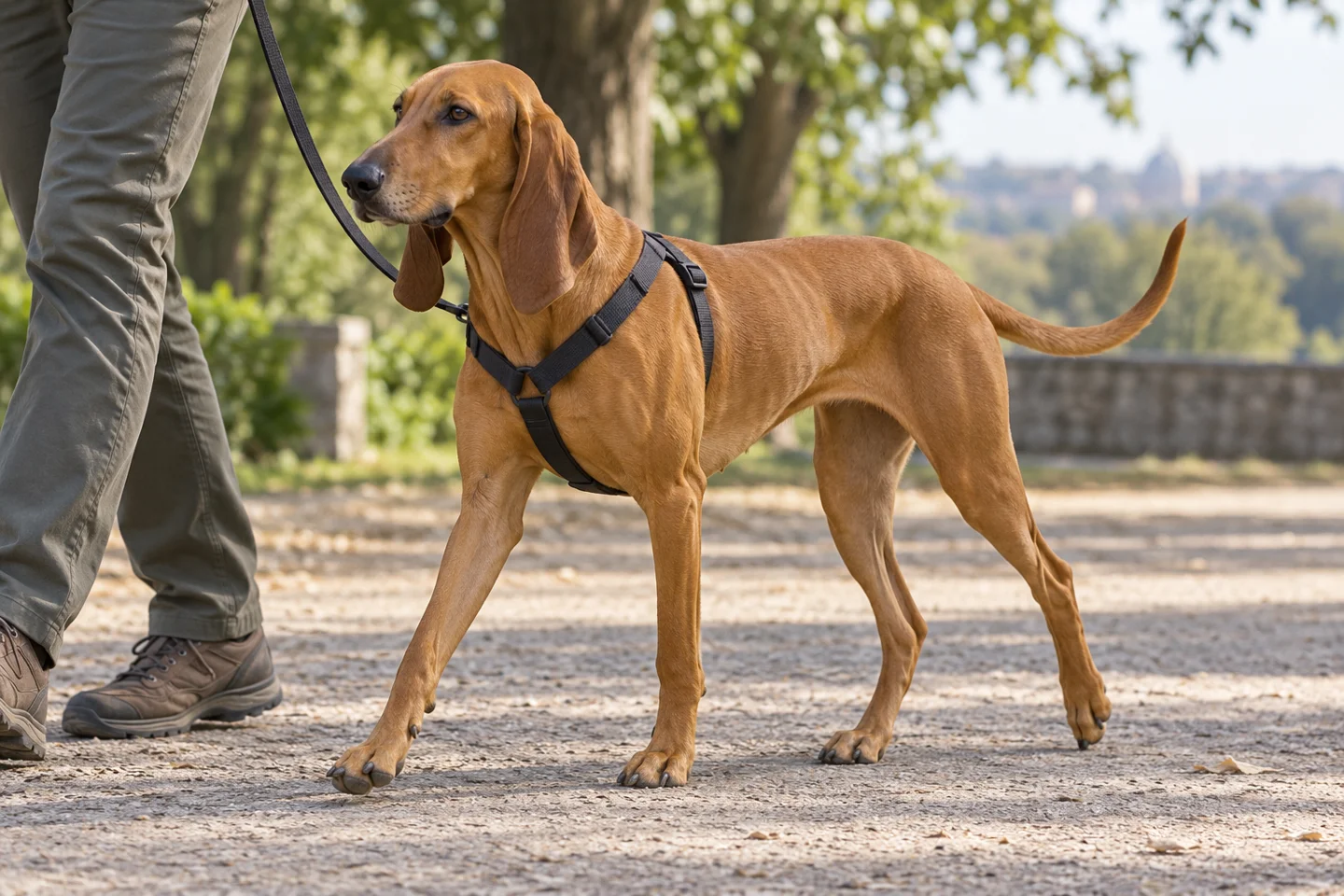
Segugio Italiano can refer to closely related Italian scenthounds with smooth or rough coats, but the FCI publishes separate standards: number 337 for the short-haired dog and number 198 for the rough-haired dog. Do not merge every measurement or coat instruction into one universal description. The illustrations in this guide select the smooth, fawn-coated dog, with natural long pendant ears and a full tail.
Ask which coat and registration a breeder means before comparing documents. A rough face does not establish a crossbreed, and a smooth dog should not be judged against a rough-coated illustration. For ownership, the practical questions extend beyond hair: scent interest, voice, secure access, handling, and recovery after activity all need discussion. Meet adults where possible and ask how they live when no work is available. A recognizable hound outline cannot tell you whether the particular animal is comfortable with a busy hallway, a cat running past, or an unfamiliar examination.
Italian hunting identity and the history you can verify
Both FCI standards describe an Italian hunting background, including use for hare and wild boar. Their historical accounts connect the dogs to older Mediterranean hound types. Those accounts provide context for the breed's development without establishing a modern puppy's personal pedigree through every claimed ancient ancestor. Ask for the actual parent identities and registry records rather than treating an origin story as equivalent evidence.
A companion can use scent through supervised searches, suitable trails, and walks that offer time to investigate safely. It does not need uncontrolled pursuit or access to dangerous holes to satisfy a historical description. Ask what the parents do between tasks and how puppies are prepared for quiet domestic life. A working record can be useful while leaving questions about travel, rest, visitors, and time apart unanswered. For a rescue, gather the available individual history and begin with what the dog currently manages comfortably rather than assuming that its adult age supplies every household skill.
Adult measurements for the illustrated smooth dog
For the smooth-haired Segugio, FCI standard 337 gives males 52–58 cm at the withers and females 48–56 cm. It gives an adult weight range of 18–28 kg and a height tolerance of 2 cm either way only for excellent subjects. Those figures should be identified as belonging to the smooth standard rather than silently applied to the rough dog. Check the other standard when assessing that form. Keep the original document with its date when discussing an event entry or breeding record. A translated summary may omit an important qualification, so ask the registry to resolve uncertainty instead of combining figures from different sources.
These are conformation references, not a feeding prescription. A veterinarian should assess ribs, waist, muscle, and growth on the individual frame. Avoid selecting extreme size or feeding a puppy toward an upper adult number. Choose a harness that fits the chest without rubbing and remains secure if the dog backs away. Recheck during development. Measure vehicle space for comfortable positioning and teach calm loading while the animal is well. Planning a stable entry routine is easier than discovering during an injury that an adult cannot manage the usual jump.
Appearance and the differences that need accurate labels
The smooth form has short close hair, while the rough form carries a harsher coat that changes the face and outline. Fawn and black-and-tan patterns occur in the standards, with their own detail about markings. The selected fawn illustration is an example, not the only possible appearance. Color should not outweigh questions about identity, movement, medical history, and observed behavior.
The long ears are naturally pendant, and the full tail should remain normal anatomy. Puppy proportions and coat develop with maturity, so ask about the particular dog's development instead of expecting an exact copy of a fully grown show image. A picture cannot show clinical ear findings, genetic results, or comfortable recovery after an outing. Examine the actual dog gently and request identifiable reports. If a seller uses an unusual color or coat claim to avoid explaining registration and parentage, the attractive description is not supplying the evidence needed for a careful decision.
Training through the rewards of investigation
Teach attention, returning at short range, waiting at openings, and moving onto a mat during ordinary activity. Begin where the dog can respond and reward promptly. Access to a safe smell can reinforce comfortable walking alongside food or another suitable reward. This makes the handler relevant to the outing rather than a repeated source of interruption whenever the environment becomes interesting.
Practice recall with suitable physical safety, keeping a line clear of people, animals, and obstacles. Let returning lead back to exploration sometimes, so the cue does not always end the enjoyable part. Teach an exchange for found objects before a dangerous item appears. Avoid opening the mouth by force, jerking the collar, or shouting repeated cues when the dog is already absorbed. A qualified reward-based professional can help choose distances and rewards. If a response fails, review understanding, distraction, fatigue, and discomfort instead of treating a hound's interest in scent as evidence that harsher handling is necessary.
Exercise with variety and an honest recovery check
Provide regular walks, managed searches, and suitable controlled activity, adjusted to age, fitness, health, and terrain. A growing dog needs rest between manageable outings rather than a schedule copied from an adult hunter. Introduce longer routes gradually and notice recovery later in the day. An older hound may still enjoy solving a short trail even when its former mileage is no longer appropriate.
Carry water and choose cooler periods in warmth. A short coat does not prevent heat illness, and enthusiasm can continue after an activity has become physically demanding. Check feet after rough surfaces and observe stiffness, limping, or reluctance the following morning. Revise the plan and obtain advice when changes persist. Inspect fences, latches, and possible digging routes before free movement. Scent outside a boundary can become important suddenly, so safe exercise includes physical preparation as well as recall training. Avoid using wildlife pursuit or confrontation as an entertainment plan.

Voice and rest in a household setting
A scenthound's voice can be useful during work while causing practical problems in a shared building. Notice the trigger and recovery instead of assuming barking is either inevitable or deliberately annoying. Move a resting area away from a repeatedly triggering window and reward coming away before excitement becomes sustained. Teach a calm alternative in easy conditions rather than beginning only when a delivery is already at the door.
Introduce absences gradually and observe the response. Record pacing, vocalizing, eating, and sleep, since a damaged object alone does not explain distress. Persistent inability to settle deserves veterinary and qualified behavior advice. Another dog should be a separate compatibility decision, not an automatic remedy. Provide a predictable pattern of activity, companionship, and rest, and introduce another trusted carer before an emergency requires a sudden change. A useful ownership plan should work during ordinary working days and poor weather, not only when someone has unlimited time for a long outdoor outing.
Socialization with room to observe first
Expose a puppy to people, dogs, surfaces, equipment, and ordinary sounds in manageable conditions. Let it look from a comfortable distance, pair novelty with rewards, and keep a way to leave. A visitor can wait without reaching for the long ears or leaning over the head. Contact is optional, and a quiet observation can teach something useful without becoming a prolonged greeting.
A useful lesson may involve standing well away from traffic and rewarding the dog for looking back toward its handler. Another day might involve walking past a quiet dog without greeting. These are different skills from tolerating touch in a veterinary room. If the puppy repeatedly withdraws or cannot recover, simplify the next experience and ask for guidance on progression. Adults moving from a field setting into a home need the same assessment of what is familiar. Practice lifts, travel, and handling individually rather than assuming working experience supplies them. Review the evening afterward too. Restless vigilance or disrupted sleep can show that the demands exceeded what the animal could comfortably manage.
Children and the dog's protected areas
Adults should supervise actively and separate the Segugio during meals, chews, sleep, and rough games. Teach children to invite the dog closer, touch briefly, and pause so it can leave. Prevent neck hugging, ear pulling, climbing, and following the animal into a bed. A gentle-looking face does not remove the need for choice or make every interaction comfortable.
Adults manage found objects and exchanges. A child should not remove food or reach into the mouth to demonstrate trust. Safer participation includes helping with a supervised search or rewarding a familiar cue. Watch stillness, turning away, and repeated avoidance before a warning escalates. A dog comfortable with one household child has not demonstrated safety around every visiting group. Explain the routine to guests and use a gate when the supervising adult must focus elsewhere. Separation is a practical arrangement when cooking, another child's needs, or a call prevents close observation.
Aggression and the information before the warning
Describe a threat, snap, or bite through the actual sequence. Approach, touch, resource, location, and an escape route can all matter. A hound reacting when an inflamed ear is handled needs a different immediate plan from one defending a chew. Record the circumstances and prevent another exposure instead of choosing a broad label such as dominant or protective.
Arrange veterinary assessment for a sudden change, and seek qualified reward-based support for recurring defensive behavior. Avoid punishing warnings or recreating an incident to test whether the response was serious. Move people away, use barriers, separate resources, and choose comfortable walking distances while learning develops. If a basket muzzle adds protection, introduce it gradually and check its fit. It cannot make an overwhelming encounter appropriate or replace supervision. After a bite, obtain suitable medical advice and make reliable prevention the priority before attempting another introduction. A conformation standard's temperament ideal does not settle the risk in an individual event.
Dogs, cats, and the difference between company and safety
Begin dog meetings with separate handlers and parallel movement in a spacious place. Let both animals pause and approach voluntarily. Stop repeated pursuit when one dog tries to leave and keep early meetings short enough to assess recovery. A hound that enjoys known companions can still object to an unfamiliar dog crowding its bed, food, or an interesting smell.
At home, feed separately and provide resting choices that cannot all be controlled by one animal. Introduce cats through barriers and maintain protected routes that avoid passing close to the dog. Prevent chasing rather than allowing it once as a test. Smaller pets need reliable physical separation, including during feeding and cleaning. Ask about the individual's history while recognizing that a new setting can create new responses. If necessary separation cannot be maintained, discuss suitability before adoption instead of assuming a social reputation or affection toward people guarantees comfort with every species.
Grooming according to the actual coat
For the illustrated smooth dog, gentle brushing and inspection of skin, feet, and equipment contact points are central tasks. For a rough-coated dog, ask an experienced groomer about suitable tools and maintenance rather than applying the smooth routine without adjustment. Inspect beneath furnishings and watch for knots, plant material, or irritation. Neither coat removes the need to check what is happening at skin level.
The long ears need comfortable inspection for odor, discharge, soreness, or repeated head shaking. Ask the veterinary team about cleaning when appropriate and avoid deep tools or leftover medication. Maintain nails and introduce tooth brushing through brief rewarded handling. A nonslip surface helps the dog stand securely. If resistance repeatedly concerns one area, investigate discomfort before increasing restraint. A predictable routine makes it easier to find changes early and preserves cooperation for necessary examinations, rather than turning every grooming session into a long struggle to complete a fixed schedule.
Health: ask what was actually assessed
A complete verified universal testing protocol covering both Segugio standards was not established for this guide. Ask the breeder which current assessments apply to the form being bred and request reports linked to the parents. Do not borrow a mandatory disease list from another Italian hound to fill a gap. A commercial DNA panel needs interpretation for the relevant variants, and an attractive working record cannot substitute for clinical history.
For an adult adoption, ask about earlier wounds, lameness, ear treatment, medicines, and any remaining activity restrictions. Keep those records for the receiving veterinarian. The long ear shape makes a practical inspection routine sensible without establishing a breed-specific infection rate. Repeated discomfort or discharge needs examination rather than a guessed treatment. Ask what was found and whether a recheck is needed. Family information supports the background discussion, while the individual's current findings guide care. Missing documents should remain acknowledged uncertainty, not become either an invented diagnosis or a promise of robust health.
Field-to-home changes that deserve a clinical record
Record changes in rising, turning, walking, appetite, and recovery instead of deciding a hound is simply less enthusiastic. A dog may still follow a scent while experiencing pain elsewhere. A safely recorded video can help describe an intermittent movement, but should not require repeatedly provoking discomfort. Tell the clinician about terrain, duration, weather, and possible injuries or ingestion when an outdoor problem occurs.
Know the emergency route before leaving and consider how an adult could be moved if it could not walk. Collapse, severe breathing difficulty, significant bleeding, or rapidly worsening distress requires urgent advice. Avoid human medicines or a guessed home remedy while waiting for instructions. If the problem is not urgent but persists, arrange examination and bring treatment history rather than relying on a secondhand description that the dog once had something similar. A hunting background should encourage practical preparation, not delay care through an assumption that a working animal will recover without assistance.
Food, mixes, and a budget that reflects daily life
Record meals, rewards, chews, and extras before deciding that the hound needs more food. Match a complete diet to its life stage and ask the veterinary team to demonstrate body-condition assessment. The ration may need review when working activity, weather, or health changes. Eagerness at the bowl is not a measurement of energy need. Unexplained changes in thirst, weight, appetite, or digestion should prompt a clinical conversation rather than repeated experiments with richer food. A homemade diet requires appropriate formulation. Supplements need an identified purpose and review, particularly when several products duplicate ingredients. Keep the feeding instructions understandable enough that another carer can follow them accurately.
For a Segugio cross, establish which backgrounds are documented and which are guesses. Coat texture, proportions, vocal behavior, and pursuit may differ from expectations. A named mix cannot certify easier recall or remove the need for relevant parental assessment in a planned litter. In rescue, examine the actual animal's history and present findings. Obtain local costs for secure boundaries, veterinary appointments, suitable equipment, transport, and training assistance. Ask potential carers about their experience with a scent-interested dog and practice a handover. Suitability includes whether someone can maintain the routine during an inconvenient week. Expectations of automatic silence or untrained freedom outdoors deserve discussion before placement.
dogsDating introductions using a spacious public route
Use dogsDating to explain how this Segugio prefers to walk, including the spacing that helps around unfamiliar dogs or wildlife scent. Keep exact home coordinates private, along with the household address. Identify a public starting landmark using an approximate locality. Check for enough room to prepare separately, and avoid a first arrival that funnels the dogs nose to nose between parked cars. Agree on a turning point and an easy way to finish before starting. The home entrance is a poor place to discover whether an unfamiliar companion suits the dog.
Begin with separate handlers walking in the same direction at a comfortable separation. Keep shared food and toys out of the encounter and let contact remain optional. Watch stiffness, repeated avoidance, fixation, and recovery after excitement. Change distance or leave when needed. A calm short walk offers useful information without requiring play. Discuss both dogs' responses afterward before arranging another meeting, allowing either person to decline without pressure to prove that all scenthounds should enjoy the same social situation.
Sources and editorial notes
Sources checked October 22, 2026. Breed measurements describe reference ranges, not a diagnosis or an individual dog's ideal weight. Images are AI-generated breed illustrations and do not document a particular dog or health condition.
- AVSAB: Humane Dog Training Position Statement
- VCA Animal Hospitals: Food aggression in puppies
- VCA Animal Hospitals: Common emergencies in dogs
- Orthopedic Foundation for Animals: CHIC health screening programs
- VCA Animal Hospitals: Aggression toward unfamiliar dogs, diagnosis
- VCA Animal Hospitals: Grooming and coat care for your dog
- VCA Animal Hospitals: Ear infections in dogs (otitis externa)
- AAHA: Feeding plans for healthy, appropriate weight cats and dogs
- VCA Animal Hospitals: Heat stroke in dogs
- AVSAB: Puppy Socialization Position Statement
- VCA Animal Hospitals: Dog behavior problems, aggression toward children
- FCI standard 337: Italian Short-Haired Segugio, identity, coat and adult measurements
- FCI standard 198: Italian Rough-Haired Segugio, separate coat-specific standard
Keep getting to know dogs.
Read another guide or return to your dogsDating community.
Explore breed guidesBack to dogsDating