Silky Terrier
An Australian blue-and-tan terrier with a developing silky coat, practical handling and grooming needs, and careful knee, hip and respiratory health questions.
How these guides are researched and reviewed
- Origin
- Australia
- Adult male height
- 23–26 cm
- Female height wording
- Slightly less than males in FCI standard
- Adult coat
- Blue and tan; darker puppy coloring can occur
General information for owners. These articles have not been reviewed by a veterinarian. Medical decisions need your dog's history and an examination.
A small Australian terrier, distinct from a Yorkshire Terrier
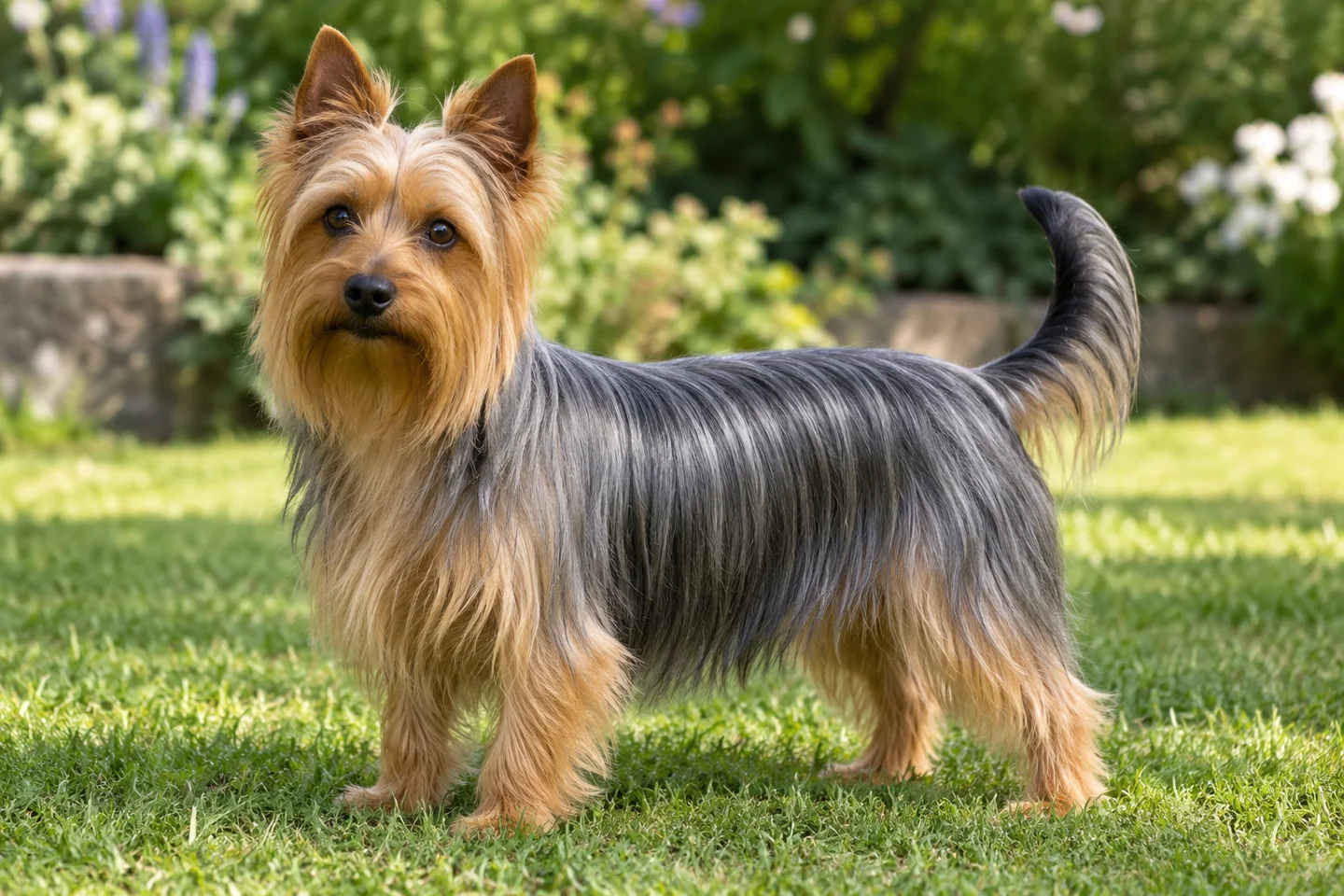
The Silky Terrier is an Australian breed with a straight silky coat, natural erect ears, and a terrier's active interests. The FCI name is Australian Silky Terrier. It is distinct from the Yorkshire Terrier and the Australian Terrier, even though both appear in its development. A seller should identify the breed clearly rather than use the names as interchangeable descriptions of a small blue-and-tan puppy.
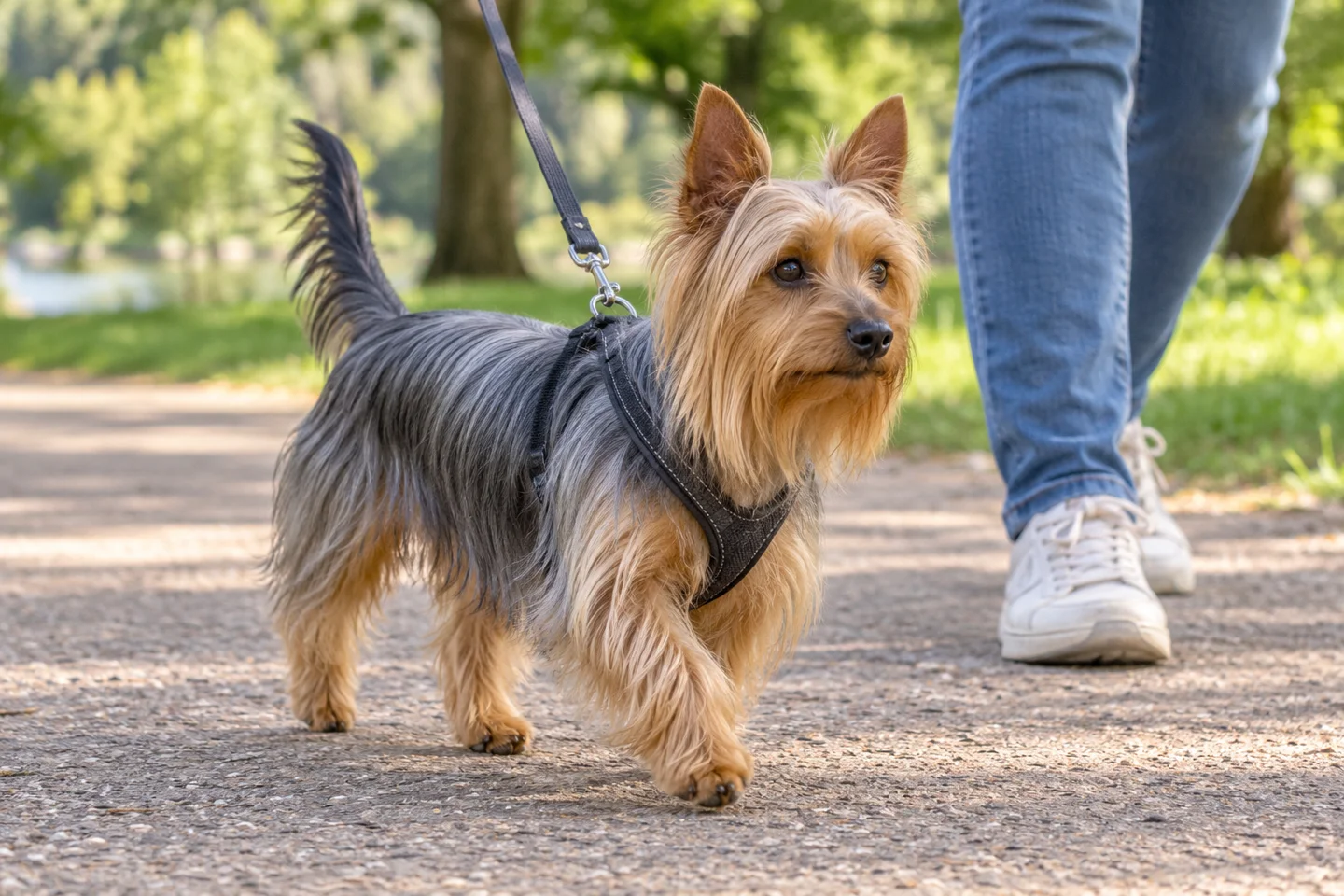
The illustrations select an adult blue-and-tan coat and a younger puppy with darker coloring appropriate to development. They show natural ears and a full tail. They cannot document real parentage or establish the animal's behavior. Anyone choosing a companion should ask about the actual dog's handling, medical records, and ordinary routine. A small body still needs safe exercise, purposeful training, and the freedom to decline unwanted contact. Being able to carry a dog does not remove the work of teaching it to cope comfortably on the ground.
Development and expectations beyond a decorative coat
The FCI historical account identifies Australian and Yorkshire Terriers among the main ancestors and places establishment of the breed in Australia. That background supplies context for alertness and interest in small moving animals. It does not mean every puppy will show the same behavior or that the dog's only appropriate life involves hunting. A household can provide safe searches, play, and walks without allowing access to wildlife.
Look beyond a carefully prepared coat when meeting adults. Ask how the dogs respond to brushing, visitors, a quiet afternoon, and another dog passing nearby. A puppy from a busy household may have different experience from one raised in a quieter setting; neither history should be assumed from a photograph. Discuss your own schedule and the people and animals in the home. Specific information lets the source assess suitability more usefully than a request for the prettiest or smallest puppy. In rescue, observed needs and documented history should guide placement while uncertain ancestry remains honestly described.
Male height and why female measurements need careful wording
The FCI gives males a height of 23–26 cm at the withers and describes females as slightly less. It does not provide a separate numeric female interval or a fixed kilogram target in that standard. Avoid inventing those figures or promoting an unofficial tiny category as healthier or more valuable. Ask the veterinary team to assess growth and body condition on the individual frame.
The coat can obscure weight change and make a puppy appear larger than it is. Learn to assess the body gently beneath the hair rather than making feeding decisions from a distant image. Choose equipment that fits securely without restricting normal movement. A small gap in a gate may matter to this dog even when a larger household dog cannot pass through it. Measure vehicle restraint and resting arrangements for the individual, and teach calm access rather than repeatedly scooping the animal up whenever something unfamiliar occurs. Safe support during necessary lifting should be taught as a separate handling skill.
The blue-and-tan adult coat develops over time
The standard allows darker puppy coloring while the blue adult coat develops. A young animal should not be expected to look like a groomed adult immediately. Ask the breeder how color has developed in relatives and avoid using a single early picture as a guarantee. Color is one part of identity, not an independent measure of medical health or temperament.
The silky hair should not prevent ordinary movement, and the standard does not call for a floor-dragging curtain. The face and erect ears should remain functionally clear. Owners choosing a practical grooming arrangement should discuss the dog's comfort and their ability to maintain it. A show photograph may involve preparation that is unsuitable for a household's routine. Do not accept that frequent tangling or painful pulling is unavoidable because the coat is attractive. A manageable care plan, taught through cooperation and supported by a suitable groomer when needed, is part of choosing the breed responsibly.
Training a dog that notices movement and opportunity
A Silky can learn the household's doorway routine in short sessions. Begin with the outside secured and reward waiting while an internal door moves. Progress before testing the skill during a delivery or exciting departure. Every carer needs to know the arrangement, including where to place the dog when several people enter together. The safest response is one practiced well before the stressful moment.
Teach returning, following the handler, and exchanging a harmless object in settings where success is likely. Food rewards can be small enough to allow repeated practice without becoming a substantial extra meal. Access to a safe investigation can also reinforce cooperation. Avoid grabbing an item repeatedly or pursuing the dog as a game. If it already guards objects, seek qualified advice and prevent access to dangerous items. The dog's size should not become an excuse to ignore threats or simply lift it out of every difficulty. Useful training reduces conflict and gives the animal more comfortable options.
Exercise for a small body with genuine outdoor interests
Provide regular walks and manageable opportunities to investigate. A small terrier can still need more than trips between a bed and the garden. Introduce surfaces, routes, and duration gradually, adapting to growth and health. For a puppy, learning about an environment and recovering comfortably matters more than completing an arbitrary distance. An older dog may prefer shorter outings with time to sniff.
Keep the animal safe around roads, larger dogs, wildlife, and gaps in boundaries. Inspect any proposed enclosure yourself. Carry drinking water and adjust in heat, while considering cold and wet conditions for the individual too. A dog eager to continue may still need the handler to stop. After activity, check feet and places where equipment touches. If a limp, cough, or altered recovery keeps recurring, discuss it with the veterinarian instead of adding exercise to improve supposed toughness. The plan should fit the ordinary week and leave enough quiet time for rest, grooming, and comfortable household life.

Barking, windows, and manageable time alone
Notice what starts barking rather than treating all noise as a fixed terrier trait. Movement outside a low window may repeatedly prompt vigilance. Change the view or access while teaching the dog to turn away and settle elsewhere. Reward a calm alternative before the reaction becomes sustained. Shouting from another room can add noise without showing the dog what to do.
Introduce short absences at a comfortable level and observe the response. Record whether the animal sleeps, eats, paces, or vocalizes. Persistent distress needs veterinary and qualified behavioral support. Damage or barking does not establish deliberate misbehavior, and adding another pet is not a guaranteed treatment. Arrange a trusted carer and practice handover before a long unavoidable absence. A small dog still requires competent management of doors, equipment, medicines, and interactions. Ask whether the proposed schedule is realistically supportable, including working days when the family cannot offer the same attention as at weekends.
Socialization from the dog’s height
Ordinary approaches can look imposing from close to the ground. Let a puppy observe people without everyone bending over it or lifting it. A visitor can sit quietly and wait for voluntary interest. Use rewards and distance to make new sounds, surfaces, and equipment manageable. If the dog repeatedly freezes or withdraws, lower the demand instead of insisting on contact.
Include comfortable time on the ground around suitable dogs, with enough separation to prevent crowding. Being carried constantly can prevent access to learning opportunities, while putting the animal into uncontrolled greetings creates a different risk. Find the manageable middle with professional help when necessary. Practice transport and veterinary-style handling as separate skills. Adult rescues also need assessment of what they actually know. Experience in one home does not guarantee comfort with children, lifts, or busy pavements elsewhere. Review recovery after outings and simplify the next session if the animal remains unusually vigilant or unsettled.
Children and a dog that can be injured by rough handling
Children need adult help to interact safely with a small terrier. Prevent lifting by young children, carrying during games, or holding the dog still for a hug. A fall or awkward grasp can injure the animal and create fear of future contact. Set up interaction at floor level with enough room for it to move away, and stop when the dog disengages.
A protected bed should be genuinely protected, rather than a place children are allowed to crawl into after the dog. Keep meals and chews outside the play area. Adults manage exchanges for objects and decide when separation is needed. An animal that is quiet may still be uncomfortable; watch turning away, stiffness, and repeated attempts to leave. Visiting children require their own supervision even if familiar family members interact well. During a busy party, comfortable separation can be the more appropriate plan. The adults' ability to maintain these boundaries is part of judging whether the household suits the dog.
Aggression and taking small-dog warnings seriously
A snap from a small dog should not become a joke or a normal part of grooming. Identify what preceded it and prevent another repetition. A brush pulling at a knot, a child lifting the body, and an approach to food are different situations. Record contact, resources, movement, and available escape. Consider discomfort and seek veterinary assessment when handling becomes newly difficult.
Qualified reward-based behavior help can support a plan for recurring warnings. Avoid scruffing, forced restraint, or punishment designed to prove authority. Those responses may increase conflict without teaching the skill needed. If safety equipment is appropriate, obtain guidance on fit and comfortable conditioning. It cannot make an overwhelming encounter acceptable. After a bite, arrange care for the injured person and review the practical management before further contact occurs. A small mouth can still cause injury, and allowing repeated conflict can make necessary care harder. Address the individual circumstances rather than attributing every event to a terrier personality.
Other dogs, cats, and small pets
Choose canine meetings that account for size and play style. A larger dog repeatedly knocking the Silky over is a reason to intervene even if both owners describe the play as friendly. Give the smaller animal room to leave without being pursued. Start with calm movement and observation before deciding whether closer interaction is useful.
At home, provide resources and routes that one animal cannot monopolize. Introduce cats with dependable separation and prevent pursuit from becoming a repeated activity. A cat should reach food, litter, and rest without passing directly beside the terrier. Small mammals need secure physical protection, including when their accommodation is opened for cleaning. Terrier history supplies a reason for caution, while the actual response must still be assessed individually. If the household cannot maintain separation during ordinary chores or absences, discuss another placement before adoption. Training and affection toward people do not promise the elimination of interest in moving animals.
Grooming as a regular cooperative task
Comb gently through the coat in small sections and inspect places likely to collect debris or rub against equipment. Do not drag a brush repeatedly through a knot. A professional can demonstrate suitable tools and a practical arrangement that preserves comfort. Hair should not obstruct vision or movement, and the dog should be able to walk and toilet without the coat creating avoidable difficulty.
Use a stable nonslip surface and reward short periods of cooperation. Introduce bathing, drying, nail maintenance, and tooth brushing gradually rather than trying to finish everything in one forced session. Observe the skin for soreness and the ears for discharge or repeated scratching. Upright ears can still develop problems. Seek advice for a new odor or painful area rather than using deep tools or leftover drops. If one body part becomes difficult to touch, stop and consider pain. Grooming is a useful chance to notice changes, but persistent findings need clinical assessment rather than an assumption that hair alone explains them.
Health: interpreting knee and hip concerns
VCA's Silky Terrier information identifies patellar luxation and Legg-Calvé-Perthes disease among conditions relevant to the breed. The list does not supply a reliable frequency for every population. Ask a breeder about actual family diagnoses and veterinary assessment, and discuss the relevance of any screening with the clinician. Do not claim that a routine puppy check or a general DNA panel excludes every orthopedic problem.
An intermittent skip, carrying a leg, or a persistent limp deserves investigation. Avoid manipulating joints at home or forcing jumping to strengthen an unexplained problem. Record when the change appears and provide a safe video if useful. The veterinarian can examine the dog and decide what further assessment is needed. Ask about comfortable activity and follow-up while the cause is investigated. A small dog that can be carried still needs the underlying problem addressed; lifting it through every task can conceal how ordinary movement has changed without explaining why.
Coughing and other changes need a clinical explanation
VCA also discusses tracheal collapse in its breed information. A cough alone cannot diagnose that condition, since several problems can produce similar signs. Describe frequency, triggers, breathing effort, and recovery to the veterinary team. Obtain prompt advice for persistent coughing, and urgent help for serious breathing difficulty or collapse. Do not choose a treatment from an online recording that sounds similar.
Ask the clinician about suitable walking equipment and any changes needed while investigation proceeds. Avoid unnecessary pressure around a sensitive neck, but do not assume replacing equipment cures the cause. Keep an accurate medication list and tell temporary carers what signs require a call. A known condition needs an individual plan, including transport and out-of-hours contact. Never improvise with human cough medicine or another dog's prescription. Clinical observations, examination, and relevant testing determine care. A breed-associated possibility is a question for assessment rather than a reason to stop investigating once a familiar label has been suggested.
Feeding, mixes, and practical ownership costs
For a small dog, uncounted extras can make a meaningful difference to intake. Measure meals and include rewards, chews, and food delivered by other household members. Choose a complete diet appropriate to life stage and ask for help assessing condition beneath the coat. Persistent appetite, thirst, digestive, or weight changes need attention. Do not rely on an unofficial tiny-size label when deciding how much a growing puppy should receive.
A Silky cross may vary in adult size, coat, grooming needs, and pursuit. Ask which background is documented and avoid promises that a named mix is automatically hypoallergenic, easier to train, or free of inherited risk. Budget locally for preventive and emergency veterinary care, suitable grooming, training, transport, and a carer who understands the animal's handling. Include the time needed for coat maintenance at home. If nobody can sustain that routine, arrange professional help in advance or consider whether a different dog would be a more manageable match.
dogsDating: protect space around a small terrier
A Silky dogsDating profile should explain comfortable partners and the kind of outing proposed. State whether larger, exuberant dogs are difficult and whether the dog prefers a steady walk to close play. Keep exact home coordinates and the household address private. Use an approximate area to choose a public meeting point with enough space to start separately.
Ask the other handler to maintain a suitable gap initially. The Silky should be able to walk on the ground without being crowded or repeatedly lifted to escape unwanted contact. Watch both dogs' ability to turn away and continue ordinary activity. Interrupt one-sided pursuit or blocking, and finish early if the arrangement is not comfortable. Shared food or toys can introduce an unnecessary resource issue during an initial meeting. Afterwards, compare what actually happened and decide whether another walk suits both animals. Either person can decline, and a short calm parallel outing can be a useful result without progressing to physical play.
Sources and editorial notes
Sources checked October 22, 2026. Breed measurements describe reference ranges, not a diagnosis or an individual dog's ideal weight. Images are AI-generated breed illustrations and do not document a particular dog or health condition.
- AVSAB: Humane Dog Training Position Statement
- VCA Animal Hospitals: Food aggression in puppies
- VCA Animal Hospitals: Common emergencies in dogs
- Orthopedic Foundation for Animals: CHIC health screening programs
- VCA Animal Hospitals: Aggression toward unfamiliar dogs, diagnosis
- VCA Animal Hospitals: Grooming and coat care for your dog
- VCA Animal Hospitals: Ear infections in dogs (otitis externa)
- AAHA: Feeding plans for healthy, appropriate weight cats and dogs
- VCA Animal Hospitals: Heat stroke in dogs
- AVSAB: Puppy Socialization Position Statement
- VCA Animal Hospitals: Dog behavior problems, aggression toward children
- FCI Australian Silky Terrier standard 236: development, adult size wording and coat changes
- VCA Animal Hospitals: Silky Terrier health considerations, including patella, Legg-Calve-Perthes and tracheal collapse
Keep getting to know dogs.
Read another guide or return to your dogsDating community.
Explore breed guidesBack to dogsDating