Småland Hound
The Smålandsstövare is a Swedish hare-and-fox hound whose small population, working selection, and natural tail variation deserve precise discussion before placement.
How these guides are researched and reviewed
- Origin
- Sweden
- FCI male height
- 46–54 cm; ideal 50 cm
- FCI female height
- 42–50 cm; ideal 46 cm
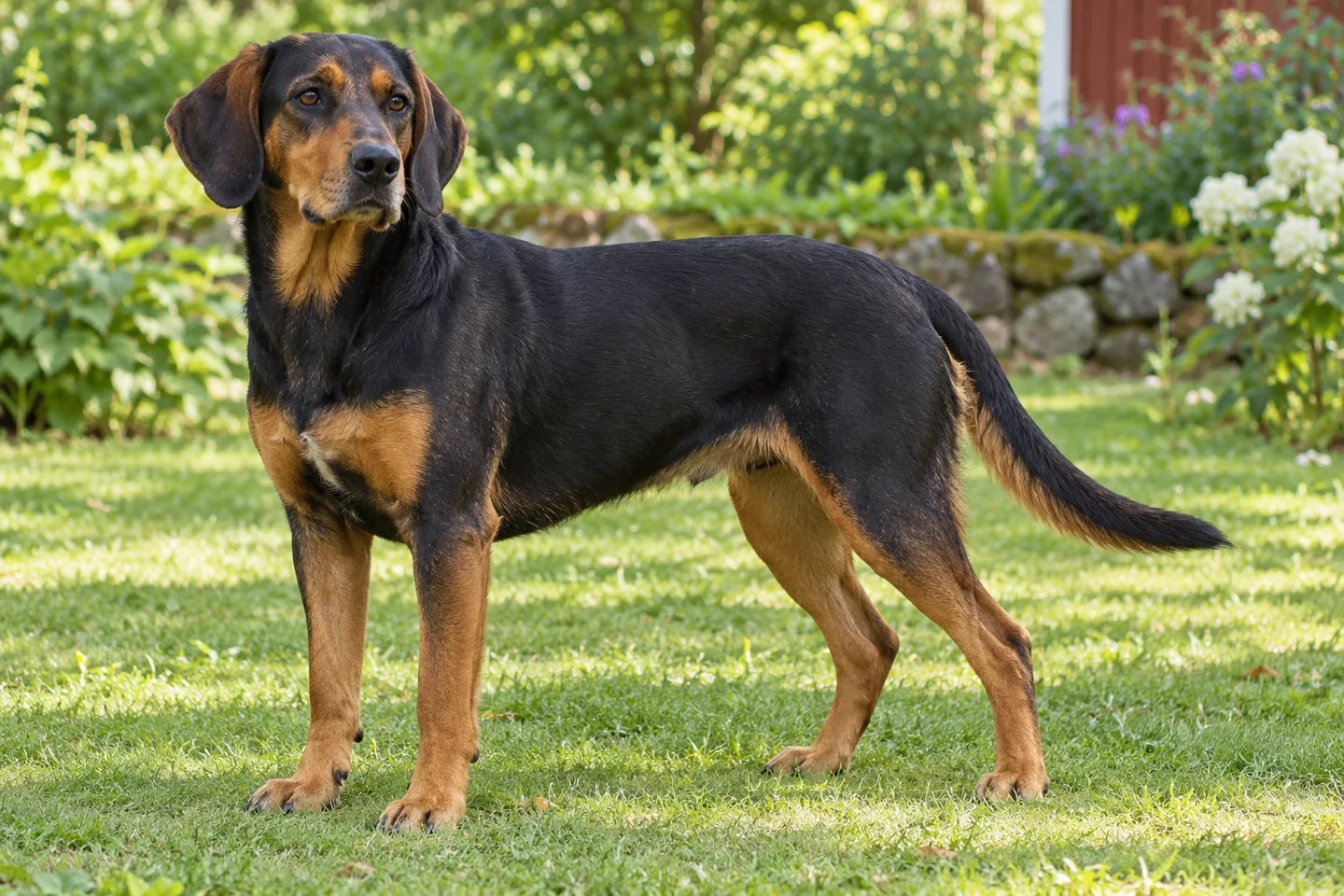
- Illustrated form
- Black and warm tan, with a full natural long tail
General information for owners. These articles have not been reviewed by a veterinarian. Medical decisions need your dog's history and an examination.
A Swedish working hound requires a specific suitability discussion
The Småland Hound, or Smålandsstövare, is a Swedish scenthound developed around hare and fox work. Sweden's kennel club explicitly advises against acquiring one solely as a companion and emphasizes access to its intended working activity. That guidance deserves a direct conversation with the breed association and source before placement. A moderately sized black-and-tan dog can look convenient in a family photograph while having needs the household has not planned for. This guide should help identify those needs, rather than assume any active home can substitute occasional long walks for an established working programme.
Ask how the available adult or puppy's family is selected and housed, what working experience is expected, and how daily company and rest are provided. A source should discuss limitations and unsuitable homes as clearly as achievements. An adult leaving work may need a different routine because of age, health, or changed circumstances, so assess that animal individually. Prepare transport, secure management, clinical care, and knowledgeable help. A sustainable commitment includes ordinary weekdays, bad weather, and periods of human illness. Admiration for an uncommon national breed does not replace the resources needed to keep its particular members comfortable and safely occupied.
Småland history and a breed distinct from other Swedish hounds
The FCI historical summary describes varied hounds in Småland during the nineteenth century, including influences from imported and local dogs. Selection later aimed to preserve a recognizable regional type, and the first standard dates to 1921. Those facts explain a working population with historical variation. They do not establish an exact ancestry recipe for every modern dog. Smålandsstövare should be distinguished from Hamiltonstövare and Schillerstövare even though organizations sometimes discuss these Swedish hounds together. A shared country or purpose cannot make their appearance and medical findings interchangeable.
Accurate records matter in a small population. Ask which breeding organization follows the family, how relatives' health and work are recorded, and what information remains incomplete. The Swedish breed association discusses preservation work, including evaluation of its breeding project. That makes genetic diversity a practical topic rather than a slogan. Ask how the source avoids overusing closely related successful animals while retaining suitable health and temperament. A prestigious parent should not excuse missing reports. For imported or rescued dogs, keep original identity information together with readable explanations so later professionals can understand the animal's background without reconstructing it from a translated name alone.
Size, coat, and naturally different tail lengths
The FCI male height range is 46–54 cm with an ideal of 50 cm; females are 42–50 cm with an ideal of 46 cm. The body is almost square and robust without being heavy. Black or liver-brown with tan is permitted, and the illustrations select black with warm tan markings. Natural rounded ears hang beside the head. Both naturally short and long tails occur under the standard. The illustrated dogs have full natural long tails, reaching roughly toward the hock and carried straight or with a modest sabre curve, rather than curled over the back.
The coat is close and harsh over a dense softer undercoat, with shorter smoother hair on the head and front of the legs. These details describe type, while comfortable movement and body condition require individual assessment. The images are labeled AI illustrations and do not verify a particular animal's pedigree or health. Do not dock a tail or otherwise alter a dog to imitate an example. Watch walking, turning, and recovery when meeting adults, and ask about pain or past injury. A growing puppy needs balanced care rather than pressure to reach a finished height or athletic outline early.
Temperament, voice, and recovery after work
A vocal working hound can require a carefully planned home environment. Find out when this dog gives voice and how it settles afterward. A response to scent differs from alarm at a window or distress when left alone. Describe the proposed housing and neighbors honestly before committing. Provide a resting area away from repeated visual triggers and teach a manageable change of activity. Shouting over vocalizing can add stimulation without explaining an alternative. A useful plan identifies the context and the dog's recovery, rather than assume the same response will address every loud episode.
The FCI describes a friendly steady temperament, but an individual still needs assessment and teaching. Meet related adults outside a posed stance when possible and ask about visitors, handling, and separation. A newly arrived adult may need time to adapt to indoor routines or a changed social group. A puppy needs appropriate exposure balanced with sleep and predictable care. Begin short comfortable absences gradually and arrange support when work exceeds current coping ability. Another dog cannot be promised as a cure for distress. Observe what actually helps the animal remain comfortable instead of asking it to prove a breed description through overwhelming encounters.
Training safe responses around scent
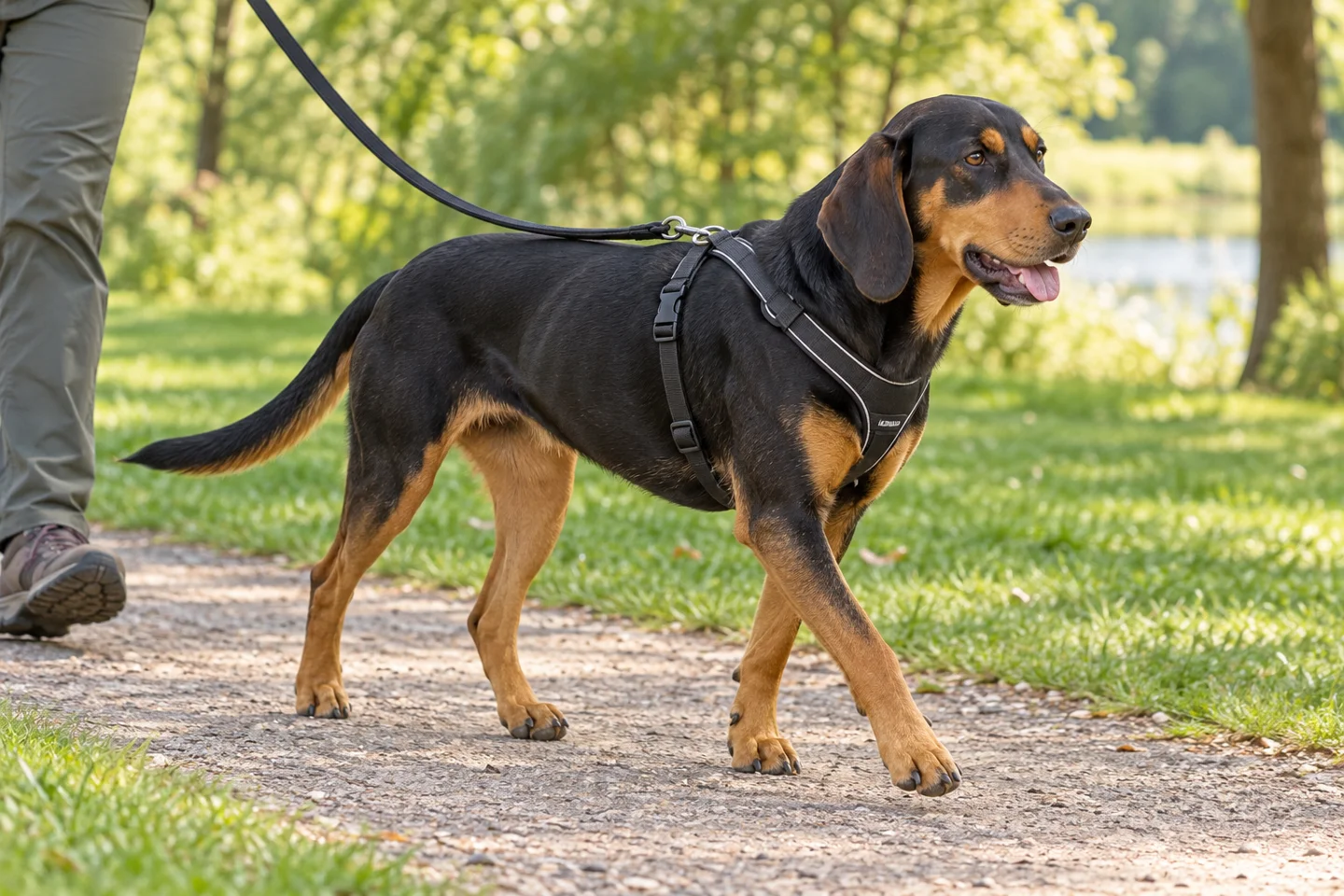
A scenthound's persistent interest deserves deliberate management while response skills develop. Reinforce recall in secure low-distraction settings, then increase difficulty in small stages. Often release the dog back to a permitted investigation after a successful return. A suitable long line attached to a harness can help in appropriate space, provided handling avoids entanglement. Never release near traffic, livestock, or vulnerable wildlife as a test of whether the animal will choose its owner. Traditional work does not make every route or chase safe, and a successful response in one context does not establish reliability everywhere.
Teach waiting at gates, moving with the handler, and a rehearsed turn away from activity. Use short appropriate scent tasks with clear endpoints when working with a trainer or source. Practise exchanges for safe objects rather than physically confronting the dog over found material. If possession causes tension or guarding, change the setup and obtain qualified help. Cooperative handling also matters: paws, ears, coat, and mouth need inspection during a working life. Gradual lessons when the dog is comfortable can prevent the first painful injury from becoming its first experience of sustained restraint or unfamiliar tools.
Exercise must match work, health, and recovery
Plan activity with the source and relevant working organization rather than borrowing a generic schedule for medium dogs. A fit adult's capacity is developed over time, while growth, illness, and periods of reduced work change the starting point. Introduce physical demands gradually and look at recovery later in the day and the next morning. Repeated stiffness, reduced stride, or unusual fatigue warrants veterinary attention. A dog excited by scent can still need rest. Young animals should build coordination and confidence through appropriate exploration rather than be expected to reproduce the endurance of mature working relatives.
Check permissions, boundaries, roads, livestock, and seasonal hazards before each route. Carry water, allow rest, and adjust to heat, cold, or wet conditions. Secure transfers between vehicle and building so an interesting odor cannot turn an opened door into an escape. An appropriate working routine still includes ordinary company and rest, and a garden alone does not provide every requirement. For a dog retiring or recovering, obtain a patient-specific activity plan and useful alternative engagement. The household should have a way to shorten demands safely, instead of assume that completing the usual route is always better than responding to changed comfort.

Aggression and preventing a bite before the situation repeats
A friendly standard description does not guarantee that a dog cannot react to fear, pain, restraint, or possession. Watch behavior during handling, rest, and introductions. Withdrawal, freezing, stiffness, a fixed stare, or growling means the interaction should change. Give space and remove pressure. Punishing a warning while continuing the approach can leave the underlying discomfort unresolved. Sudden intolerance of an ear check, foot handling, or movement deserves a veterinary discussion. Record preceding events and recovery so a professional can examine the cause rather than work from an assumed motive.
Protect known sensitive situations while obtaining help. Use separate feeding when needed, undisturbed rest, safe storage of tempting items, and barriers during visitor arrivals. All carers need the actual history of bites or close calls and a clear management routine. A veterinarian and suitably qualified behavior professional can guide persistent risk, including positively introduced basket-muzzle training where appropriate. A muzzle does not permit forced greetings or rough care. Improvement is comfortable manageable behavior with successful choices at suitable distances. An animal that becomes silent under pressure may still be experiencing the problem that originally created the warning.
Children, dog introductions, and small animals
Adults should supervise contact with children and intervene before excitement becomes rough. Prevent ear pulling, climbing, chasing, and disturbance of meals or sleep. Give the dog a resting area children cannot enter and separate before running games become difficult to ignore. Teach a brief invitation to contact followed by a pause, allowing the animal to leave. A child's willingness to follow rules cannot replace a safe arrangement. A young person should not be responsible for controlling a scent-focused hound near roads or interpreting every warning during a busy visit.
The FCI specifically describes the Småland Hound as a hound used individually rather than a pack hound. Do not assume it will automatically want every unfamiliar dog's company. Introduce with separate handlers and space to move in parallel, observing the ability to disengage. Cats, poultry, rabbits, and other small pets require their own assessment and secure barriers. Familiarity with one animal does not establish every outdoor response, and some combinations need permanent separation. Never allow a chase as a test. Accurate prior experience helps plan, while physical safeguards protect animals when ancestry or likely behavior remains uncertain.
Grooming harsh hair and inspecting feet
Use gentle brushing appropriate to the close double coat and part areas under equipment to inspect the skin. Loose undercoat needs attention during shedding, while short head hair still deserves examination after vegetation. Look over feet, pads, and nails after rough terrain. Remove loose surface material carefully and seek help for embedded objects or painful swelling. Bathe when needed with suitable products and dry comfortably. A neat outline is not the only goal; the routine should make a change in condition easier to notice before it becomes a larger problem.
Check the visible outer ears for redness, discharge, odor, and sensitivity. Persistent shaking or pain should be assessed rather than repeatedly treated with old drops. Avoid deep probing, especially after a route where plant material could have entered. Teach brief ear lifting, paw inspection, and mouth care through comfortable steps and rewards. Tell a groomer or clinician about handling limits and recent changes. A dog normally accepting care but suddenly avoiding one area may be uncomfortable. Demanding more tolerance without investigating can delay treatment and make the animal's response to future inspection more difficult.
Health: hips and epilepsy are documented questions
The Swedish Kennel Club identifies hip dysplasia and epilepsy among conditions occurring in the Småland Hound. That statement supports specific family questions without giving an individual prediction or a current population rate. Ask about diagnosed cases in relatives, the age and circumstances, and which reports are available. A working or show result cannot replace medical evidence. Keep descriptions of seizures separate from a confirmed neurological diagnosis, and do not assume a broad DNA panel can exclude every relevant disorder simply because the animal belongs to a recognized breed.
Norway's programme for several Swedish hound breeds took effect on 1 July 2026 and includes known hip status for breeding animals with specified pairing conditions. It also addresses genetic diversity and health goals across those hounds. Read the actual current rules for the planned litter rather than transferring a statistic or condition from another breed in the group. Request identified parental reports and an explanation of the combination. A qualifying result informs one part of a breeding decision, while symptoms in the dog at home still require assessment of that patient. Rarity makes transparent records more useful; it does not establish either extraordinary health or inevitable illness.
Seizure observations and keeping medical records useful
If an unexplained episode occurs, protect the dog from immediate hazards and contact the veterinarian for instructions. Note timing, responsiveness, movements, and recovery when safe. Do not put hands in the mouth or give human medication. A video can help describe an intermittent event if obtaining it does not delay care or create danger. Prolonged or repeated episodes, injury, or poor recovery need urgent help. An online breed description cannot determine whether the event was a seizure or identify its cause. The veterinarian needs an accurate account of this individual and its medical history.
Where treatment is prescribed, make the schedule and follow-up understandable to another adult. Keep the original reports, current medication details, and contact instructions accessible. Report a new pattern instead of adjusting medication from another owner's experience. Share confirmed information with the source or appropriate confidential health-reporting route where helpful. The distinction between suspicion and diagnosis matters to family records and future care. A carrier label for an unrelated test, or an earlier reassuring certificate, should not be allowed to dominate interpretation of a new clinical event that requires its own examination and investigation.
Preserving a small population requires more than choosing a famous parent
The breed association's preservation discussion and the Norwegian hound programme emphasize population management as well as individual assessments. Ask how close relatives and repeated use of a successful sire are considered. Diversity information has meaning only alongside health, temperament, and functional suitability. An owner should not be pressured into breeding solely because an uncommon dog's genes are said to be needed. Any decision needs current professional and club guidance, appropriate examinations, and a realistic welfare plan for parents and puppies. Keeping a suitable pet entire is not the same task as managing a breeding population.
For a buyer, this topic changes the questions asked rather than creates a promise. Ask which records can be checked, how relatedness is interpreted, and whether later owner findings are collected. Avoid assuming an outcross or preservation project automatically removes every health concern. It requires its own documentation and evaluation. An ordinary owner can contribute accurate follow-up and cause-of-death information when known, through an appropriate confidential route. That is more useful than repeating an unsupported lifespan or a claim that working selection makes all dogs healthy. Respectful reporting also means protecting the privacy of other owners while sharing information needed for sound decisions.
Nutrition, mixes, and the cost of an appropriate placement
Feed complete nutrition suited to life stage, health, and workload, with measured portions and training rewards included. Review condition as seasonal activity changes. A mix may inherit varied size, coat, and hunting behavior, and black-and-tan coloring alone cannot establish Småland ancestry. Crossing does not guarantee reduced activity or freedom from inherited disorders. Preserve uncertain labels and assess the individual with the source and veterinarian. A claimed breed mix should not be used to bypass the careful suitability discussion required for a dog whose working background and observed needs may be substantial.
Budget for routine and urgent care, suitable insurance or emergency funds, secure equipment, transport, training support, and knowledgeable care during absences. Obtain local estimates instead of a universal lifetime-price figure. Clarify source support and return arrangements and identify a carer who can manage scent distractions and gates. A home must remain workable during illness, difficult weather, and later health restrictions. The choice should fit the dog's normal life as well as the owner's ambitions. An uncommon hound needs reliable ordinary care long after the novelty of learning its Swedish name or admiring its regional history has passed.
dogsDating walks should begin without an assumption of pack sociability
A useful dogsDating profile for this hound describes an ordinary walk: how often it stops to investigate, whether it calls when excited, and what happens when another dog approaches from behind. Invite someone willing to accommodate that pace rather than promising a nonstop fitness session. Arrange the initial walk in a public place with several ways to turn back. Give only a broad location online and keep exact coordinates and the home address confidential. Walk separately into the area, then travel in the same direction while observing whether both dogs can continue investigating. Avoid a shared release onto an attractive scent trail, where competition and pursuit would make an otherwise simple first introduction harder to supervise.
Watch the ability to sniff, look away, and keep moving comfortably. Repeated freezing, pursuit, blocking, or attempts to escape means the arrangement needs adjustment or an early finish. Calm repeated walks can become worthwhile companionship without close play. Compare spacing, route, duration, and pace afterward and use those observations to plan another invitation. Avoid posting precise addresses or another person's private details in public pictures. A useful meeting leaves the animals able to disengage and their handlers able to manage them, even when a comfortable connection requires more distance or time than the profiles suggested.
Sources and editorial notes
Sources checked October 22, 2026. Breed measurements describe reference ranges, not a diagnosis or an individual dog's ideal weight. Images are AI-generated breed illustrations and do not document a particular dog or health condition.
- AVSAB: Humane Dog Training Position Statement
- VCA Animal Hospitals: Food aggression in puppies
- VCA Animal Hospitals: Common emergencies in dogs
- Orthopedic Foundation for Animals: CHIC health screening programs
- VCA Animal Hospitals: Aggression toward unfamiliar dogs, diagnosis
- VCA Animal Hospitals: Grooming and coat care for your dog
- VCA Animal Hospitals: Ear infections in dogs (otitis externa)
- AAHA: Feeding plans for healthy, appropriate weight cats and dogs
- VCA Animal Hospitals: Heat stroke in dogs
- AVSAB: Puppy Socialization Position Statement
- VCA Animal Hospitals: Dog behavior problems, aggression toward children
- Official breed standard: Småland Hound
- Swedish Kennel Club: Smålandsstövare work, home suitability, and documented health concerns
- Norwegian Kennel Club: Swedish hound breeding programme effective July 2026
- Swedish Småland Hound association: breed-preservation project and evaluation
- Cornell University: recognizing and managing canine seizures
Keep getting to know dogs.
Read another guide or return to your dogsDating community.
Explore breed guidesBack to dogsDating