Stabyhoun
The Stabijhoun is a Dutch versatile farm and pointing dog with a bushy natural tail, needing cooperative teaching, practical coat care, and careful interpretation of distinct genetic and clinical records.
How these guides are researched and reviewed
- Origin
- Netherlands
- FCI ideal male size
- 50–53 cm; 22–27 kg
- FCI ideal female size
- 48–50 cm; 18–23 kg
- Illustrated coat
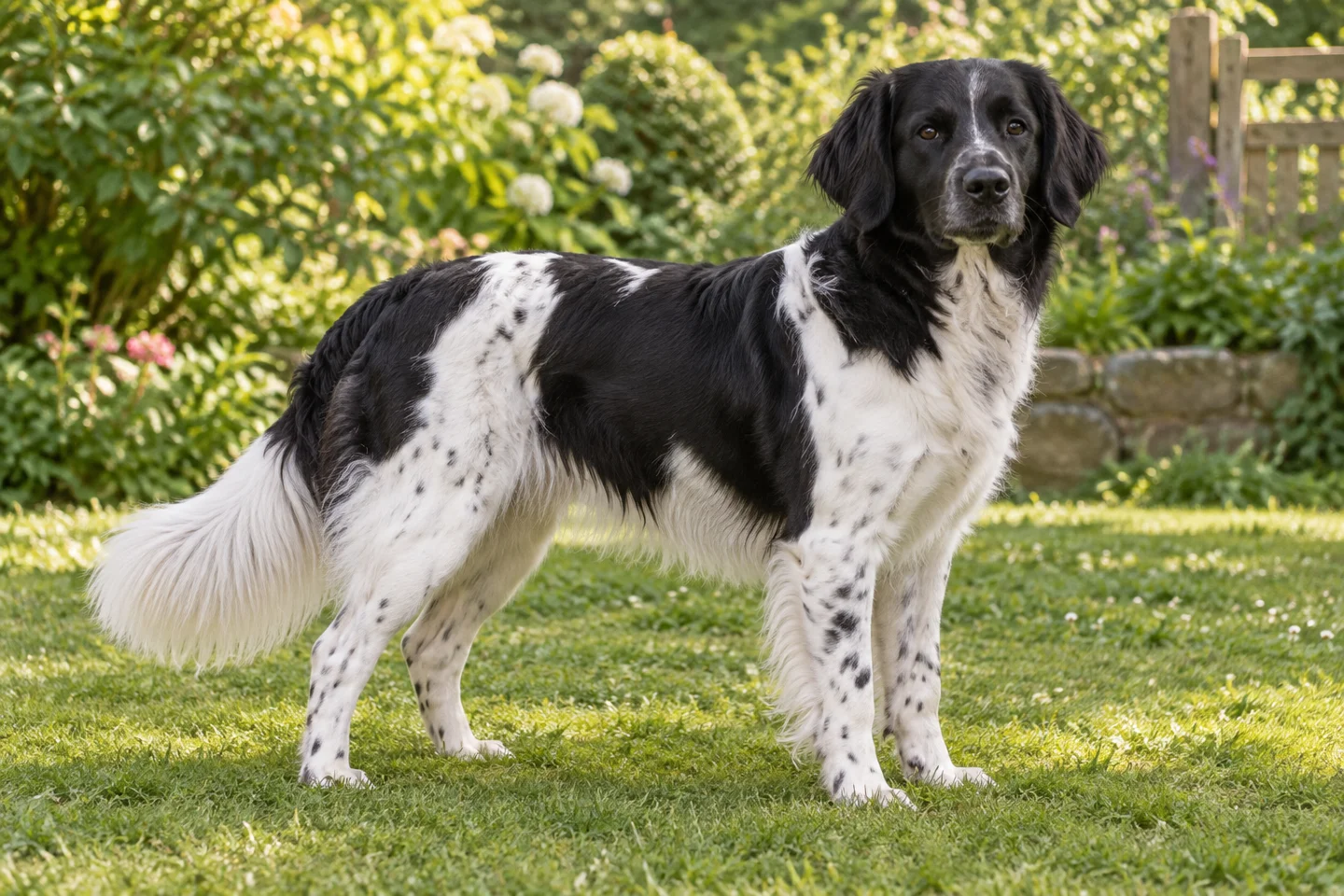
- Black-and-white pied with a bushy full natural tail
General information for owners. These articles have not been reviewed by a veterinarian. Medical decisions need your dog's history and an examination.
A Dutch farm dog with a pointing-dog classification
The Stabyhoun, spelled Stabijhoun in its FCI standard, is a Dutch versatile dog with farm and hunting work behind its appearance. A black-and-white coat and comfortable family photograph can make it look like a generic spaniel, but its own identity and individual interests deserve attention. A prospective home should plan movement, investigation, learning, company, and quiet recovery. Ask how the source's adults behave in ordinary situations before assuming a moderate size means a moderate commitment. A good placement connects this particular animal's needs with resources the household can provide consistently.
Useful questions concern visitors, small animals, valued objects, handling, and necessary time apart. How does the dog settle when activity ends? What teaching and management support that behavior? Meet adults where possible and ask for honest descriptions of difficult days. A puppy is developing, while an adult moving homes may need time to transfer existing skills. Prepare secure space, transport, veterinary care, and a modest arrival routine. Ongoing source support matters when a new owner discovers that an expected easy task requires more teaching or a different arrangement than anticipated.
Names, Frisian history, and a distinct breed
Stabyhoun and Stabijhoun are naming forms for this breed, associated with Friesland in the Netherlands. The FCI describes versatile farm and pointing work, including keeping a yard free of small pests. It is distinct from the Wetterhoun, despite shared regional history and organizations that work with both. A similar place-name or mixed club website should not cause a reader to transfer the wrong coat description or medical policy. Accurate names and registered identification help sources and clinicians trace the right records when animals move across languages or countries.
Historical versatility should guide a practical conversation rather than become a promise that a puppy can fill every role without preparation. Ask what the family currently does, how adults are housed, and how selection balances health, temperament, and comfortable structure. A rescue may offer useful foster observations without complete ancestry. Preserve uncertainty instead of assigning a pedigree from black patches and long hair. A recognized pedigree is valuable documentation, but the placement decision still needs behavior and clinical information about the actual animal. A suitable home provides safe opportunities and care even when the owner's ideal activity plan has to change.
Size and the bushy tail that differs from a setter’s flag
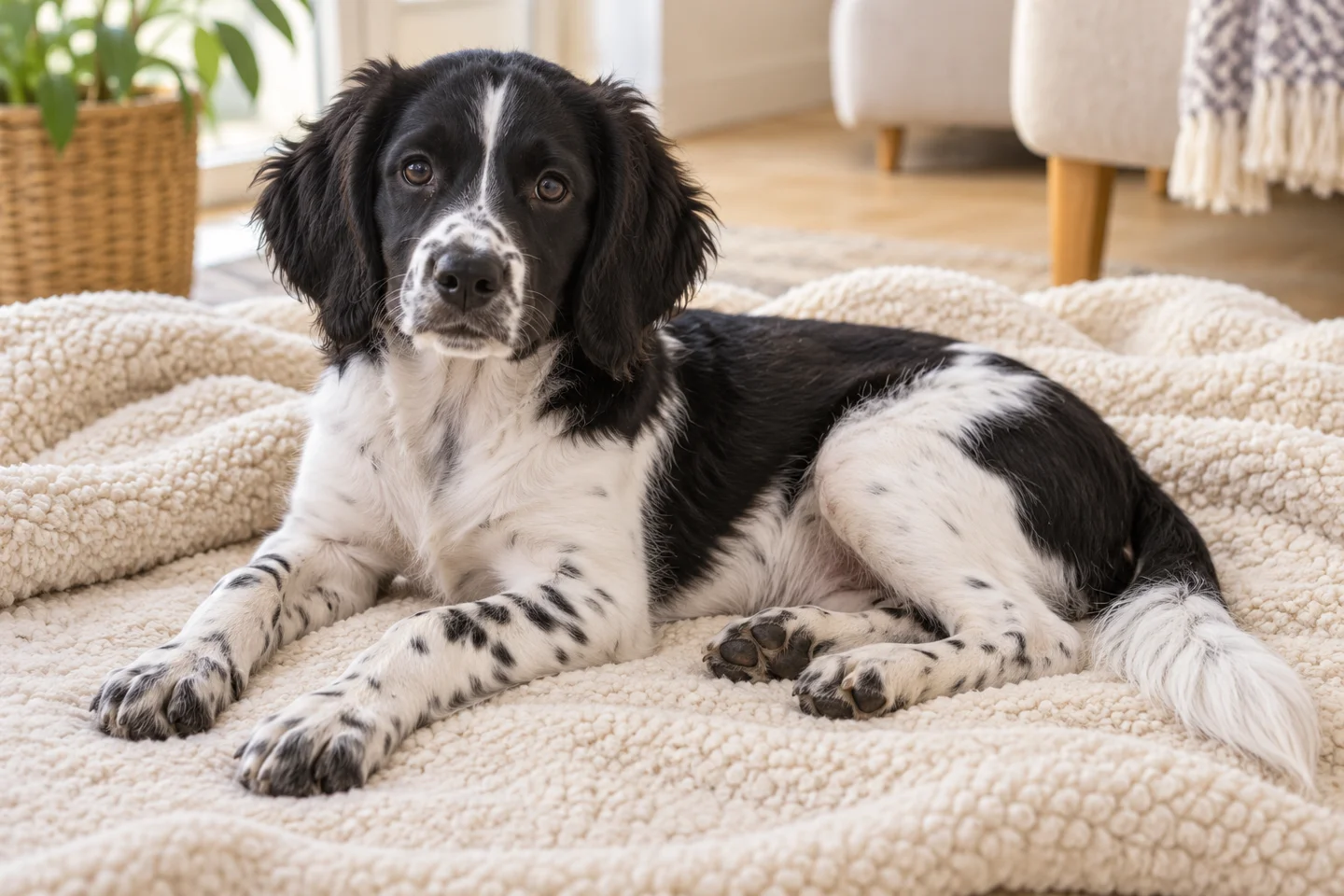
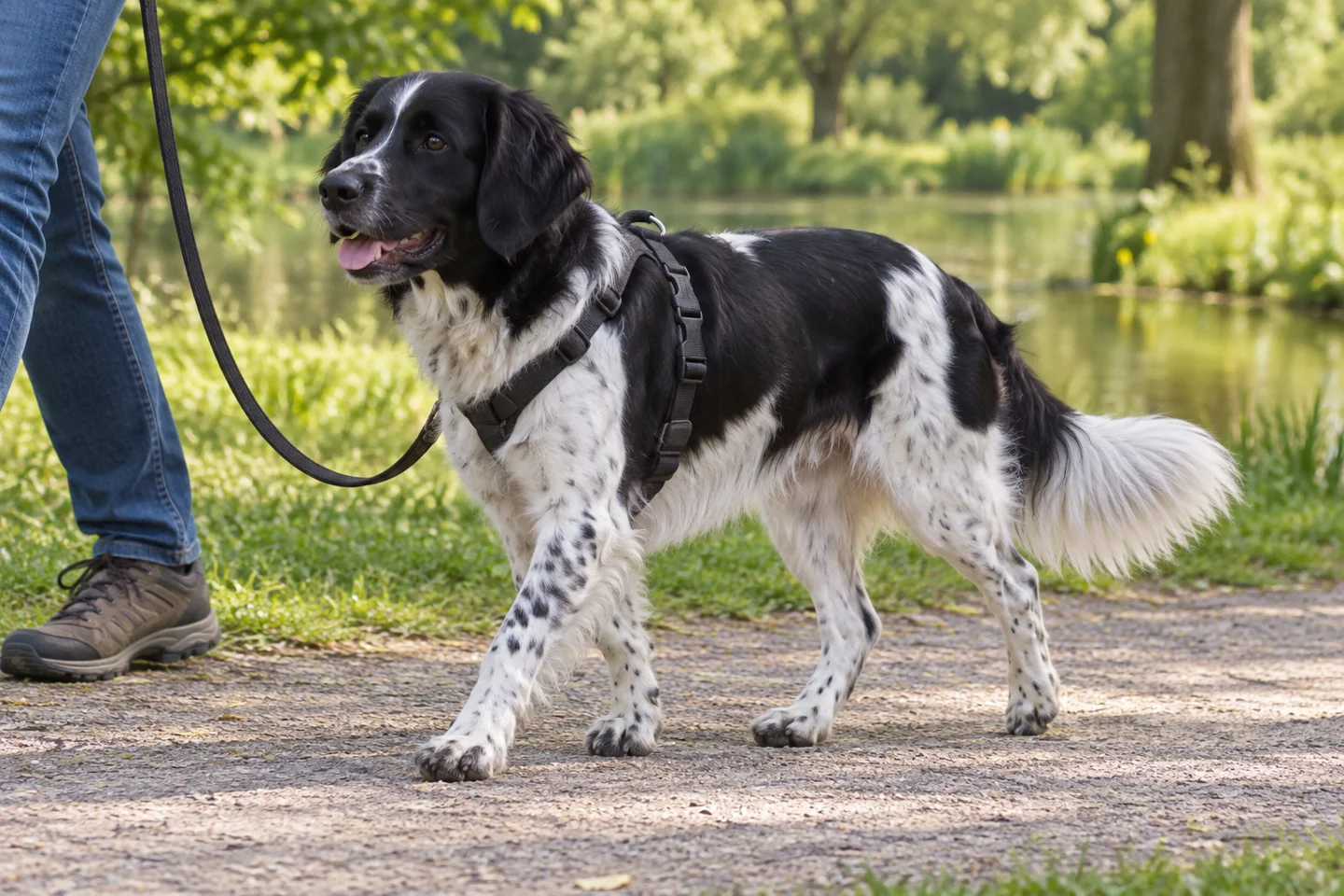
The FCI ideal male height is 50–53 cm and female height 48–50 cm, with its stated 2 cm allowance around the ideal range. Listed weights are 22–27 kg for males and 18–23 kg for females. The moderately rectangular body carries a straight medium coat with shorter head hair and more abundant furnishings. Black or brown pied and roan patterns are recognized. The illustrations choose black-and-white pied with natural hanging ears and a full tail. Each is labeled an AI illustration, rather than a photograph establishing the identity or health of a named dog.
The tail reaches the hock and has round bushy hair around it, rather than a setter-like feathered flag. It usually hangs at rest and may lift in action without curling over the back or forming a spiral. This detail is useful when assessing an illustration, while a real animal's movement and comfort matter more than exact resemblance to a picture. Watch walking, rising, and turning, and ask about injuries or altered recovery. Fit equipment to the actual frame and check beneath hair for rubbing. Standard numbers do not justify forcing rapid puppy growth or ignoring individual body condition.
Temperament and learning to change activities
A dog able to investigate independently still benefits from clear ways to return attention to a person. Reward check-ins during sniffing and make the ending of a game predictable. Inside, provide rest away from busy doors or constant window activity. Meet adults to learn how quiet moments are achieved rather than assume a family reputation supplies automatic settling. A household continually creating another exciting task may give the dog little opportunity to learn that nothing is required. Activity and comfortable rest should both be ordinary parts of the day.
Give unfamiliar people and places manageable introductions. Let the animal observe, recover, and choose engagement instead of requiring immediate petting. A new adult may need familiar cues and a modest first schedule, while a puppy needs appropriate experiences balanced with sleep. Start comfortable separations in small steps and observe the response before extending them. Another pet cannot be promised as a cure for distress. Arrange practical care when workdays exceed the animal's current ability to cope. The useful measure is this dog's comfort and recovery, rather than whether it appears to satisfy the most optimistic phrase in a breed summary.
Training recall, exchanges, and cooperative care
Teach recall in quiet secure settings and reward returning promptly. Often allow another permitted investigation after a successful response, then increase distraction gradually. A suitable long line on a correctly fitted harness can support learning where it can be handled without entanglement. Do not test reliability by releasing near roads, livestock, or vulnerable wildlife. The fact that a dog works with people does not remove competing interests. Waiting at exits and a practiced turn with the handler are useful skills before an unexpected event makes a familiar route difficult.
Keep object games cooperative. Begin with a safe item close by, reward delivery, and exchange calmly for release. Prevent access to dangerous material rather than chase the dog around the house. Possession that causes stiffness or guarding needs a revised setup and qualified guidance. Handling lessons should include brief coat parting, feet, ears, and mouth checks in a stable comfortable position. Reward participation and allow pauses. Everyday care skills can be more useful than a polished trick if they let the animal be examined accurately without struggling. The first painful problem should not also be its first sustained experience of unfamiliar restraint or tools.
Exercise and safe investigation on varied ground
Provide varied movement, searching, learning, and recovery suited to age, health, and fitness. A working background suggests useful outlets but does not establish one mandatory daily distance. Build new demands gradually after travel, illness, or reduced activity. A growing dog needs coordination and safe exploration rather than an adult endurance target. Watch comfort later in the day and the next morning. Persistent stiffness, reduced tolerance, or changed willingness deserves veterinary assessment. Excitement at the start of a game is only one observation and cannot prove that more exertion is comfortable or useful.
Inspect boundaries and transfer points so a gap or opened vehicle door does not become an escape opportunity. Choose routes with permission and a manageable level of traffic, livestock, or wildlife. Carry drinking water and adjust timing and duration in heat. Swimming, where appropriate, needs its own check of quality, current, banks, temperature, and an easy exit, with gradual introduction and suitable supervision. A versatile history does not guarantee safety in unfamiliar water. Quiet days should also have a workable plan, using appropriate engagement without making repetitive high-speed play the only available way to obtain calm indoors.
Aggression and preventing pressure around resources
A friendly reputation does not guarantee an absence of aggression. Fear, pain, restraint, possession, or repeated unwanted contact can affect an individual. Watch withdrawal, freezing, stiffness, a hard stare, or growling and reduce the pressure. Do not punish a warning while continuing to reach toward the face, resting place, or valued item. A sudden change in tolerance deserves veterinary attention, particularly when handling a foot, ear, mouth, or moving the body appears involved. Concrete information about what happened before and afterward helps a professional investigate the cause.
Protect meals and rest, prevent access to unsafe objects, and use barriers during difficult visitor arrivals while arranging help. All adults and carers should understand the same routine and receive an honest account of bites or close calls. Persistent risk warrants veterinary and suitably qualified behavior support. Positively introduced basket-muzzle training can assist an individual plan where appropriate, but does not permit forced contact or rough care. Improvement means comfortable manageable behavior with successful choices. Silence under restraint cannot by itself establish that the animal is relaxed or that the underlying pressure has been resolved.
Children, other dogs, and smaller animals
Adults need to supervise contact and prevent pulling hair, hugging, climbing, chasing, and disturbance of sleep or meals. Provide a resting area children cannot enter and separate before noisy running games become intense. Teach an invitation to brief contact followed by a pause and respect the dog's choice to leave. A child's promise to be gentle cannot replace a safe layout when excitement or divided adult attention changes what can be managed. Ask about actual prior experience, including ages and setting, while recognizing that familiar family contact and a busy visit are different situations.
A Stabyhoun's hunting background belongs in the conversation about household animals. Ask separately about cats, birds, rabbits, and dogs, including whether contact happened indoors, through a barrier, or during a walk. Those situations provide different evidence. Prepare secure accommodation for small animals and never release one to discover whether the dog will pursue it. A cat also needs routes and resting places beyond the dog's reach. With another dog, begin with two capable handlers walking far enough apart to avoid crowding. Leave balls and food bowls out of the introduction. Comfortable movement outdoors is useful information, but sharing a home adds sleeping places, access to people, and resources that require their own management.
Grooming straight hair and bushy furnishings
Maintain the coat gently through to the skin, with attention behind ears, under equipment, in the armpits, and through bushier areas around the rear and tail. A smooth outer surface can hide a tangle below. Remove attached plant material after outings before it becomes incorporated into a knot. Ask a groomer familiar with the breed to show tools and a practical schedule. A painful mat needs appropriate help rather than a prolonged pulling session intended to preserve appearance. Comfortable maintenance should keep sight and movement clear without turning the coat into another breed's exaggerated finish.
Dry thoroughly after wet activity or bathing and keep bedding and equipment clean. Check feet, pads, and nails after rough ground. Inspect the visible outer ears for odor, redness, discharge, sensitivity, or repeated shaking and seek advice rather than probe deeply or apply leftover medicine. Include dental care in short cooperative routines. Tell a professional about restrictions or changes in tolerance. A dog suddenly avoiding a familiar care step may be uncomfortable, and demanding more compliance can obscure the reason. The useful result is an animal whose condition can be checked accurately and whose care remains manageable between appointments.
Health records differ between national programmes
The Finnish Stabijhoun association's current breeding guidance includes formal hip and elbow assessment alongside specified genetic information and pairing advice. Ask which programme governs the actual proposed parents, and request original reports with matching identification and dates. A requirement or recommendation in one national system should not be represented as an identical worldwide rule. Clinical imaging, a disease-variant assay, a genetic identity profile, and a pedigree answer different questions. A broad phrase such as all clear is less useful than knowing which findings were made and how they informed the pairing.
Include diagnosed family history and later owner reports, while keeping missing information visible. A CHIC or other programme label should lead to the underlying results rather than replace their interpretation. A routine puppy examination cannot establish every parental inherited risk, and a commercial DNA panel cannot exclude all future disease. For an adopted adult, collect its own treatment, injuries, medication, and unfinished follow-up first. A veterinarian can help judge which additional assessment matters to that patient. Avoid inventing a current population frequency from old selected samples or assuming an uncommon breed must be unusually free from illness.
Cerebral dysfunction and the specific test report
The Dutch association describes cerebral dysfunction as a serious inherited neurological condition recognized in young Stabijhouns and discusses a specific DNA test. Finnish guidance also addresses testing and pairing interpretation for CD. Ask for the named result and the current applicable rules rather than infer a health clearance from any swab certificate. A carrier result and clinical illness are different concepts, and a breeding decision needs informed interpretation. The existence of a test does not mean every abnormal movement or behavior in a puppy has that cause or that one assay excludes all neurological disease.
New repetitive abnormal behavior, poor coordination, difficulty eating, or altered development should be described to the veterinarian promptly. Give timing, progression, and family records when available, with urgent contact for severe deterioration. Do not wait for a breed-club reply while a puppy is becoming unwell. Video can help if obtained safely, but filming must not delay care. Follow the patient's actual diagnosis and instructions, preserving reports for later professionals. Accurate communication distinguishes a confirmed condition from an inherited explanation guessed because a disease name appeared in a search result, which matters both to this dog's treatment and to the family record.
Von Willebrand findings need careful clinical interpretation
Dutch and Finnish association material discusses type1 von Willebrand disease and the distinction between genetic findings and observed bleeding. Their breeding policies are not identical. Ask which current programme the source follows and have the exact result interpreted, rather than assume that every carrier is clinically ill or that an animal without obvious signs needs no relevant history recorded. Historical percentages from selected tested dogs should not be presented as a precise current whole-population risk. Diversity and the clinical significance of a result both deserve informed attention in a small breeding population.
Tell the treating veterinarian about a known result, family bleeding history, or previous surgical complication before a procedure. Unexpected or persistent bleeding needs prompt professional advice. Do not choose medication or alter a surgical plan from another owner's account. A clinician can determine what assessment or precautions are appropriate to this individual, and what the genetic information can and cannot explain. Keep original reports accessible to carers and new clinics. A normal-looking coat, active behavior, or routine examination does not substitute for a clear account of a documented finding that may matter when injury or treatment occurs.
Nutrition and growth without pushing an adult outline
Choose complete food appropriate to life stage, health, and workload and measure portions. Include training rewards and enrichment food, especially when several people enjoy working with the dog. Review condition beneath the hair with the veterinary team as activity changes. A puppy needs balanced growth rather than extra supplements or excess calories intended to create an adult frame quickly. Keep a simple record when appetite, drinking, stool quality, or weight changes. Clear observations are more useful than repeatedly changing several products without an explanation for the problem.
Feed in a quiet area without competition and protect meals and chews from interference. Practise voluntary exchanges with suitable objects outside a confrontation. Discuss homemade or restrictive diets and supplements before relying on them, particularly if an established condition changes nutritional needs. A working or natural-food label does not establish suitability for the patient. Make the routine understandable to another carer, including measured amounts and any clinical instructions. Food should support comfortable activity and condition, while any persistent digestive or appetite change deserves assessment rather than an assumption that the animal is merely being selective.
Mixes, practical costs, and choosing a sustainable home
A Stabyhoun mix can vary in frame, hair, pursuit interest, and social responses. Ask what is known about both parents and preserve uncertainty where ancestry is inferred. Black-and-white patches or a bushy tail cannot confirm the label. Crossing does not guarantee moderate activity, easier maintenance, or freedom from inherited disorders. Judge the animal's observed needs and likely development rather than expect a precise convenient compromise between two breed summaries. A rescue with useful foster information can be assessed honestly without inventing a pedigree to make its requirements sound more predictable.
Budget for grooming, routine and urgent clinical care, appropriate insurance or emergency funds, training help, secure equipment, transport, and knowledgeable sitting. A carer should understand door safety, object exchanges, and the individual animal's comfort around other dogs. Clarify ongoing source support and return terms in writing. Obtain actual local estimates instead of trusting a universal lifetime-price claim. A home should remain practical through employment, illness, bad weather, and later mobility changes. The commitment is to ordinary daily care as well as enjoyable outings, with resources that remain available once the initial excitement of choosing an uncommon Dutch breed has passed.
dogsDating walks should keep room for choice
Use dogsDating to find a walking companion whose expectations match this Stabyhoun's actual habits. Tell the owner if greetings become difficult around balls, water access, or running dogs. Arrange a first walk on neutral public ground with enough width for two separate walking lines. Show a general locality online without revealing exact coordinates, the home address, or identifying views of the entrance. Establish a short initial circuit rather than committing both dogs to a long enclosed route. Start with ordinary movement and leave retrieving equipment packed away. The handlers can gradually reduce separation if both animals remain comfortable, while recognizing that shared investigation can be enjoyable without an invitation to chase, wrestle, or share a valued object.
Choose an early turning point where either owner can take a separate path home. That option prevents a meeting from becoming a commitment to walk together after a dog has stopped coping. Notice what happens when a runner passes or the group reaches water, and respond before excitement develops into chasing or obstruction. If extra room restores easy walking, retain it. Owners can discuss the next outing once the dogs are settled, using specific observations about the route and the moments that were difficult. There is no need to progress to loose play simply because the walk went well. Obtain consent for shared pictures and avoid publishing a location that identifies someone's home.
Sources and editorial notes
Sources checked October 22, 2026. Breed measurements describe reference ranges, not a diagnosis or an individual dog's ideal weight. Images are AI-generated breed illustrations and do not document a particular dog or health condition.
- AVSAB: Humane Dog Training Position Statement
- VCA Animal Hospitals: Food aggression in puppies
- VCA Animal Hospitals: Common emergencies in dogs
- Orthopedic Foundation for Animals: CHIC health screening programs
- VCA Animal Hospitals: Aggression toward unfamiliar dogs, diagnosis
- VCA Animal Hospitals: Grooming and coat care for your dog
- VCA Animal Hospitals: Ear infections in dogs (otitis externa)
- AAHA: Feeding plans for healthy, appropriate weight cats and dogs
- VCA Animal Hospitals: Heat stroke in dogs
- AVSAB: Puppy Socialization Position Statement
- VCA Animal Hospitals: Dog behavior problems, aggression toward children
- Official breed standard: Stabyhoun
- Dutch Stabij and Wetterhoun association: cerebral dysfunction and its specific test
- Dutch Stabij and Wetterhoun association: type1 von Willebrand findings and breeding-policy limits
- Finnish Stabijhoun association: current clinical and genetic breeding recommendations
- Ameri-Can Stabyhoun Association: breed purpose, standard, and owner information
Keep getting to know dogs.
Read another guide or return to your dogsDating community.
Explore breed guidesBack to dogsDating