Weimaraner
A German gray pointing dog, with short-haired illustrations, preparation for active household life and distinct screening, hypomyelination and urinary-health guidance.
How these guides are researched and reviewed

- Origin
- Germany
- Male size
- 59–70 cm; approximately 30–40 kg
- Female size
- 57–65 cm; approximately 25–35 kg
- Illustrated coat
- Short-haired gray; long-haired form also recognized
General information for owners. These articles have not been reviewed by a veterinarian. Medical decisions need your dog's history and an examination.
Choosing a Weimaraner involves more than the gray coat
The Weimaraner is a German pointing dog with a distinctive gray coat. Short-haired and long-haired forms appear in the FCI standard; the illustrations here select the short-haired form. A blue-black advertising label should not be treated as equivalent to every gray shade described by that standard. Ask which registry governs the litter and how the seller's wording relates to the actual documents.
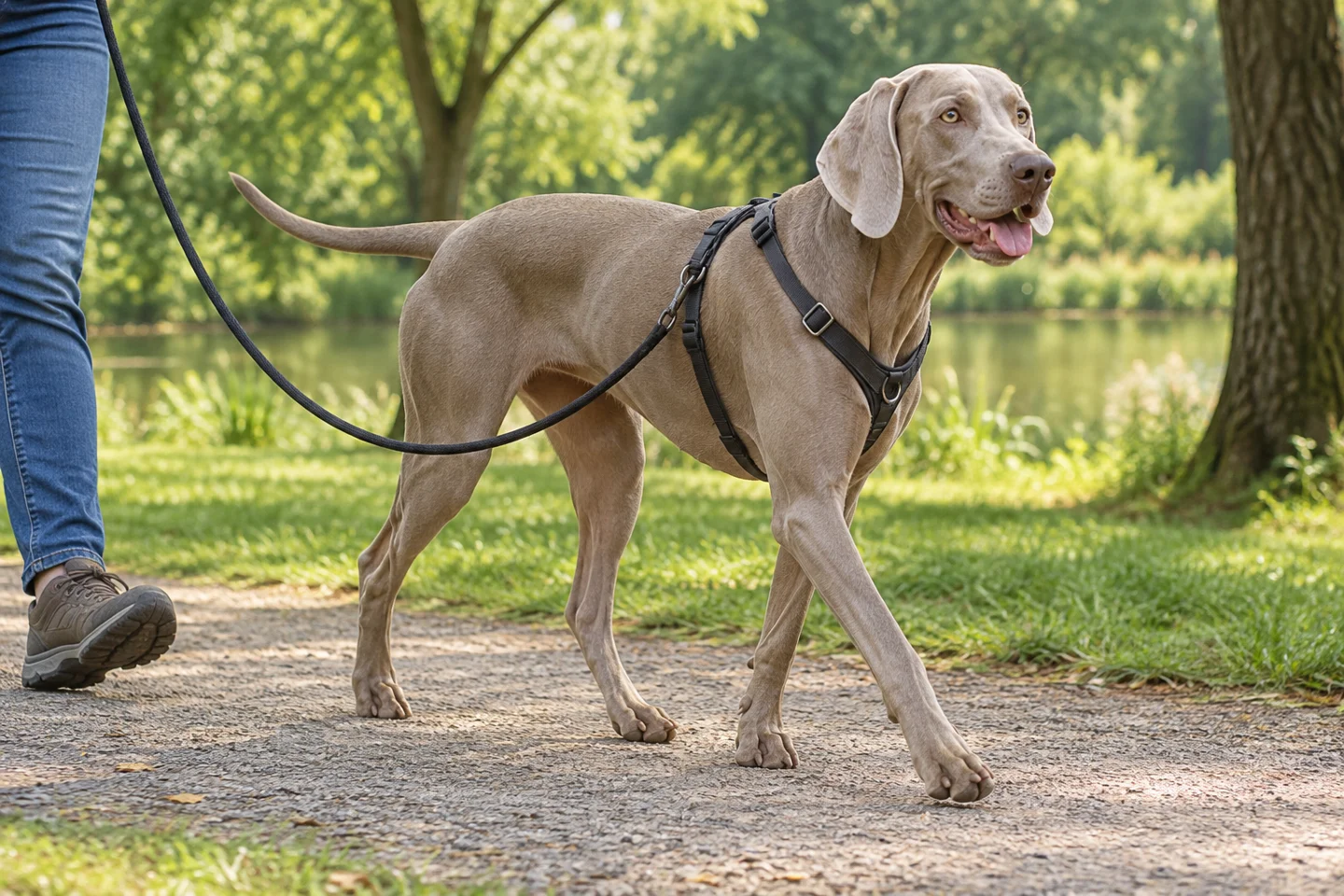
The selected dogs have natural hanging ears and complete tails. A puppy's eyes can look blue-gray before maturing, so an early photograph should not be interpreted as a promise of permanent blue eyes. Images illustrate appearance rather than certify the animal's health or background. Meet the family in ordinary circumstances when possible. A striking photograph does not show what happens when the dog must rest, wait during a delivery, or accept examination. Those details help determine whether this animal and your household can live comfortably together.
German gundog development and the companion household
The FCI history describes the breed's German development and changing hunting use. That background explains why a prospective owner should think about investigation, movement, and cooperation with a handler. It cannot establish how much activity a particular puppy will need or promise that every dog enjoys the same sport. Companion care can include safe searching and structured tasks without exposing wildlife to pursuit.
Ask a breeder what the adults do during an ordinary week when no event is scheduled. Discuss the household's work hours, other animals, transport, and available help. A large active young dog can be a poor match for an arrangement that depends on one exceptional weekend walk. An adult rescue may have learned useful skills in another setting while still needing a deliberate transition to yours. Describe what is known and what must be taught. A history of working successfully does not necessarily include lifts, a noisy apartment entrance, or comfortable time apart from the usual handler.
Adult measurements and planning for a substantial dog
The FCI gives male heights of 59–70 cm and female heights of 57–65 cm. Its approximate weight references are 30–40 kg for males and 25–35 kg for females. The references belong alongside assessment of frame, muscle, and condition; they are not instructions to force every puppy toward the largest adult figure. Have the veterinary team review growth and explain how to assess the individual.
Consider the practical consequences before bringing a puppy home. The grown dog needs suitable vehicle restraint, room to turn and lie down, and equipment that remains secure during a backward movement. Teach calm car entry on a stable surface. If illness later makes loading difficult, a previously learned ramp routine may be useful. Arrange traction on smooth floors near exits, where excitement can produce abrupt turns. A change in willingness to rise or load deserves attention even when the dog remains keen outdoors. Enthusiasm cannot determine whether a heavy adult is comfortable or ready for a demanding outing.
Short-haired and long-haired are different coat arrangements
The short-haired Weimaraner has a dense close coat, while the long-haired form carries longer hair and feathering. The selected illustrations deliberately avoid combining a smooth body with an invented plumed tail. Ask the breeder to identify the expected coat and the practical care needed. Color and texture should remain separate from claims about temperament or medical protection.
Inspect the real animal beyond its most photogenic angle. Skin beneath equipment, ear comfort, feet, and movement matter to daily care. Puppy softness and proportions change, so avoid demanding an adult finish immediately. For an adopted dog, a gray coat can suggest possible ancestry without establishing certainty. A veterinarian's examination and the actual behavioral history provide more useful care information than a confident label based only on color. Keep clear current photographs for identification and check microchip contact details after transfer. When sharing pictures publicly, exclude addresses and private documents visible in the background.
Training through the start of an outing
Practice the first minute of a walk rather than accepting a scramble from the car to the trail. With the outside secured, reward waiting while equipment is attached. Open access only when the handler is ready and there is space to move safely. Repeat at quiet destinations before trying a crowded parking area. Every person handling the dog needs the same sequence.
Attention and returning can be reinforced through food, a suitable activity, or access to a safe smell. Keep early tasks achievable and increase distractions gradually. If the dog cannot respond near moving wildlife, work farther away rather than repeating the cue while physical control becomes harder. A properly managed line may support learning in a suitable location, but careless handling can tangle people or animals. Ask an instructor to review the setup. The aim is a response available in the actual environment, backed by safeguards. A dog's desire to stay near a familiar person does not establish reliable recall in every circumstance.
Exercise and the problem of constant escalation
A plan that adds faster activity every time the dog appears restless can become difficult to sustain. Provide regular movement, investigation, and achievable training, then assess whether the animal can recover and sleep. Restlessness may involve pain, distress, or an overexciting environment as well as insufficient activity. A veterinarian and suitable instructor can help when the pattern remains difficult to interpret.
Build fitness gradually. Puppies need developmental care and rest rather than an adult running schedule, and older animals may need shorter or gentler routes. Evaluate surfaces, temperature, water access, and the possibility of leaving early. A circular outing without an exit can become a problem if a dog becomes lame halfway through. After activity, examine pads and note changes later that evening or next morning. Do not dismiss repeated stiffness because the animal was enthusiastic during the walk. Secure free-running areas need inspection for gaps and hazards before release, not trust based on a facility name.

Teaching rest and tolerating a closed door
Give the dog a resting place outside busy routes and practice brief calm periods while people continue ordinary tasks nearby. A bed positioned beside a constantly opening front door can make settling much harder. Change the arrangement if household movement keeps prompting vigilance. Quiet recovery should be an expected part of the routine rather than something that happens only after exhaustion.
Build time apart through stages the dog can manage and observe the response. If it paces or vocalizes continually, or cannot settle after the owner returns, seek help before arranging a longer absence. Damage alone cannot distinguish the cause. Another dog adds a relationship to assess and may not resolve separation distress. Introduce a trusted carer early, including walks and equipment fitting while you are present. A care plan needs to work when the usual person becomes ill or travels. The Weimaraner's reputation for attachment does not remove the responsibility to prepare alternatives.
Socialization for the life the dog will actually lead
A puppy destined for a busy home needs gradual experience of the sounds and movement it will encounter there. Begin at a manageable distance from school traffic or bicycles rather than placing it in the middle of the busiest moment. Reward relaxed observation and allow departure. Contact from strangers is optional; a useful session can involve watching without anyone stroking the animal.
Teach handling and transport independently too. A dog can enjoy people while finding a paw examination frightening. Practice brief contact on a nonslip surface, increasing only while the animal remains comfortable. An adult rescue may need new lessons after a move, even if it was confident elsewhere. Watch how readily ordinary behavior returns afterward. Repeated withdrawal or prolonged vigilance suggests the next experience should be easier. Choose a reward-based professional who can explain that progression. Social learning requires an appropriate level of difficulty, not simply remaining in an overwhelming situation until the dog stops moving.
Children and managing the adult dog’s momentum
A young Weimaraner moving quickly through a small room can knock over a child without intending harm. Plan running games and arrivals so that the dog is not trying to cross the same narrow space. Adults control entrances and leads near roads. A child should not be given responsibility for holding a substantial dog because the first few minutes of the walk appear quiet.
During contact, protect the animal's choice to leave and its undisturbed rest. Prevent climbing, neck hugging, and interference with meals or chews. A child finding the dog with a stolen object should ask an adult for help, not pull at its mouth. Suitable participation might involve preparing a search while the dog waits behind a barrier. Visiting children need active supervision even when the household relationship is comfortable. Separate before a party or divided attention makes observation unreliable. A family description cannot promise tolerance for every sudden movement, so the adults' practical arrangements remain central to safety.
Aggression and a practical review of the incident
If a warning or bite occurs, identify what changed immediately beforehand. A person reaching for a painful paw, another dog approaching food, and a visitor blocking a doorway present different problems. Stop access to the trigger while help is arranged and record the sequence. Do not reenact the event to obtain proof or a clearer recording.
The veterinary assessment should include discomfort and illness where relevant, particularly after an abrupt change. Recurring threatening behavior needs qualified support and dependable barriers while learning proceeds. Avoid punishment aimed at suppressing a growl; the reason for the warning can remain. A basket muzzle, when advised, needs gradual positive introduction and appropriate fit. It supports a specific plan rather than making forced contact acceptable. After an injury, arrange medical attention and address how another person or animal might reach the same situation. A broad reputation for friendliness cannot predict the next encounter or replace prevention based on the actual dog.
Dogs, cats, and the response to running animals
Start a prospective canine relationship where both handlers have room to turn away. Watch whether each animal can pause and disengage rather than judging only the amount of running. Persistent one-sided pursuit or repeated attempts to hide call for interruption. A successful relationship with one companion does not establish agreement with a new dog around a bed or food.
In the home, arrange independent access to essential resources. Cats need protected routes and reliable separation while introductions progress. Do not allow a chase to discover whether the cat can manage it. Acceptance of a familiar resident animal cannot certify the response to an unfamiliar animal running outside. Small pets require secure accommodation and a plan for times when doors or enclosures are opened. Ask about the individual history and acknowledge missing information. If the household cannot maintain safety during ordinary chores and absences, reconsider placement rather than expecting training or affection toward people to eliminate all pursuit.
Grooming and examining the ears after outdoor activity
For the selected short-haired dog, gentle brushing should be paired with inspection rather than treated as the whole task. Check pads, nails, skin beneath equipment, and areas exposed to vegetation. A smooth coat can make some changes visible while leaving small injuries easy to miss. Persistent licking or rubbing needs investigation when it does not settle.
The hanging ears need observation for odor, discharge, pain, and repeated shaking. Ask the veterinary team how to clean when cleaning is indicated. Deep tools or leftover medication can make a new problem harder to assess. Teach tooth brushing, nail care, and a comfortable standing position through manageable sessions. If the dog suddenly objects to touch in one place, pause and consider pain. The long-haired form also needs appropriate attention to feathering and debris, so its routine will differ from the illustration. In either coat, cooperative care should improve access to the body without making the animal endure an unexplained painful procedure.
Health: a current panel includes several distinct questions
The AKC's current national-club recommendations list hip, cardiac, ophthalmologist, and thyroid evaluations, alongside DNA tests for spinal dysraphism, hypomyelination, and hyperuricosuria. These assessments are not substitutes for one another. Ask to see identifiable reports rather than counting the word tested in an advertisement. A routine puppy appointment cannot answer every question addressed by those parental assessments.
Discuss the relevant findings with the veterinary team. A favorable result in one area does not explain a new symptom in another, and completed screening cannot exclude every possible illness. Ask a breeder how later family diagnoses are recorded and communicated. For a rescue, request current medicines, previous investigations, and a clear account of symptoms as well as whatever family information exists. Preserve the distinction between screening an apparently healthy breeding animal and investigating a clinical problem in your dog. Both are useful, but they answer different questions at different times.
Hypomyelination is a specific puppy disorder
UC Davis describes Weimaraner hypomyelination as an autosomal recessive condition associated with tremors in young puppies. The laboratory notes that signs often resolve during early development, while some dogs retain mild tremor. That account should not be converted into advice to ignore every shaking puppy. A clinician must establish what is happening and assess other possible causes.
Ask for the exact HYM result when discussing a litter. A carrier for this recessive variant is different from an affected puppy, and a clear result does not certify the absence of every neurological disease. If an owner sees tremor, record onset and circumstances safely and seek examination. Do not provoke an episode or delay help for a video. Medication, toxins, metabolic problems, and other diagnoses require individual clinical consideration. The useful role of the genetic information is to answer a defined inherited-risk question, not to supply a single explanation for all later changes in movement or coordination.
Hyperuricosuria and paying attention to urination
UC Davis explains that hyperuricosuria involves increased urinary uric acid and susceptibility to certain urinary stones. The relevant variant is recessive. A result should be interpreted for that condition rather than treated as a prediction that every dog with two copies will have the same clinical course. Give the veterinary team the report and follow its advice about monitoring or individual care.
Notice straining, repeated attempts, discomfort, blood, or a change in urine output. A dog unable to pass urine needs urgent veterinary attention. Do not wait for a planned breed-club discussion or attempt a home dietary correction first. Owners should not impose another animal's prescription diet or medicine on the basis of a shared breed. Record previous stone analysis and treatment if available. A negative HUU result also does not exclude every other cause of urinary disease. Clinical assessment determines the present problem while the genetic record adds specific background information.
Feeding, mixes, and realistic costs
Review meals and reward food against the actual week's activity and body condition. A dog doing less after injury may need a revised ration, while unexplained weight or appetite changes require assessment rather than guessing. Choose complete food appropriate to life stage and discuss properly formulated alternatives if considering homemade feeding. Keep medicines and dangerous products beyond reach, including bags left after outings.
A Weimaraner mix may differ in size, coat, pursuit, and ability to settle. Documented parentage can guide questions without guaranteeing an easier companion or freedom from inherited problems. Budget with local figures for veterinary care, secure transport, training help, suitable boundaries, and competent care during absences. Include the time needed for regular activity and gradual teaching. A backup person must be able to handle doors and walks safely. Ownership becomes more manageable when those arrangements are practiced before an emergency rather than assumed from the dog's affection for familiar people.
dogsDating and agreeing on an initial distance
Explain the Weimaraner's actual walking preferences on dogsDating, including pace, pursuit triggers, and the room needed near unfamiliar dogs. Keep exact home coordinates private and do not share the household address publicly. Select a public starting landmark within an approximate locality and check that handlers can prepare separately without crowding car doors or an entrance.
Agree that either person can request a pause, more space, or an early finish. Begin with controlled movement apart and notice whether the dogs can return to ordinary investigation after seeing one another. A greeting is not compulsory. Repeated blocking, fixation, or attempts to escape mean the arrangement needs changing. Avoid introducing shared toys or a pile of food between unfamiliar animals. Afterwards, discuss specific responses and decide whether another walk suits both dogs. A calm parallel route can be a useful result without a requirement to progress to close play or unrestricted running.
Sources and editorial notes
Sources checked October 22, 2026. Breed measurements describe reference ranges, not a diagnosis or an individual dog's ideal weight. Images are AI-generated breed illustrations and do not document a particular dog or health condition.
- AVSAB: Humane Dog Training Position Statement
- VCA Animal Hospitals: Food aggression in puppies
- VCA Animal Hospitals: Common emergencies in dogs
- Orthopedic Foundation for Animals: CHIC health screening programs
- VCA Animal Hospitals: Aggression toward unfamiliar dogs, diagnosis
- VCA Animal Hospitals: Grooming and coat care for your dog
- VCA Animal Hospitals: Ear infections in dogs (otitis externa)
- AAHA: Feeding plans for healthy, appropriate weight cats and dogs
- VCA Animal Hospitals: Heat stroke in dogs
- AVSAB: Puppy Socialization Position Statement
- VCA Animal Hospitals: Dog behavior problems, aggression toward children
- FCI Weimaraner standard 99: coat forms, German origin and adult size
- American Kennel Club: current Weimaraner national-club health-testing recommendations
- UC Davis Veterinary Genetics Laboratory: Weimaraner hypomyelination and result interpretation
- UC Davis Veterinary Genetics Laboratory: hyperuricosuria, urinary stones and inheritance
Keep getting to know dogs.
Read another guide or return to your dogsDating community.
Explore breed guidesBack to dogsDating