Welsh Terrier
A compact black-and-tan wire-coated terrier, with natural-tail illustrations, practical care and source-specific lens-health and movement-disorder guidance.
How these guides are researched and reviewed
- Origin
- Great Britain; Wales
- Height reference
- Not exceeding 39 cm
- Weight reference
- 9–9.5 kg
- Coat
- Hard close wire coat, black and tan or black grizzle and tan
General information for owners. These articles have not been reviewed by a veterinarian. Medical decisions need your dog's history and an examination.
A black-and-tan Welsh terrier of its own
The Welsh Terrier is a compact, wiry-coated British terrier with its own standard. It is separate from the Lakeland Terrier, Airedale Terrier, and Wire Fox Terrier. Similar grooming outlines can make photographs confusing, so check the actual registered identity rather than treating every bearded black-and-tan dog as the same breed.
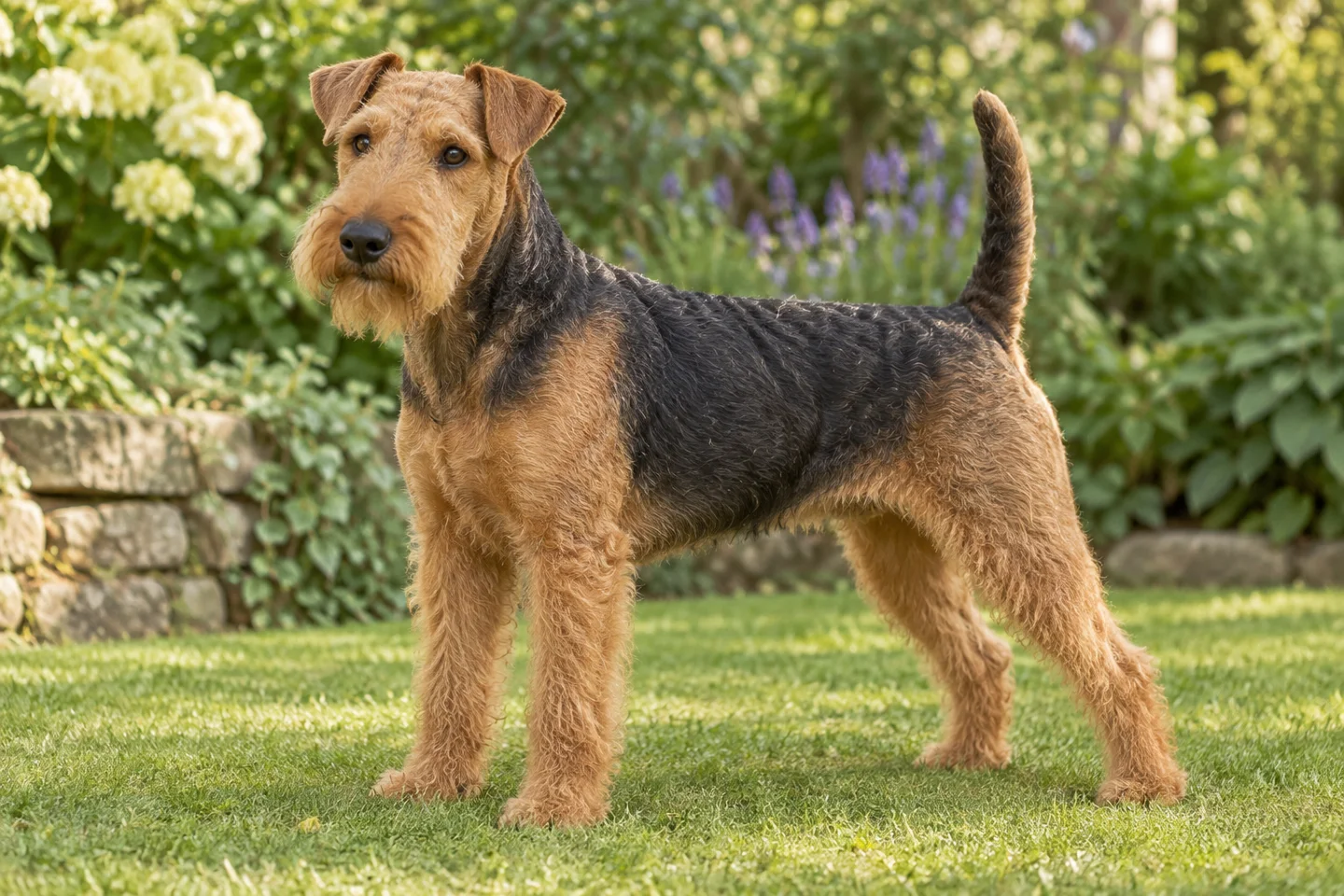
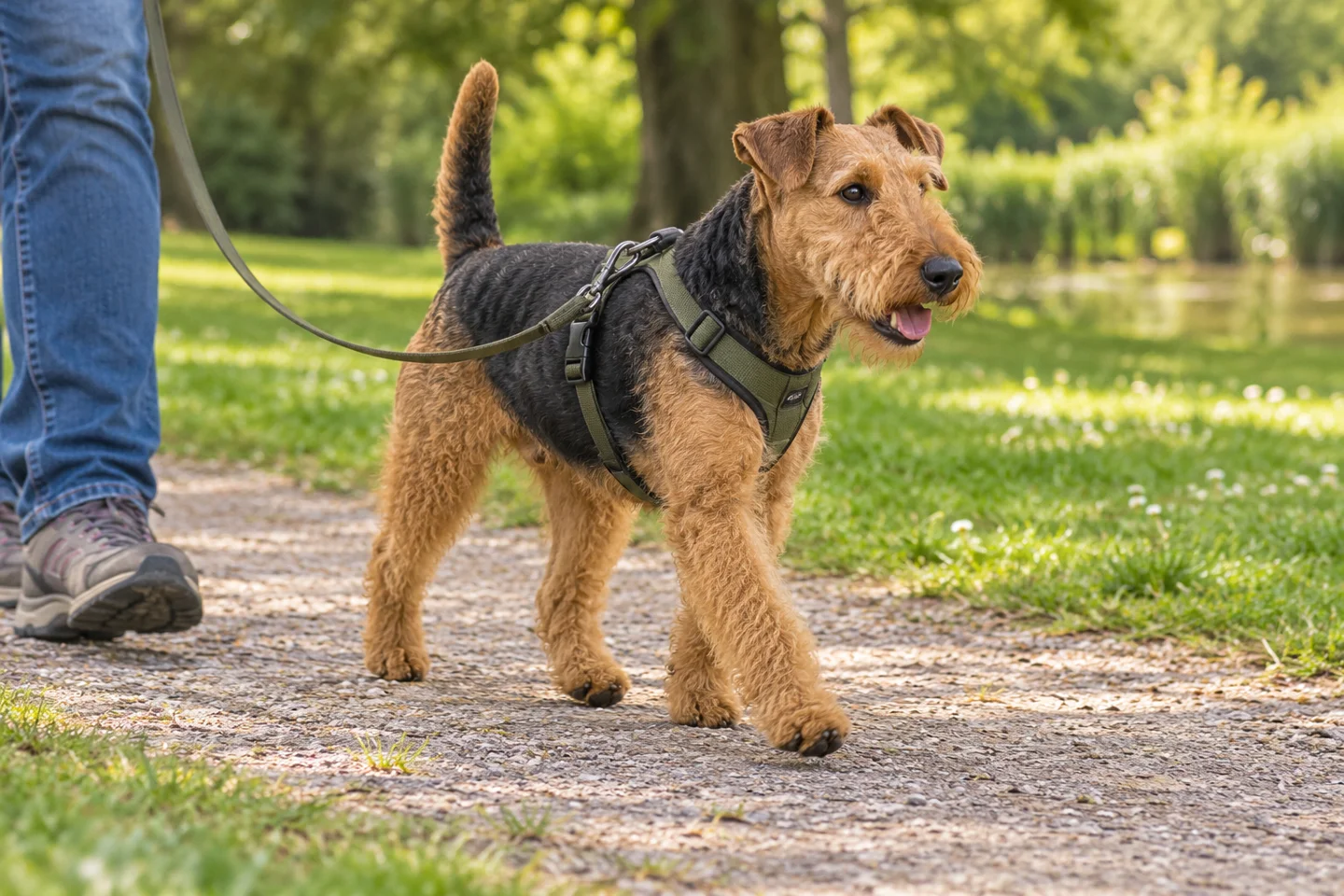
The selected illustrations show a black saddle with tan head and legs, natural small V-shaped ears folding forward, and a complete upright tail. Puppy coloring is darker and furnishings are still developing. These images explain appearance without documenting real animals or medical findings. Meet the actual dog and ask about routine handling, rest, travel, and responses around unfamiliar animals. A neat coat can conceal how much care is needed, while a lively expression cannot establish that the dog will fit every household. A puppy still needs clear teaching and safe management in the environment where it will live.
Working history and practical modern expectations
The FCI history discusses Welsh terrier work involving quarry such as fox, badger, and otter. That supplies context for investigation and persistence, without proving every remote ancestry story or determining an individual puppy's future. Companion owners can offer safe searches and appropriate activity without exposing wildlife or pets to pursuit. Historical use does not override current access rules.
Ask how the breeder's adults live between outings or events. Can they rest while people visit and cooperate with coat maintenance? How do they respond when the usual routine changes? Specific examples matter more than a general statement that terriers are busy or loyal. An adult entering a new home may know useful skills while needing a gradual transition to different entrances, travel, or time alone. Discuss those tasks directly rather than assuming maturity supplies them. A sustainable match includes an ordinary week and backup care, not only an owner's enthusiasm for occasional long walks or an attractive grooming style.
Adult measurements and a frame beneath the furnishings
The FCI gives a height not exceeding 39 cm and a weight reference of 9–9.5 kg. It does not divide those figures into separate male and female intervals. Do not invent an exact female band or promote an unofficial miniature category. Ask the veterinary team to assess the actual frame, growth, muscle, and condition rather than feed toward a number in isolation.
Learn to examine beneath the coat. A prepared outline can conceal gradual gain or loss, so useful records over time matter more than one photograph. Select equipment for the individual and check fit during growth. It should permit movement while remaining secure if the dog backs away. Inspect gaps in gates and fencing, and teach calm travel restraint. Necessary supported lifting can be practiced without making it the answer to every unfamiliar situation. If the dog later becomes reluctant to rise or turn, seek advice rather than assume that terrier enthusiasm guarantees comfort or that additional exercise will solve the change.
The wire coat, folded ears, and full natural tail
The standard describes hard, close, abundant wiry hair, with black-and-tan or black-grizzle-and-tan coloring. The chosen example avoids the predominantly white coat of a Wire Fox Terrier. Natural forward-folded ears sit close to the cheeks. A full upright tail is included; surgical shortening is not needed to make the illustration recognizable.
A puppy should not be expected to show the finished adult jacket immediately. Ask how the coat develops and what maintenance the family requires. Grooming choices should preserve normal sight, movement, and access to skin. A seller's claim about unusual color cannot answer unrelated questions about health or temperament. Meet dogs outside a prepared picture and observe ordinary care when possible. For rescue, assess matting and discomfort before deciding on cosmetic work, with professional help where necessary. The practical objective is a comfortable animal whose care the household can maintain, not an outline that remains impressive only immediately after a salon appointment.
Training with a terrier who wants to investigate
Teach attention in a place where the dog can respond, then build toward more interesting surroundings. Reward cooperation promptly and sometimes allow a safe investigation afterward. That gives the handler a role in access to the environment rather than only ending it. Coming back can lead to another appropriate activity instead of always predicting confinement or departure.
Practice an exchange using harmless items before dealing with a real hazard. Repeated chasing or forced removal from the mouth can increase conflict and make the urgent situation harder. Secure dangerous objects while training develops. Teach a pause at an exterior door behind a physical safeguard, and make sure every regular carer follows the procedure. If guarding or intense pulling already affects daily life, obtain qualified reward-based guidance. Intelligence and persistence do not eliminate the need for clear teaching. The next step should fit the actual skill and emotional state, rather than become a contest over which participant will stop first.
Exercise that can be repeated through an ordinary week
Provide regular walks, suitable play, and safe searching adapted to age and health. A small athletic dog needs opportunities beyond toileting outside, while a puppy should not be pushed through an adult endurance target. Gradually introduce new terrain and duration, observing sleep and recovery. Older animals can continue enjoying investigation with shorter or easier routes.
Before using an enclosure, inspect boundaries, latches, holes, and obstacles for this dog. A reassuring facility name cannot prevent escape or collision. Outdoors, consider water, temperature, surfaces, and the possibility of leaving early. An enthusiastic animal can still need the handler to stop. Check feet and equipment contact points after rough activity, then notice movement later. Repeated stiffness, limping, or unusual recovery deserves assessment. More jumping is not a treatment for an unexplained change. A sustainable routine also includes calmer alternatives when work, weather, or unavailable facilities prevent the preferred outing, with enough quiet time to avoid continual anticipation of another chase.

Barking and the arrangement beside a window
A low window overlooking a busy path can keep a terrier responding all day. Change access to the view while rewarding movement toward a quieter resting place. Practice early in the sequence, before barking becomes sustained. Shouting from another room may add noise without making the next action clearer. The trigger matters: excitement at passersby and distress during absence need different questions.
Introduce time apart gradually and observe whether the dog eats, rests, paces, or vocalizes. Persistent inability to cope warrants veterinary and qualified behavior support. Damage alone cannot establish deliberate misbehavior, and adding another pet may not resolve the difficulty. Arrange a trusted carer and rehearse the routine before a long unavoidable absence. The person needs walking equipment, entrance rules, feeding instructions, and medical contacts. Discuss the actual household schedule before placement. A general claim that the breed adapts well cannot supply practical cover when the usual person becomes unavailable.
Socialization and learning to stand for care
Give a puppy manageable experience of people, other animals, sounds, surfaces, and travel. Watching quietly at a distance can be a useful lesson without a greeting. Ask strangers to wait rather than lean over or lift it for contact. Preserve a retreat route and reduce the demands if the puppy repeatedly freezes or withdraws.
The grooming surface deserves separate teaching with stable nonslip footing and brief rewarded touch. Progress toward paws, ears, and mouth gradually. A dog should not first discover prolonged restraint during a painful medical problem. Adults adopted into a new setting need the same review of what they actually know. Rural experience does not establish comfort with every busy pavement or examination room. Continue learning after changes in the home. Look at recovery afterward, including ordinary sleep and activity. A session that leaves the dog vigilant for hours needs a revised progression, not simply more time with the same overwhelming demands.
Children and a beard that belongs to the dog
Prevent children grabbing the beard or coat to hold the terrier near them. Let the animal approach, pause after brief contact, and stop when it moves away. Young children should not carry it during games; an awkward grip or fall can injure the body and make future handling frightening. Adults manage necessary lifting with suitable support.
Meals, chews, sleeping space, and found objects need protection from interference. A child finding a contested item should call for help rather than reach toward the mouth. Suitable participation might involve preparing a simple search while the dog waits elsewhere. Visiting children require supervision even when household relationships are comfortable. Before noisy play or a party, arrange separation rather than wait for an objection. Use a reliable barrier when adult attention becomes divided. Suitability depends on maintaining those arrangements consistently. Affection toward familiar people cannot certify tolerance for every grasp, pursuit, or excited group in the home.
Aggression and identifying what made contact difficult
A warning during coat care may involve pulling, sore skin, or fear of restraint. Stop the procedure and examine the practical situation. A response to another dog near food or a visitor at the door requires different questions. Record the approach, touch, resource, and space available before the event. Create safety and prevent a repetition while obtaining help.
A veterinarian should assess new sensitivity or abrupt changes. Qualified reward-based behavior support can help with recurring threats, supported by barriers and manageable distances during teaching. Avoid punishing growling or repeating the incident to prove it was serious. A quieter warning does not establish that the concern has disappeared. If a basket muzzle is advised, condition it comfortably and use it for the specified purpose. After a bite, arrange medical attention and review how access occurred before another person faces the same situation. A small body or a breed ideal cannot substitute for a prevention plan tailored to the individual dog.
Dogs, cats, and the management of small animals
Choose dog meetings with room for each animal to leave and handlers able to change distance. Look for reciprocal pauses rather than assume running always means mutual enjoyment. A larger dog repeatedly landing on the terrier should be interrupted, even when described as friendly. A calm outdoor meeting also cannot establish immediate comfort sharing beds or bowls.
At home, provide independent access to resources. Cats need protected routes to food, litter, and quiet areas, with introductions that prevent chase rehearsals. One stationary observation does not predict the response to sudden running later. Small pets require secure accommodation and a plan whenever it opens. Ask about actual history while acknowledging gaps. If daily chores or absences would repeatedly undermine necessary separation, reconsider placement before adoption. Training supports cooperation with the handler without promising the removal of every pursuit interest. Affection toward household members is useful information, while compatibility with each other animal remains its own practical question.
Grooming and choosing a manageable maintenance plan
Ask a groomer experienced with the wire coat to explain maintenance choices and demonstrate a routine the household can sustain. A show finish and a practical pet arrangement may involve different work. Neither removes the need to inspect skin and brush gently. Avoid repeatedly pulling through knots or cutting where the skin beneath cannot be identified safely.
Check behind ears, beneath equipment, and around limbs for debris and irritation. Use a stable nonslip surface and achievable sessions. Introduce bathing, drying, nail care, and tooth brushing progressively. The folded ears need observation for odor, discharge, and pain. Cleaning or medication should follow advice about the individual cause rather than deep tools or leftover drops. If handling becomes difficult in one area, investigate discomfort before increasing restraint. Grooming should make the body accessible for examination while preserving comfortable movement and ordinary life. A cosmetic outline does not justify repeated painful care or hiding persistent skin problems beneath furnishings.
Health: primary lens luxation has a defined DNA question
The current AKC national-club recommendation names primary lens luxation DNA testing for Welsh Terriers. UC Davis describes PLL as displacement of the lens from its normal position, with potential inflammation and glaucoma. Request the actual result and verify dog identity and test name rather than accept a general panel headline. A favorable result applies to the tested variant, not every possible eye disease.
Laboratory interpretation distinguishes clear, carrier, and affected-risk results for this recessive condition, while noting some clinical risk in carriers. Do not assume the word carrier always means no need for eye monitoring. Discuss findings professionally before a breeding decision. For your dog, a red, cloudy, painful, or unusually closed eye needs prompt veterinary advice. Do not wait for the next screening event or use medication from another animal. Clinical assessment addresses the problem present now, while a DNA record provides specific background information. The two should remain available without being treated as interchangeable guarantees.
Paroxysmal dyskinesia is not a diagnosis from a video alone
The Welsh Terrier Club hosts Royal Veterinary College information and a research summary about paroxysmal dyskinesia, involving episodes of abnormal movement or muscle tone. The discussion describes preserved consciousness in reported cases and distinguishes a movement disorder from simply labeling every episode a seizure. It does not establish that every unusual movement in a Welsh Terrier has that cause.
If an episode occurs, keep the setting safe, time it, and seek veterinary instructions. Obtain video only if that can be done without provoking the event, delaying care, or placing anyone at risk. Describe awareness, movement, recovery, medicines, and possible exposures. The clinician can consider neurological and other explanations and decide on further investigation. Do not start another dog's prescription or impose a special diet through a superficial comparison with a different breed. A published case series supplies useful clinical context without providing a universal inherited certainty or a reliable population frequency. The actual animal needs an individual explanation and plan.
Keeping an episode record useful for the clinician
Between intermittent events, an animal may appear ordinary, making a dated record useful. Note when the episode began, what preceded it, how long it lasted, and how the dog behaved afterward. Include any digestive signs or other changes without deciding in advance that they prove one mechanism. Record normal days too if the veterinarian requests them. Avoid repeatedly testing a suspected trigger at home.
Ask for a clear plan about urgent signs, safe activity, and follow-up. Carers should know whom to contact and where the history is stored. Collapse, serious breathing difficulty, major injury, or suspected poisoning needs prompt professional direction regardless of a prior movement-disorder discussion. Do not let a familiar label obscure a new pattern or a worsening episode. Current prescriptions must be followed as directed rather than adjusted through breed-group advice. If a diagnosis is confirmed, discuss accurate family communication and voluntary health reporting while respecting privacy. Useful evidence comes from careful observation and clinical assessment, not certainty manufactured from an anecdote.
Feeding, mixes, and the budget for ordinary care
Measure regular meals and include rewards and chews when reviewing intake. Choose complete food appropriate to life stage and discuss persistent thirst, digestive changes, appetite differences, or unexplained weight with the veterinary team. A coat prepared into a neat outline is not a condition assessment. Homemade feeding needs proper formulation and supplements should serve a defined purpose.
A Welsh Terrier mix may vary in adult build, coat texture, pursuit, and social behavior. Ask what ancestry is documented and avoid promises of easier handling or freedom from inherited disease. Relevant parental information remains useful for a planned litter. Obtain local costs for veterinary care, coat support, training, secure equipment, transport, and competent cover. Include maintenance between appointments, and teach another person the dog's care routine before an absence. A workable home provides safe investigation and protected rest through ordinary difficult weeks as well as enjoyable outings. Attraction to the breed's appearance cannot answer those daily responsibilities alone.
dogsDating with a clear plan for space
A Welsh Terrier dogsDating profile should explain actual preferred partners, pace, and situations requiring additional room. Keep exact home coordinates private and leave the household address out of public information. Use an approximate locality to choose a public starting landmark where both handlers can prepare separately, with room to turn away.
Agree that either person can request a pause or finish. Begin apart and observe whether each dog can notice the other, resume investigation, and move with its handler. Physical greeting is optional. Repeated blocking, fixation, or attempts to escape contact mean the arrangement should change. Avoid shared toys or food during a first meeting. Afterwards, compare specific moments before deciding whether another outing would suit both animals. Either person can decline. A quiet parallel walk can remain a useful relationship without progressing to close play or assuming that similar terriers should automatically enjoy the same form of contact.
Sources and editorial notes
Sources checked October 22, 2026. Breed measurements describe reference ranges, not a diagnosis or an individual dog's ideal weight. Images are AI-generated breed illustrations and do not document a particular dog or health condition.
- AVSAB: Humane Dog Training Position Statement
- VCA Animal Hospitals: Food aggression in puppies
- VCA Animal Hospitals: Common emergencies in dogs
- Orthopedic Foundation for Animals: CHIC health screening programs
- VCA Animal Hospitals: Aggression toward unfamiliar dogs, diagnosis
- VCA Animal Hospitals: Grooming and coat care for your dog
- VCA Animal Hospitals: Ear infections in dogs (otitis externa)
- AAHA: Feeding plans for healthy, appropriate weight cats and dogs
- VCA Animal Hospitals: Heat stroke in dogs
- AVSAB: Puppy Socialization Position Statement
- VCA Animal Hospitals: Dog behavior problems, aggression toward children
- FCI Welsh Terrier standard 78, October 2026: identity, natural tail, size and coat
- American Kennel Club: current Welsh Terrier PLL testing recommendation
- UC Davis Veterinary Genetics Laboratory: primary lens luxation and carrier interpretation
- Welsh Terrier Club: Royal Veterinary College movement-disorder information and research summary
Keep getting to know dogs.
Read another guide or return to your dogsDating community.
Explore breed guidesBack to dogsDating