Wetterhoun
A Frisian curly-coated water dog, with specific coat care, property management, RAG1-SCID interpretation and current Dutch screening-context distinctions.
How these guides are researched and reviewed
- Origin
- The Netherlands; Friesland
- Ideal male reference
- 59 cm; approximately 34 kg in FCI standard
- Ideal female reference
- 55 cm; approximately 28 kg in FCI standard
- Coat and tail
- Firm body curls, smooth head and legs, full spiral tail
General information for owners. These articles have not been reviewed by a veterinarian. Medical decisions need your dog's history and an examination.
The Wetterhoun is a Frisian water dog
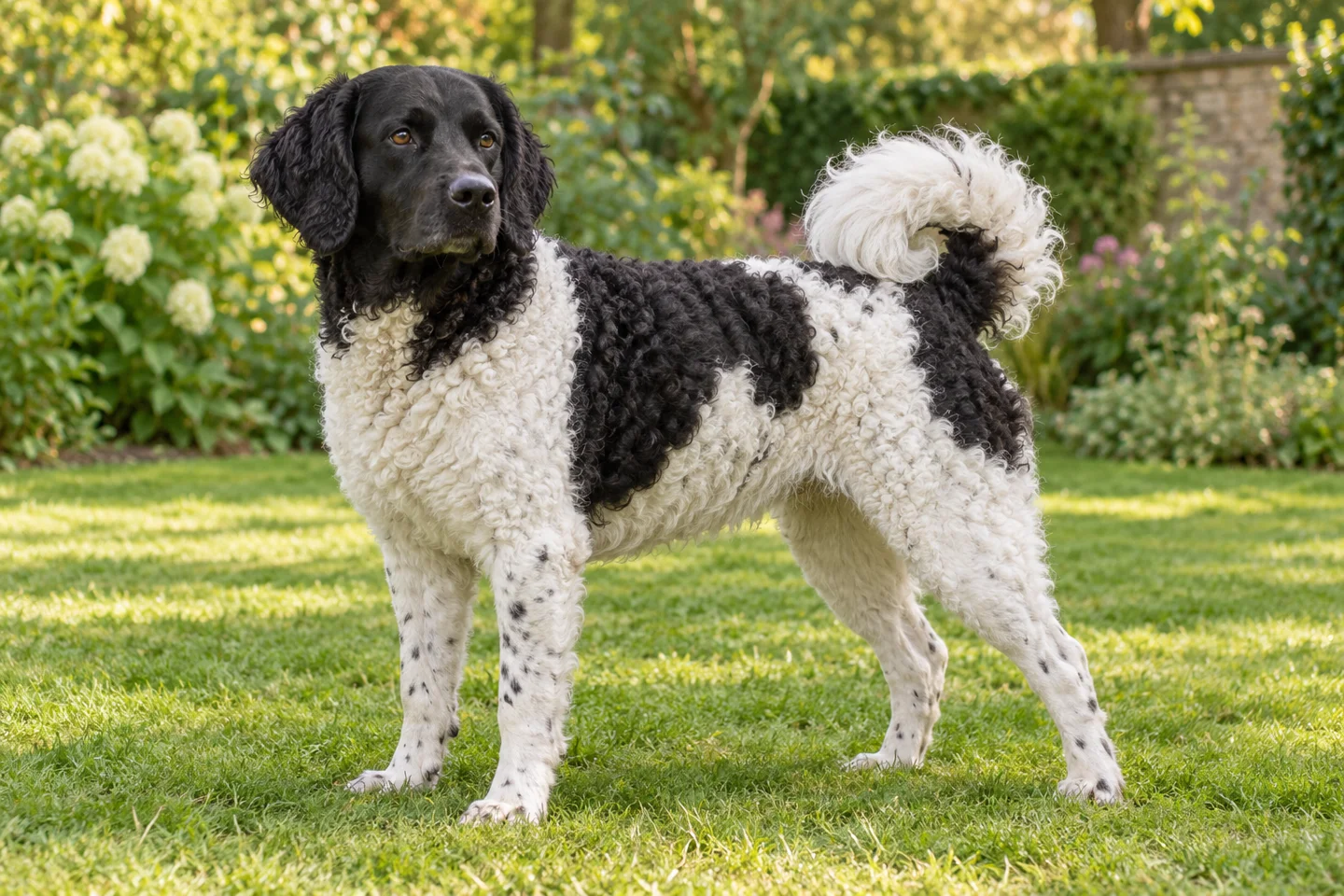
The Wetterhoun is a Dutch breed associated with Friesland, with dense body curls, a smooth-haired head, and a tightly spiraled natural tail. It is separate from the Stabyhoun, despite the shared regional context and the names appearing together in club material. A curly dog from the Netherlands is not automatically a Wetterhoun; registration and actual history should be checked.
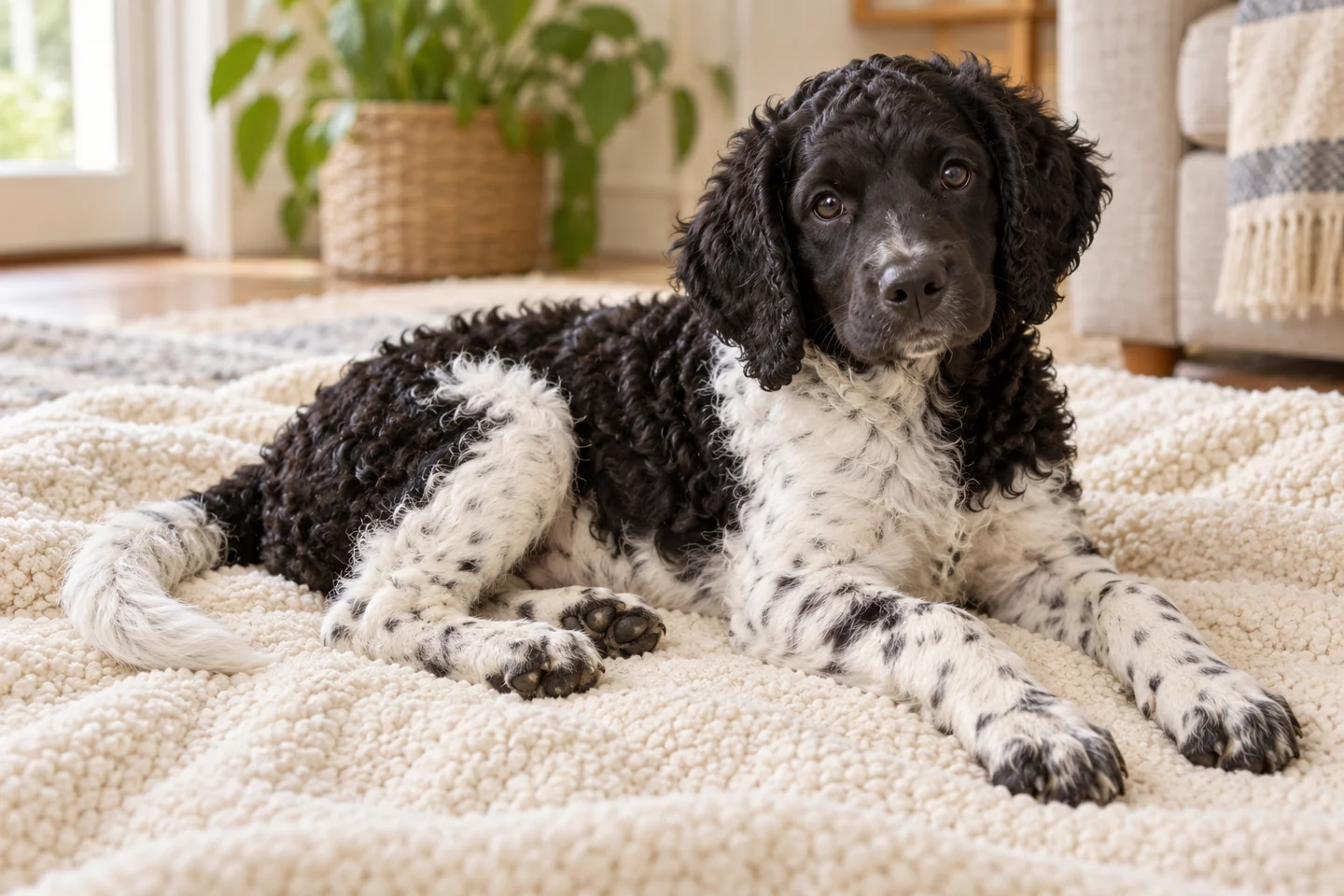
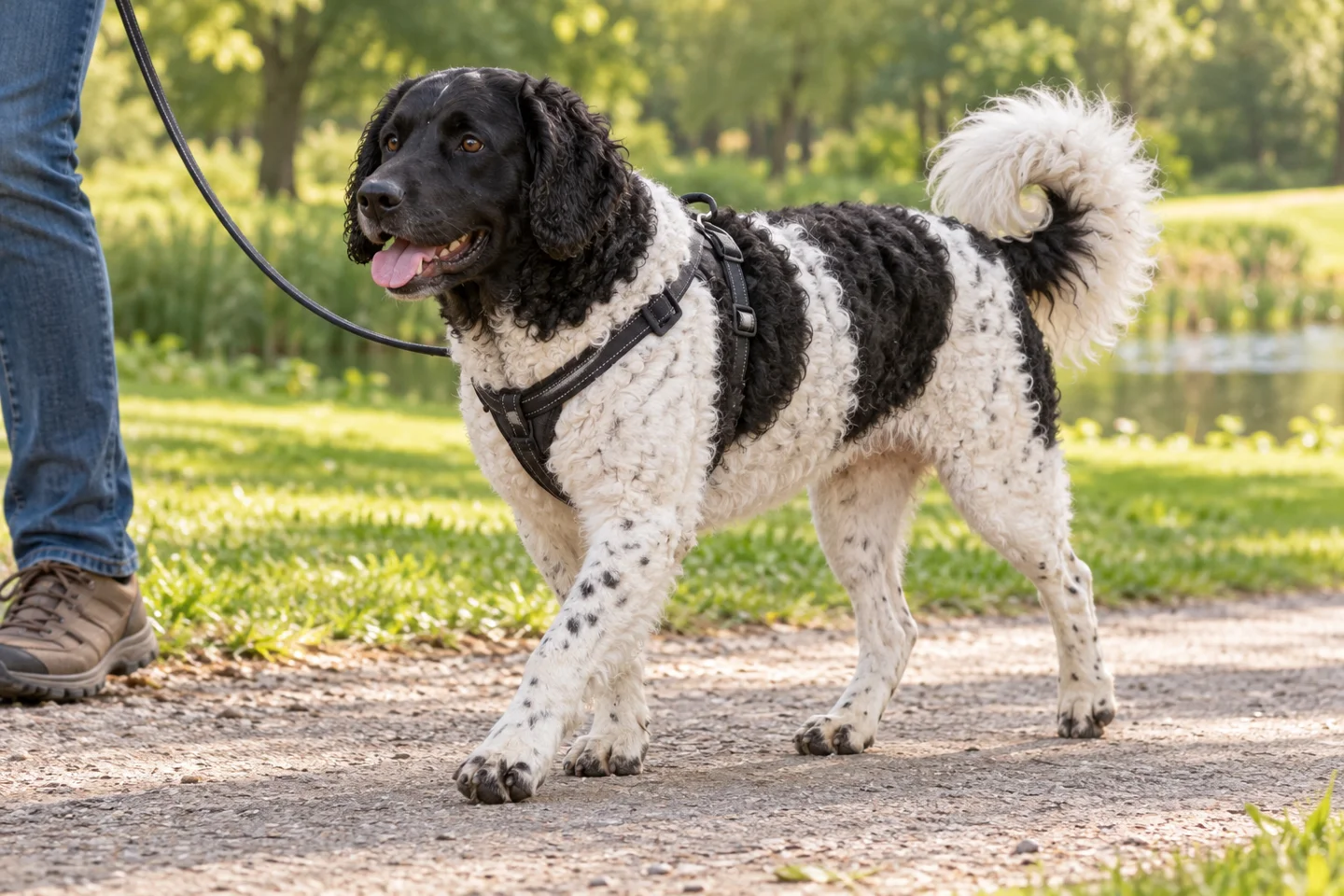
The illustrations choose black-and-white coloring, natural hanging ears, and a complete tail curled over the croup. They do not depict a poodle-trimmed face or make the legs as curly as the body. Images provide appearance references rather than documentary evidence of parentage or health. When considering a real dog, observe its daily care and behavior. Ask how it accepts visitors, travels, rests, and cooperates with examination. A sturdy appearance cannot establish emotional comfort or readiness for a particular home, and a puppy needs teaching about ordinary life regardless of its working background.
Frisian work and choosing appropriate modern tasks
The FCI describes hunting and water work, with historical otter use. The Dutch registry also discusses farm and yard duties. Those accounts explain why investigation, outdoor activity, and watchfulness deserve attention. They do not mean a companion owner should expose wildlife to pursuit or assume every puppy will enjoy the same type of water activity.
Ask about recent family experience rather than relying on a distant working story. How do the adults respond to unfamiliar people at the gate? What happens when an outing is cancelled? A household can offer safe searches and suitable movement while teaching calm rest and necessary handling. If working placement is planned, seek experienced local instruction and understand the relevant access and wildlife rules. An adult arriving from another setting may need a gradual transition to household equipment, travel, or time alone. Discuss those tasks explicitly. Independence is a reason to make teaching clear and manageable, not to abandon cooperation or rely on confrontation.
Adult references in the current FCI standard
The 2023 FCI standard gives ideal heights of 59 cm for males and 55 cm for females. Its approximate weight references are 34 kg and 28 kg respectively. These are the figures used here; other descriptions may give different male weight estimates. Assess the actual animal's frame and condition with the veterinary team rather than feeding toward the heaviest figure found online.
A broad muscular dog needs practical planning. Check the grown animal's vehicle space and restraint, and teach calm entry while it is well. A stable ramp or supported access may later help if movement becomes difficult. Arrange traction near doors and care surfaces. Ask the veterinary team to demonstrate assessing condition beneath the curly coat. A change in waist, muscle, or ease of rising can be less obvious from a casual photograph. Persistent difficulty turning or loading deserves investigation even when the dog still appears willing to work or walk. Physical enthusiasm does not identify the cause of a change.
Curls, smooth areas, and the natural spiral tail
The dense body coat forms firm curls, while head and legs carry short hair. Natural ear hair changes along the ear, rather than forming a uniform poodle-like surface. The complete tail rolls into a spiral carried over or beside the croup. The chosen black-and-white illustration is one permitted appearance; brown and other specified markings also occur under the standard.
Puppy curl and proportions develop with age. Ask the breeder what normal care looks like in the family rather than expecting an adult finish immediately. An image cannot establish whether skin beneath the curls is comfortable or whether necessary handling has been taught. Meet the actual dogs and ask to see gentle examination. For a rescue, care should follow current coat and skin findings while ancestry is described with appropriate uncertainty. Do not let a distinctive tail or color answer unrelated questions about medical records, behavior, or the household's ability to manage a substantial dog.
Training cooperation around property entrances
A watchful dog benefits from an arrival routine learned before real visitors create pressure. Set up a comfortable area separated from the entrance and reward moving there during quiet practice. Ask household adults to use the same procedure. A second barrier can prevent an outer door opening from depending on one person holding the dog physically.
Visitors should not be expected to negotiate access themselves or demonstrate bravery around a dog at the gate. Teach observation at a manageable distance and reward a response that moves the animal away from the entrance. If territorial behavior already makes access difficult, seek qualified reward-based advice and maintain physical safeguards. Avoid allowing repeated fence confrontations as proof of authenticity. The task is to create safe, predictable handling around ordinary arrivals. A working history does not explain what a particular dog understands, and increasing the volume of a cue cannot replace a response that has been taught in achievable steps.
Exercise that does not assume automatic swimming ability
Provide regular outdoor movement and appropriate searches, adapted to age, fitness, and medical findings. A water-dog history does not certify an individual's confidence, stamina, or safety in every body of water. Introduce suitable water access gradually with supervision, safe entry and exit, and attention to currents, temperature, and local hazards. Do not throw a hesitant animal in to teach it.
Build demanding land activity progressively too. Puppies need manageable experiences and recovery rather than an adult work schedule. Older dogs may prefer easier ground or shorter periods. Bring drinking water and evaluate heat and cold for the actual conditions. After activity, inspect feet, skin, and equipment contact points. Record repeated stiffness, altered stride, or unusual fatigue and obtain advice. Enclosed areas require boundary inspection before freedom. A sustainable week should include useful alternatives when water access or a preferred route is unavailable, rather than depend on one ambitious outing to meet every need.
Rest and time with a different carer
Place the bed away from a doorway the household uses continually. Teach short periods of calm while people move nearby, and reduce access to views that keep prompting vigilance. A dog spending the day watching a boundary may need a different environment as well as more training. Rest should be a practical part of the routine, not an accidental result of exhaustion.
Introduce absence gradually and observe the response. Persistent pacing, vocalizing, or failure to recover merits veterinary and qualified behavior support. Another dog is a separate responsibility and may not resolve distress. Arrange a trusted carer before a long unavoidable absence, including practice with doors, equipment, and walks. The person needs current medical instructions and an emergency contact. Discuss the actual weekly schedule with the source before placement. A rural reputation or an affectionate family description cannot establish that the dog will comfortably manage every period without its usual person.
Socialization without surrendering the choice to retreat
A puppy can learn about unfamiliar people while they remain at a comfortable distance. Pair manageable novelty with rewards and let it decide whether to approach. Strangers should not lean over or restrain it for contact. If the animal repeatedly withdraws or freezes, simplify the experience rather than extending it until escape seems unavailable.
Include surfaces, transport, noises, and veterinary-style handling in gradual lessons. Comfortable paw and ear contact should be developed before injury requires care. An adult rescue may have extensive experience in one setting and little in another. The household should assess what is actually familiar rather than infer universal confidence from age or robust build. Review the period after an outing too. Prolonged vigilance or disrupted sleep can indicate that the next session needs fewer demands. An experienced reward-based instructor can help choose the starting point and progression. Successful exposure is measured by useful coping and recovery, not the number of people who touched the dog.
Children and a broad dog in a busy family space
A substantial dog can knock over a child during ordinary movement, even without threatening intent. Give running games a separate area and avoid placing the dog's bed in a narrow play route. Young children should not climb on the body, grab curls, or follow into resting space. Adults are responsible for interrupting before contact becomes uncomfortable.
During quiet interaction, help a child invite an approach and pause after a brief stroke. A dog moving away ends the attempt. Protect meals and chews, and leave found-object exchanges to adults using a safe plan. Familiarity with household children does not establish comfort with visiting groups. Plan separation before noisy play or divided attention makes supervision unreliable. A child should not control the lead near traffic or manage an arrival at the gate. Suitability depends on whether adults can maintain these arrangements consistently, alongside their expectations of the breed's family behavior. Affection is useful information without becoming a promise of tolerance for every encounter.
Aggression and the practical meaning of a warning
A threatening response needs a specific account. A dog at a property entrance, one touched near a sore ear, and one approached over food may have different immediate concerns. Create safety, prevent another exposure, and record the sequence. Include the people or animals present, contact, distance, and whether the dog could leave. Do not stage a repeat to prove that the reaction was serious.
New sensitivity or an abrupt change should prompt veterinary assessment. For recurring defensive behavior, qualified reward-based assistance can support a plan with physical safeguards and achievable teaching. Punishing a growl can leave the concern intact while making it less observable. If a basket muzzle is advised, introduce it comfortably and use it for the agreed purpose. It cannot make forced social contact appropriate. After a bite, arrange care for the person and review how access occurred. Breed descriptions cannot certify the next interaction; prevention needs to address this animal in the situation where the problem arose.
Other animals and a history involving vermin
A Wetterhoun's prior relationships supply useful information about those particular animals, not every possible new companion. Introduce dogs with separate handlers and room to move away. Observe whether both can disengage. One-sided pursuit or blocking needs interruption before the animals are expected to resolve it through escalation.
Inside, prepare independent access to food and rest before adding a dog. Cats need protected routes to their essentials and introductions that prevent chasing. A stationary cat at the first observation can produce a different response from one running later. Small pets require secure accommodation and a plan for cleaning or transfers. Ask about actual history while acknowledging gaps, particularly in rescue. If ordinary chores or absences would repeatedly defeat necessary separation, reconsider placement before adoption. Training can improve handling without promising that an animal with a vermin-working background will ignore every small creature throughout its life. Affection toward familiar people does not answer that separate question.
Grooming firm curls without treating the coat as poodle hair
Ask a knowledgeable groomer or breeder to demonstrate routine care for this particular coat. The firm curls and natural texture call for an approach suited to the Wetterhoun, rather than automatically copying a poodle's cosmetic schedule. Check beneath equipment and around ears for debris, soreness, and moisture. Use veterinary advice if skin problems change the appropriate bathing plan.
After wet activity, make sure the animal can dry comfortably and inspect places that remain damp. Maintain nails and introduce tooth brushing through brief cooperation on a stable surface. Hanging ears need observation for odor, discharge, scratching, or pain; their natural shape does not diagnose the cause. Avoid deep tools or medication left over from another episode. If one body part becomes difficult to touch, investigate discomfort before increasing restraint. A care routine should preserve access to skin and condition assessment while remaining manageable for both the dog and its regular carer.
Health: SCID is an inherited immune deficiency
The Wetterhoun-specific SCID test concerns severe combined immunodeficiency associated with RAG1. It is an autosomal recessive condition, distinct from the broad idea of an autoimmune disease. A dog with one relevant variant is a carrier rather than an affected puppy. Ask for the exact laboratory report and have the result interpreted in relation to the proposed mating.
Do not treat a general DNA-panel headline as evidence that the Wetterhoun variant was included. A result for another species or a different form of SCID does not answer the same question. If a puppy is repeatedly ill, fails to thrive, or otherwise appears unwell, arrange clinical assessment rather than deciding from pedigree alone. Several causes are possible, and current care must not wait for a breeding discussion. The genetic record supplies a defined inherited-risk answer; it cannot exclude every infection or immune problem the individual might experience. Keep testing information tied to identifiable dogs and share it accurately with the veterinary team.
Dutch screening rules and the difference between clubs
The Dutch registry's Wetterhoun page describes SCID and hip assessment in the breed clubs' rules, with elbow assessment additionally required by the Friese Hounen Club. It also states that new registry breeding norms were published in July 2026 and checks began in October 2026. A prospective owner should confirm the current rules governing the specific litter instead of treating one older club list as a permanent worldwide panel.
Request the actual orthopedic reports and discuss what they measure. An identifiable parental assessment is different from an owner saying the dog works well. Neither screening nor an enthusiastic walk excludes every cause of lameness in an offspring. If your dog develops a change in movement, it needs its own examination. Ask about appropriate activity while investigation proceeds. Records should distinguish national registry requirements, club expectations, and an individual clinician's recommendation. Each can matter without being interchangeable. That distinction is particularly useful when a puppy is bred in one country and lives in another.
Outcross programs, mixes, and population claims
The Dutch registry notes a Wetterhoun outcross project. A documented conservation or population-management program is different from an unspecified cross advertised with an appealing name. Ask which organization oversees a proposed program, what identification and follow-up it uses, and how later generations are recorded. An owner should understand the actual plan rather than assume any cross either damages or automatically improves health.
For an individual mix, adult build, coat, pursuit, and social behavior can vary. Relevant parental information remains useful where known, while uncertain background should be stated plainly. Avoid promises of hybrid vigor as a guarantee against disease. In rescue, current examination and observed behavior guide immediate care even when family records are absent. Ask how the source communicates later findings and provides support after placement. Population concerns require careful evidence and long-term decisions; they should not become pressure on a household to accept a dog whose needs it cannot safely meet.
Meals, medical cover, and a budget for a substantial companion
Measure meals and include rewards when reviewing intake. Choose a complete diet appropriate to life stage and discuss changes in condition or medical requirements with the veterinary team. The standard's approximate weight is not a ration formula. Persistent thirst, appetite, digestive, or weight changes need assessment. Homemade alternatives require proper formulation, with supplements serving an identified purpose.
Obtain local costs for veterinary care, secure equipment, transport, training, coat support, and trusted cover. A backup carer needs to manage the adult at entrances and around distractions. Practice that routine before an absence. Keep current prescriptions and emergency contacts accessible. Serious breathing difficulty, collapse, major injury, or suspected poisoning needs prompt professional direction, not improvised human medication. Check transport arrangements for a dog unable to walk. A household's enthusiasm for outdoor life is one part of suitability, alongside its ability to provide quiet recovery, medical care, and dependable management during an inconvenient week.
dogsDating introductions outside the property routine
Describe the Wetterhoun's actual experience with unfamiliar dogs on dogsDating, including suitable pace and the amount of space that helps. Keep exact home coordinates private and omit the household address. Choose a public starting point through an approximate locality rather than invite a new dog to the home gate as a first test.
Agree on separate preparation, an initial gap, and a straightforward way to finish. Begin with controlled movement where both dogs can notice the other and resume investigation. Physical greeting is optional. If either repeatedly blocks, fixes on, or tries to escape the other, change the arrangement promptly. Avoid shared toys or food during the initial meeting. Afterwards, compare what each handler saw and decide whether another outing suits both animals. Either person can decline. A quiet parallel walk can be a useful arrangement without requiring close play or assuming that shared water-dog interests create automatic compatibility.
Sources and editorial notes
Sources checked October 22, 2026. Breed measurements describe reference ranges, not a diagnosis or an individual dog's ideal weight. Images are AI-generated breed illustrations and do not document a particular dog or health condition.
- AVSAB: Humane Dog Training Position Statement
- VCA Animal Hospitals: Food aggression in puppies
- VCA Animal Hospitals: Common emergencies in dogs
- Orthopedic Foundation for Animals: CHIC health screening programs
- VCA Animal Hospitals: Aggression toward unfamiliar dogs, diagnosis
- VCA Animal Hospitals: Grooming and coat care for your dog
- VCA Animal Hospitals: Ear infections in dogs (otitis externa)
- AAHA: Feeding plans for healthy, appropriate weight cats and dogs
- VCA Animal Hospitals: Heat stroke in dogs
- AVSAB: Puppy Socialization Position Statement
- VCA Animal Hospitals: Dog behavior problems, aggression toward children
- FCI Wetterhoun standard 221, 2023: coat, natural tail and adult reference figures
- Dutch Raad van Beheer: Wetterhoun, club screening distinctions, outcross project and 2026 breeding norms
- Embark Veterinary: Wetterhoun-specific RAG1 severe combined immunodeficiency and recessive inheritance
Keep getting to know dogs.
Read another guide or return to your dogsDating community.
Explore breed guidesBack to dogsDating